> -----Original Message-----
> From: [EMAIL PROTECTED] [mailto:[EMAIL PROTECTED] On
> Behalf Of William T Goodall
> Sent: Wednesday, April 11, 2007 3:40 PM
> To: Killer Bs Discussion
> Subject: Re: This is not a False Alarm...
>
>
> According to a summary of the Stern Review
>
> http://www.hm-treasury.gov.uk/Independent_Reviews/
> stern_review_economics_climate_change/sternreview_index.cfm
>
> published in The Grauniad
>
> http://environment.guardian.co.uk/climatechange/story/0,,1935211,00.html
I read the Stern review a couple of times and appreciate the fact that some
attempt was made to quantify the costs.  It looks to me to be rather
optimistic.  The most important factor, to me, is that they ignored a very
good measure of the cost of decreasing energy consumption and alternate
fuels: the continued increase in the demand for fossil fuels after prices
have risen about 4x from the mid 90s.

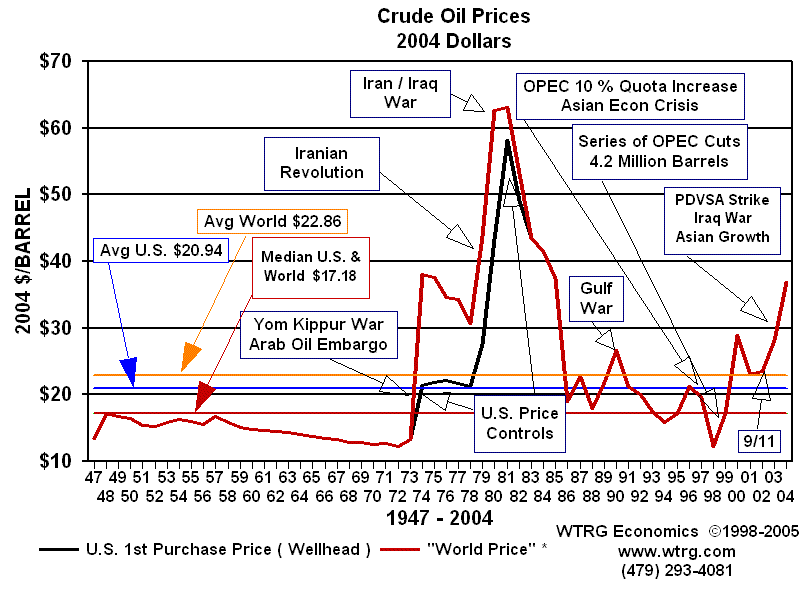
If you look back to the price hike in the late '70s and early'80s,
consumption started to drop by 1980 (it dropped 3% from '79 to '80, 4% from
'80 to '81, and a total of 10% from '79 to '84).

http://www.eia.doe.gov/emeu/ipsr/t46.xls


If you look at the price curve

http://www.wtrg.com/oil_graphs/oilprice1947.gif

you will see that the drop started before oil hit a peak.

We are > 1.5 years after the price rose to about $70/barrel in the summer of
'05, and consumption still is rising.  That's an important data point that
must be addressed in any economic model.

I fear that the report generated, for the government, the desired result.
But, I could be proven wrong by an experiment....raise the tax on oil and
gas and see what happens.

Dan M.


_______________________________________________
http://www.mccmedia.com/mailman/listinfo/brin-l