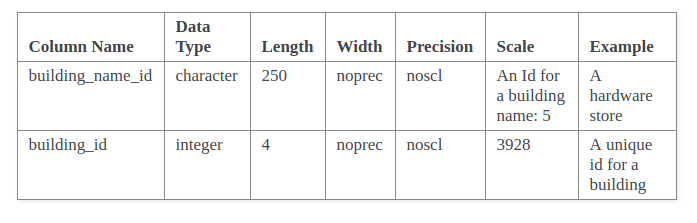
I ended up trying something which gets me part of what I'm looking for, but
still leaves me without the structure I'm looking for.
To get a nice looking html table which I could control formatting with a
custom CSS, I placed a "custom.css" file in a "_static" folder. I also
placed a "page.html" file in a "_templates" folder. That page html file
looks like this:
{% extends "!page.html" %}
{{ super() }}
{% block body %}
{% filter upper %}
<b><font size="+2">Schema: {{ schema_gen["name"] }} </font></b><br/>
{% endfilter %}
<b><font size="+1">Description: {{ schema_gen["comment"] }} </font></b><br/>

<p>
{% for item in outputschema  %}
<b><p>Table Name: {% filter upper %} {{ item["table_nam"] }} {% endfilter
%}<br/></b>
<b>Description: {{ item["table_comment"] }}<br/></b>
{% if item["table_columns"] %}
<table>
<tbody>
<thead>
<tr>
<th>Column Name</th>
<th>Data Type</th>
<th>Length</th>
<th>Precision</th>
<th>Scale</th>
<th>Description</th>
</tr>
</thead>
{% for columns in item["table_columns"] %}
<tr>
{% for column in columns %}
<td>{{ column }}</td>

{% endfor %}
</tr>
{% endfor%}
</tbody>
</table>
{% endif %}
</p>
{% endfor %}
</p>


{% endblock %}

After uploading to my repo, Sphinx automatically generated my ReadTheDocs
docs and created a very nice looking index.html page with my tables
formatted correctly, and using the css I needed.

I'm still confused because this created my tables in my INDEX page. How do
I leave my index page intact (containing other ReStructureText content)
without my inherited "page.html" content, but have a sub-page listed in my
index page toctree with this new html content (ie schema1) ?

My index.rst:

.. toctree::

   schema1
   schema2

I want my schema1.html file to contain my tables as I've dynamically
generated them in the code block above.
I'm quite confused about how I can potentially use the inheritance
templating to work in a single subpage only, rather than in my index page.

I tried putting a file named schema1.html in my "_templates" folder, but
that didn't do anything.

I must be missing something quite fundamental to inheritance in Sphinx.
What am I not understanding?


On Thursday, March 29, 2018 at 2:50:00 PM UTC+13, Peter Burdine wrote:
>
> A few things:
> 1) You may want to consider another jinja extension to sphinx:
> https://pypi.python.org/pypi/sphinx-jinja.  We use YAML as the
> datasource, though it could be anything maps to Python lists/dicts (json,
> xml, etc).  You can then either reference the a file with the jinja
> template, or you can embed the jinja code in your .rst files.  We have
> found it is easiest to make list tables for this.  You can use
> {% if loop.first %}
> to setup your table headers.
>
>
> 2) The builder controls the output formatting not the reST input (unless
> you use tablularcolumns for LaTeX, but that is another story).  Have you
> tried:
> https://stackoverflow.com/questions/23462494/how-to-add-a-custom-css-file-to-sphinx
>
>
> On Wednesday, March 28, 2018 at 12:45:44 AM UTC-7, Jan wrote:
>>
>> I'm trying to understand sphinx, and I'm thoroughly not understanding how
>> to implement even some basic concepts. I've created a sphinx project linked
>> to my readthedocs account. Everything works to generate my basic index.rst
>> file in read the docs. I'm trying to follow the ideas of adding dynamic
>> input to a specific page within my project, as mentioned here:
>> http://ericholscher.com/blog/2016/jul/25/integrating-jinja-rst-sphinx/
>>
>> My objective is to setup my sphinx project so that whenever a specific
>> text file changes in my /docs folder, it updates my ReadTheDocs content
>> dynamically/automatically.
>>
>> My /docs folder has these key elements:
>>
>> parsethisfile.txt
>> conf.py
>> index.rst
>> Database.rst
>> ...
>>
>> In my conf.py I've added some python which parses a txt file, and then
>> creates references to the object:
>>
>> def rstjinja(app, docname, source):
>>     """
>>     Render our pages as a jinja template for fancy templating goodness.
>>     """
>>     # Make sure we're outputting HTML
>>     if app.builder.format != 'html':
>>         return
>>     src = source[0]
>>     rendered = app.builder.templates.render_string(
>>         src, app.config.html_context
>>     )
>>     source[0] = rendered
>>
>> def setup(app):
>>     app.connect("source-read", rstjinja)
>>
>> html_context = {
>>     #'outputschema': schema_list_out
>> }
>>
>> The "schema_list_out" is a list (or I could make a dictionary) which
>> contains elements for a database schema, such as table names, comments,
>> column names and column parameters.
>>
>> If I wanted to generate dynamic ReadTheDocs pages, I've successfully been
>> able to add some variables to my Database.rst file like this:
>> {% for schema_item in outputschema %}
>> **Schema Name: {{ schema_item["name"] }}**
>> {% endfor %}
>> and sphinx correctly creates a Database.html file that shows this:
>>
>> Schema Name: buildings
>>
>> More importantly, I'm trying to create nice looking tables for the items
>> in my "schema_list_out" list. The only way I've been able to do that is
>> using the python tabulate module (in my conf.py), where I generate the
>> table within python, output as rst, and save it as a list element object
>> within my "schema_list_out". If I use the right control structure in my
>> rst, I generate a nice looking table in rst format that looks correct in my
>> sphinx generated output:
>>
>>
>> <https://lh3.googleusercontent.com/-dhpbPBXkgwQ/Wrsp8EOcAWI/AAAAAAAAF2E/kU8XMyxpMEs6H_aeDuEsNQ6DN9XEthTMACLcBGAs/s1600/schema2.png>
>> But the problem here is I have no way of controlling how this looks
>> inside the rst file because it's RST, and I can't add HTML, css or anything
>> else to control how the table looks (like table width, color etc). reST
>> markup doesn't seem to offer enough control over a table.
>> How do I create dynamically created tables which can be formatted nicely,
>> in RST? If I could create the tables easily in my Database.html, I'd do
>> that, but it's not a template, it's generated by sphinx from my
>> Database.rst. I can't figure out how to create my Database.html myself,
>> with the jinja control structures inside of it. How do do that?
>>
>>
>>
>>
>>

--
You received this message because you are subscribed to the Google Groups
"sphinx-users" group.
To unsubscribe from this group and stop receiving emails from it, send an email
to [email protected].
To post to this group, send email to [email protected].
Visit this group at https://groups.google.com/group/sphinx-users.
For more options, visit https://groups.google.com/d/optout.