Wonderful idea, Margaret! How can we make this happen?
                Greta Eckhardt


From: Lincoln <[email protected]> On Behalf Of Margaret Flint
Sent: Friday, November 7, 2025 7:37 AM
To: [email protected]
Subject: [LincolnTalk] Could this be a future for the fallen trees of Lincoln?


UPDATES

CAMPUS & BUILDINGS

NATURE / NATURAL RESOURCES


Coach Barn Stories: From Trees to Tables


 <https://shelburnefarms.org/about/staff-and-board/holly-brough>

Posted by  <https://shelburnefarms.org/about/staff-and-board/holly-brough>
Holly Brough

Director of Communications

November 6, 2025

All of the tables in the new Coach Barn are made from wood harvested at
Shelburne Farms. Most of that wood is poplar.  John Monks of
<https://treegoods.com/> Vermont Tree Goods, the  man behind the tables,
explains why that’s the case, and what it means.   Note: The interview has been
edited for length and  clarity.


How did you become involved in making the tables for the Coach Barn?

Back in 2018, I learned that
<https://shelburnefarms.org/about/news-and-stories/farewell-poplar-drive>
Shelburne Farms was taking down big trees along Poplar Drive because they were
starting to die, and were a hazard. But the Farm couldn’t find anybody to mill
them, so they were going to be left to rot in the woods. I called and met with
Marshall Webb to look at the trees. “We could mill them,” I said. In his mind
and in my mind, to cut them and let them rot was wrong.

There were about 20 massive trees. We trucked them over to my shop, and slowly
milled them into big slabs with natural edges. We air-dried the slabs for a
couple of years, then kiln-dried them, then stacked and stored them.


<https://shelburnefarms.org/sites/default/files/inline-images/John%20Monks%20and%20slabs2%20-%20blog.png>
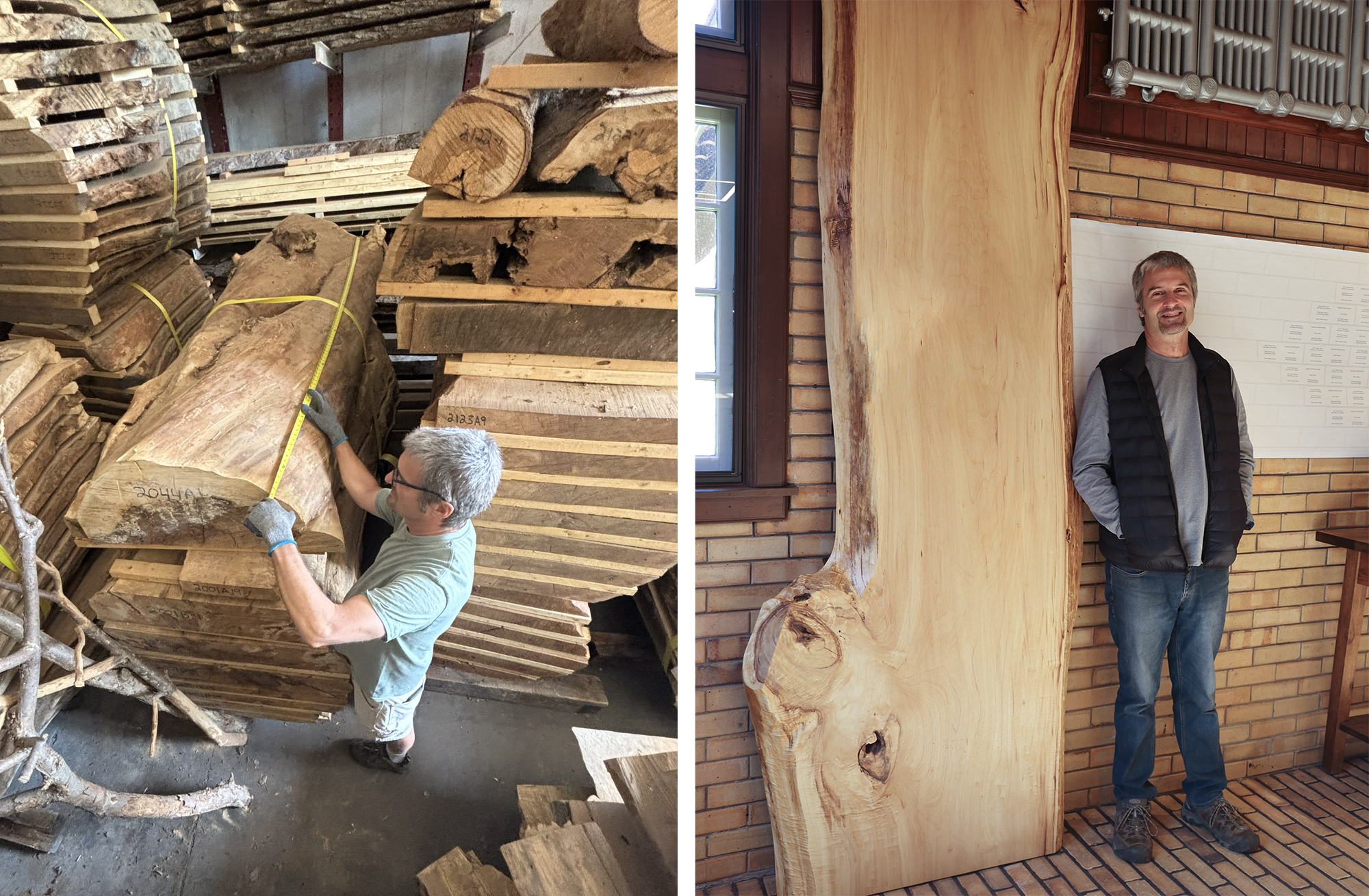
 John Monks of Vermont Tree Goods among stacked slabs of Shelburne Farms poplar
in his workshop, and standing next to a commemorative slab installed in the
Coach Barn.


Marshall had commissioned a few Farm tables before he passed, but after a few
years, we started wondering, “What are we going to do with all this?” Then
early in 2025, Shelburne Farms said, “We have this project at the Coach Barn,
and we need lots of tables.” I said, “Okay, we've got lots of your wood!”

This summer we brought the wood slabs to  <https://www.vermontfarmtable.com/>
Vermont Farm Table in Bristol, and as a production shop, they built and
assembled all the tables.


How were you able to mill such big trees?

I had built this huge sawmill that's effectively a huge electric chainsaw. It's
very unconventional. Most commercial sawmills don't want trees over about 24
inches in diameter, and a lot of these poplars were four feet or more wide–way
beyond what any local commercial sawmills can handle.


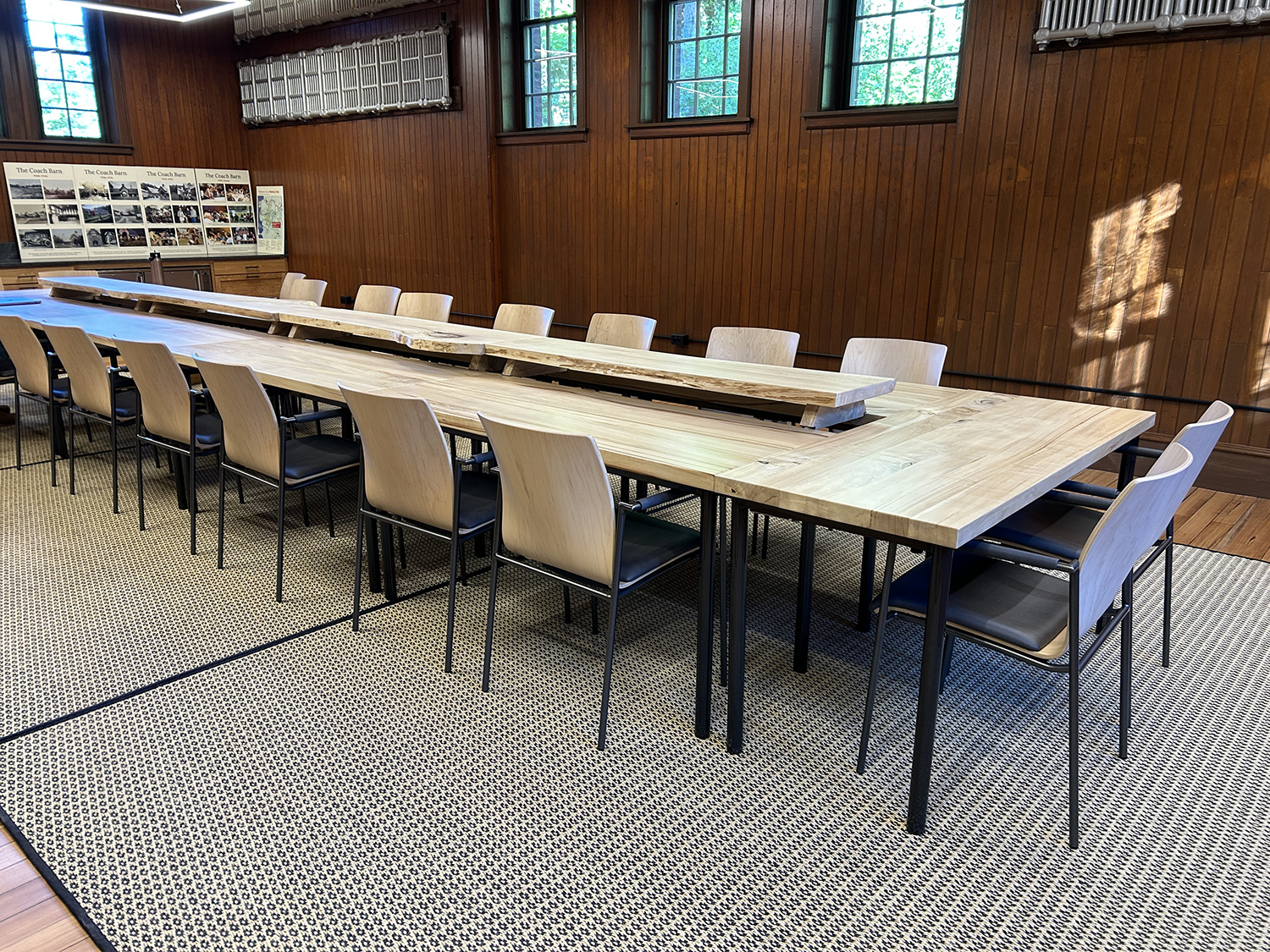
<https://shelburnefarms.org/sites/default/files/inline-images/meeting%20room%202.jpg>
 The poplar table in the Meeting Room of the Coach Barn.


How did you get involved in milling such big trees?

I was a house builder for many years, and started making some furniture for
family and friends. But in 2010 we had a fire and lost all our belongings. (It
was horrible, but thankfully nobody got hurt.)  I set out to replace some of
the furniture that I had built, and I wanted to make a large live-edge dining
table. I couldn't really find the wood that I wanted, so I went to a couple of
tree service companies and asked them what they did with the big trees they
cut. One guy took me behind their shop and pointed at this huge pile of big
logs and said, “We'll just burn it all this winter to make it go away.” Right
then I knew what my mission was, because, to me, wasting all that wood was so
wrong. That day really was sort of a life changing moment for me.

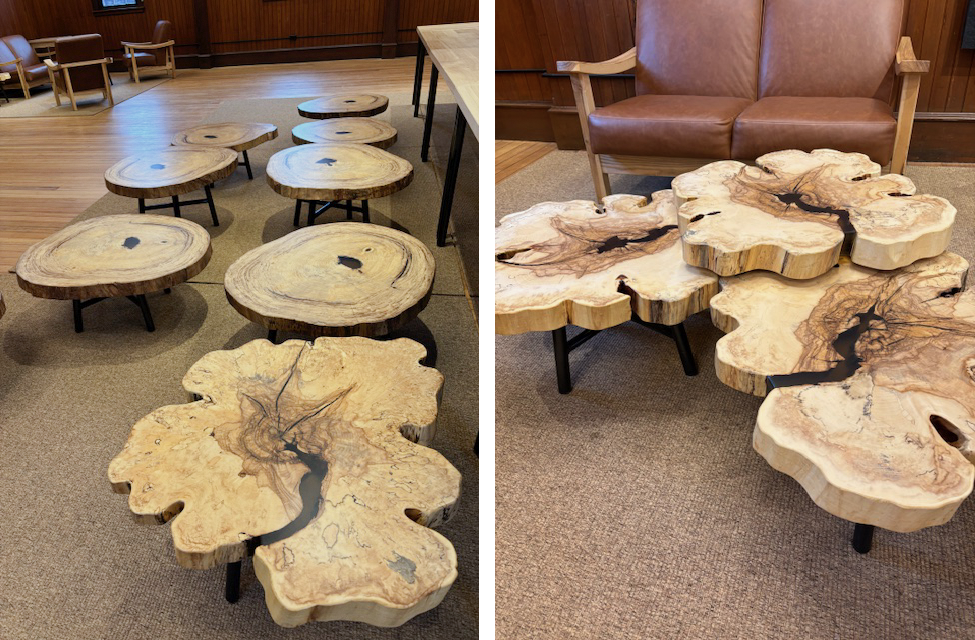
  <https://shelburnefarms.org/sites/default/files/inline-images/IMG_1312.png>
Several coffee tables soon after their arrival at the Coach Barn. The round
ones are made of poplar. The tables with the dramatic notched edges are made of
horse chestnut trees also harvested at Shelburne Farms.


Why was using the wood from Poplar Drive important to you?

Well, for a number of reasons. One is environmental. Wood is approximately 50%
carbon by weight, and a lot of people don't realize that if you let a tree rot,
over 90% of its carbon will become carbon dioxide. There's this misconception
that all the carbon just gets reabsorbed into the dirt and that's not the case.
I have no idea what all those trees weighed--many, many tons—but they
represented many, many tons of carbon dioxide.

The other main reason for me is aesthetics. Even though cottonwood is not
considered high value in the lumber world, it's really quite beautiful stuff,
as you can see by the tables. To throw out such beauty is like throwing out
masterpieces.

And then there’s a spiritual side to it all. I read somewhere that we share
half our DNA with trees. So in a way, we're related to them. We're descended
from whoever they are descended from. We're all Earthlings.

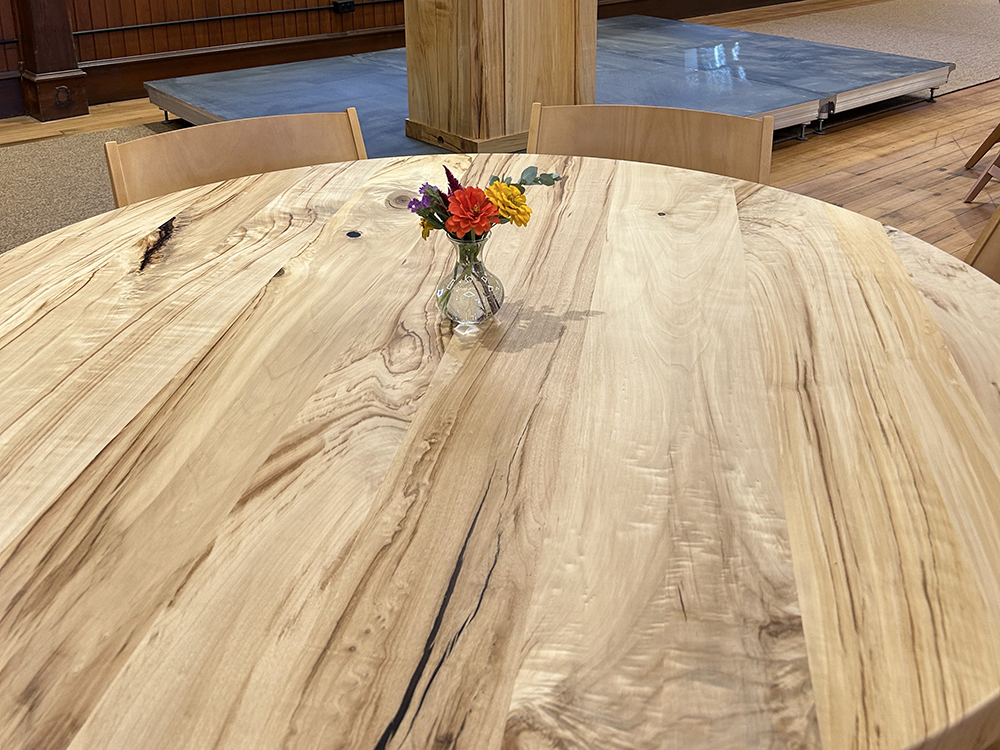
  <https://shelburnefarms.org/sites/default/files/inline-images/IMG_8451.jpg>
One of the round-top tables in the West Hall, all made of Shelburne Farms
poplar by Vermont Farm Table. "Some of these tables look like Jupiter to me,"
chuckles John, referring to the dark whorls and character marks in the wood.


How does this project fit into your overall approach to harvesting trees?

The traditional forestry model is based on what they call a tree’s “financial
maturity”: once a tree is big enough to make a profit on it, you go in the
woods and cut it. But I strongly believe that phrase should be replaced with
“carbon maturity.”

Most trees die slowly. They may still be alive, but they're clearly at that end
point. We've all seen it–like a big old maple tree in your yard losing one limb
and then another.  I call that point their peak carbon maturity. To me, if
you're going to harvest a tree, that's the time to do it.

It turns out that many trees in our communities, whether they’re along a
roadside or in people’s yards, are peak carbon trees. And if you look at their
board footage, I believe that it's greater than the amount of wood we're taking
out of the forests. We're basically wasting the vast majority of these “carbon
mature” trees, and at the same time, cutting down relatively young trees in the
forest.

I see us as finding homes for unwanted trees. The more homes we find, the more
trees we get to recycle. It's really a very simple concept. That’s the
motivation for me.


How do you hope people will experience or respond to these tables?

I don't think there's any one message. Hopefully, people will think, “Wow,
these are beautiful. And isn't it wonderful that when those trees had to come
down they were preserved, and we can continue to see their beauty, especially
their interior beauty.”

When I started this business, I just wanted to make beautiful tables. As time
has gone on, my motivation has shifted. Now it's much more about the
environment and what we do with trees, especially trees coming out of our
communities. I'm hoping very much that the carbon impact of recycling these
trees is stressed. We shouldn't be viewing them as just part of the waste
stream.


<https://shelburnefarms.org/sites/default/files/inline-images/John%20Monks%20rounds%20-%20blog.jpg>
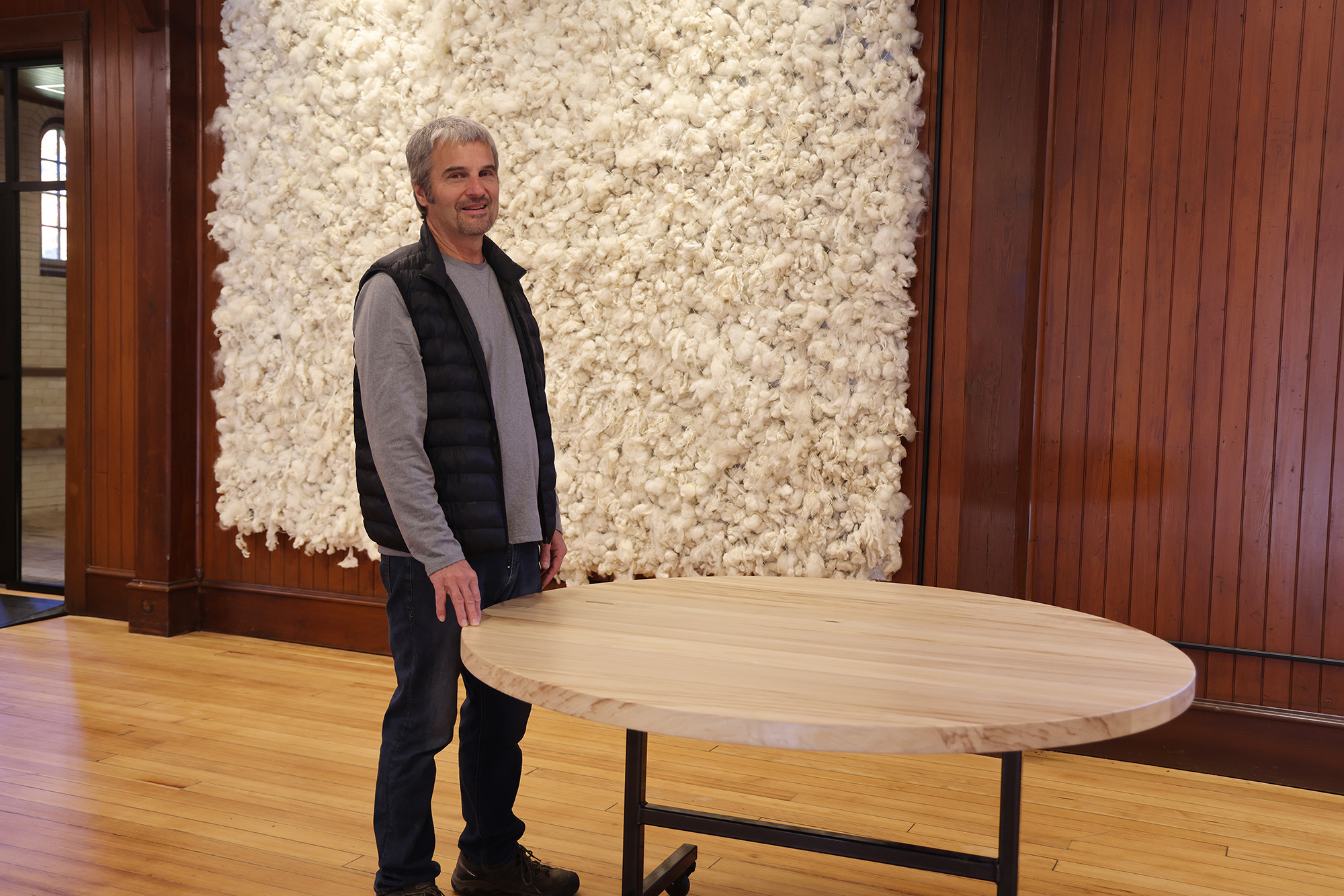
 John Monks beside one of the round poplar tables in the West Hall.


How does it feel to have these tables here as part of the Coach Barn?

For the wood to return to the Farm and be here for generations to come is the
best possible scenario. I'm honored that I played a role in it.

But in many ways, I see this really as Marshall's gift. When there weren’t the
resources to get the trees milled, he made it happen. We were kindred spirits
when it came to the trees. For me more than anything, it's about Marshall.


<https://shelburnefarms.org/sites/default/files/inline-images/Marshall%20and%20poplar%20-%20blog.jpg>
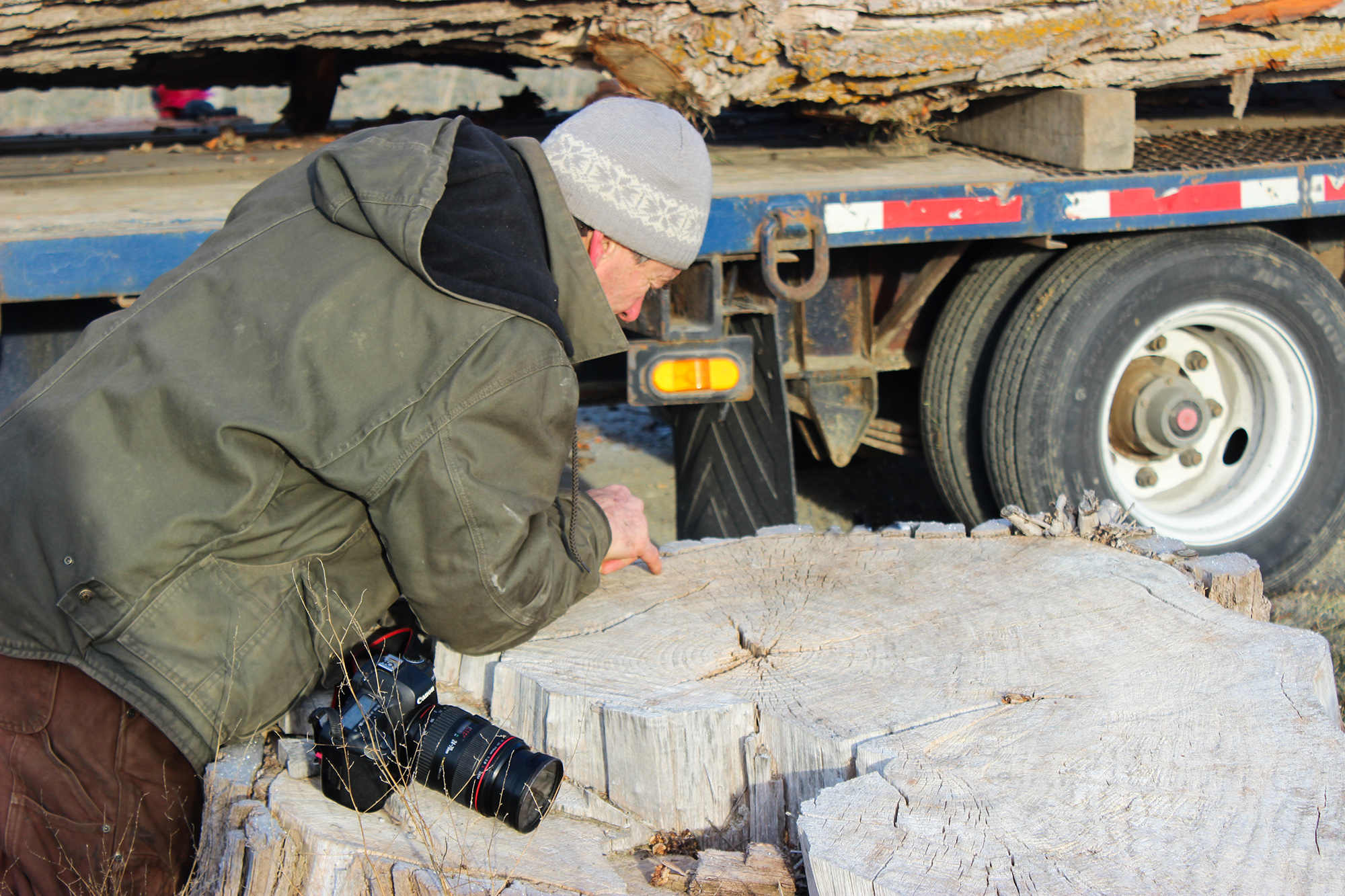
 Marshall Webb in 2018, counting the age rings of one of the recently cut
poplars.


Tags


 <https://shelburnefarms.org/taxonomy/term/41> Updates

 <https://shelburnefarms.org/taxonomy/term/6> Campus & Buildings

 <https://shelburnefarms.org/taxonomy/term/8> Nature / Natural Resources


Comments


Submitted by Ken and Susie Mandelbaum on Thu , 11/6/2025 - 07:33 PM

A beautiful way to honor Marshall. We miss him.

*
<https://shelburnefarms.org/comment/reply/node/4120/field_comments/15754> Reply

Submitted by Sue Louchheim on Thu , 11/6/2025 - 07:40 PM

AWESOME!! THANK YOU FOR SHARING THIS BEAUTIFUL STORY!!!

*
<https://shelburnefarms.org/comment/reply/node/4120/field_comments/15755> Reply

Submitted by Jacques-Paul Marton on Thu , 11/6/2025 - 07:47 PM

This is a beautiful and brilliant story. Expressed with Nature's eloquence. So
much of Marshall's spirit is embedded in the tables. Those statuesque Poplars
that once served as one Nature's ambassadors to the Farm Barn have returned.
Thank you, Mr. Monks. Your knowledge, skill, and passion for your craft is very
--
The LincolnTalk mailing list.
To post, send mail to [email protected].
Browse the archives at https://pairlist9.pair.net/mailman/private/lincoln/.
Change your subscription settings at
https://pairlist9.pair.net/mailman/listinfo/lincoln.