https://www.wired.co.uk/article/mini-electric-first-drive
Mini Electric first drive: a great electric car for the masses
29 January 2020  Jeremy White
[images
https://wi-images.condecdn.net/image/oY8NgN6B4oW/crop/810/f/5.jpg
 / Mini

https://wi-images.condecdn.net/image/ZAZkpkAxrbp/crop/810/f/2.jpg
 / WIRED

https://wi-images.condecdn.net/image/zkqyzykkBP1/crop/810/f/img_3594.jpg
 / WIRED

https://wi-images.condecdn.net/image/MpvNWNA9Jkm/crop/810/f/3.jpg
 / Mini

https://wi-images.condecdn.net/image/8awE2Ez553d/crop/810/f/4.jpg
 / Mini
]

The new flagship EV from BMW has arrived. It looks set to be one of the most
sought-after cars for 2020, and it's a mighty fine electric addition to the
Mini family

There are a few reasons why the new Mini Electric is one of the most hotly
anticipated electric cars of 2020. One would be that this is the first
vehicle from the iconic brand to be battery powered that you can buy. Those
with good memories will recall that there was, back in 2009, a trial to
lease a Mini E for six months.

Another reason is that this new EV will replace the BMW i3 as the group's
flagship all-electric car. A third is that unlike Lotus's Evija, Aston
Martin's Rapide E or Porsche's Taycan, which firmly aim the eco (and
performance) benefits of EVs at the wealthy minority, this will be an
electric car for the masses.

From £24,400, the Mini Electric will not only be the BMW Group's newest full
EV, it will also be its cheapest. The top-spec model will cost less than the
i3, which launched back in 2013.

You could therefore argue the Mini Electric, is far more important than any
of the offerings from the high-end manufacturers. This is where the
meaningful battle will be waged to convert the hearts and minds of those on
school runs, shopping trips, average commutes and weekend jaunts to the
coast.

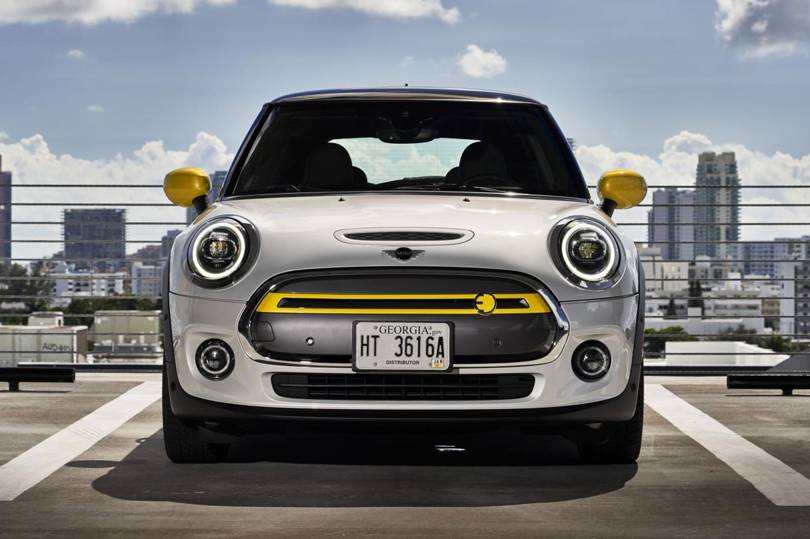
But is it any good? Well, it looks like a Mini. Because it is one. One of
biggest pluses and minuses for the Mini Electric is that it has been built
on the existing Mini architecture. This means that BMW Group knew exactly it
was working with when modifying the ICE version, but it also means you get
none of the advantages the i3 has in terms of being conceived and designed
as an electric car.

Don't look for an abundance of lightweight composites or a streamlined cabin
taking advantage of the space savings the lack of a conventional powertrain
brings. There are no obvious concessions to the new electric motors.
Contrast this with the Honda e, incidentally, and you can see the
difference. What it does mean, however, is there is a welcoming familiarity
to the Mini Electric. You instantly feel at home, and that's no bad thing.

What does strike you is the lack of noise as the Mini Electric pulls up or
away. Yes, it does have a specially designed noise that it pumps out to let
the unsuspecting pedestrian know of its presence, but it is so quiet you
have to almost strain to hear it.

Inside you get the sort of digital instrument cluster and central display
that befits a full-EV. In these emerging days of mass-production electric
cars, to entice traditionalists away from their familiarity with internal
combustion engines, manufacturers, Mini included, are loading up the specs
so you get flashy displays and optional extras as standard. This won't
always be the case, so enjoy it while it lasts.

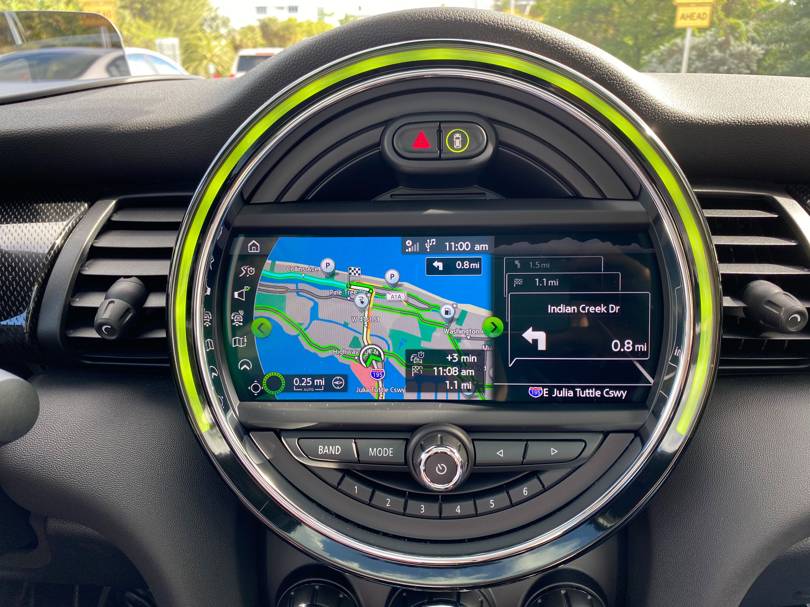
The 5.5-inch colour digital dash displays various info, including current
flow of energy and range, while navigation is handled on the bright and
clear central 6.5-inch touchscreen, which is responsive and bright. A nice
touch is that traffic updates link to the navigation automatically, updating
the car's range – this is another reason why the satnav, usually an optional
extra on Minis, is standard on the Electric. If the car thinks you're not
going to make it to your destination, it will re-route you to public
charging stations within range to top up.

The first-drive model, as seen in the pictures here, has additional upgrades
including a Harmon Kardon sound system, head-up display, matrix LEDs,
wireless phone charging in the central arm rest and a noticeably larger
8.8in version of that infotainment touchscreen, which could well be laying
out extra for.

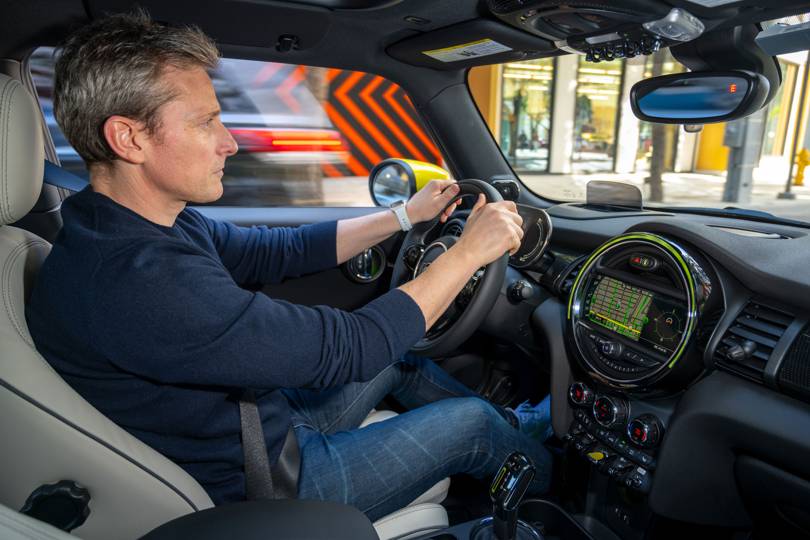
Room for four adults inside? Yes. But you are left wondering what could be
have been done had Mini created a special chassis for the Electric. That
said, if it had would you still be able to pick up one for £600 less than
the equivalent Cooper S model?
Mini

Speaking of the hot-hatch Cooper S, the Mini Electric is good for a nippy
zero to 62mph in 7.3 seconds with a maximum output of 184hp and torque of
270Nm – comparable to the Cooper S. Top speed is limited to 93mph, though.

The Mini marketing bumf mentions that the Electric feels "like a go-kart" on
the road. And this is one of the occasions where the car delivers on such a
promise. It manages to pull off the neat combo of feeling planted on the
road while also being superb fun to whip round tight corners or accelerate
away from side roads.

The throttle mechanics on the Mini Electric deserve particular praise. It is
responsive, but also nuanced – there is no guesswork involved applying
pressure to get just the delivery of power you are looking for.

Of the four driving modes ("Sport" with more direct steering and a more
rapid power delivery; "Mid" with less aggressive steering; and "Green" and
"Green+" for the obligatory eco modes featuring gentler accelerator
response), Mid is the best. You get predictable regenerative braking if
slightly on the heavy side and, handily, you can lighten this regen braking
with a flick of a switch. Within a few miles you become completely used to
driving with the one pedal and can easily forgo the use of the brake pedal
entirely.

Another advantage of this is that the range is extended. The Mini Electric
can handle a range of between 124 and 144 miles, according to the Worldwide
Harmonised Light Vehicle Test Procedure. Our test route was about 70 miles
with a good amount of gunning away from lights and unmapped diversions down
side streets, yet we got nowhere near reducing the Electric to half charge.

The Sport mode is punchy but not unwieldy, and the eco settings – though
undoubtedly worthy – do remove a great deal of fun from the car. That said,
after driving the Electric for 20 miles or so we completely forgot we were
driving an EV – an illusion only dashed when we put our foot down and the
car's inner go-kart was revealed again.

With that 145-mile range, it's clear this Mini's heart is sensibly in urban
driving as opposed to long distance. This was highlighted at one stage when
we pulled alongside a Tesla Model X. In comparison it was a hulking great
thing. You couldn't help but think the Mini Electric was far better suited
for the city.
Mini

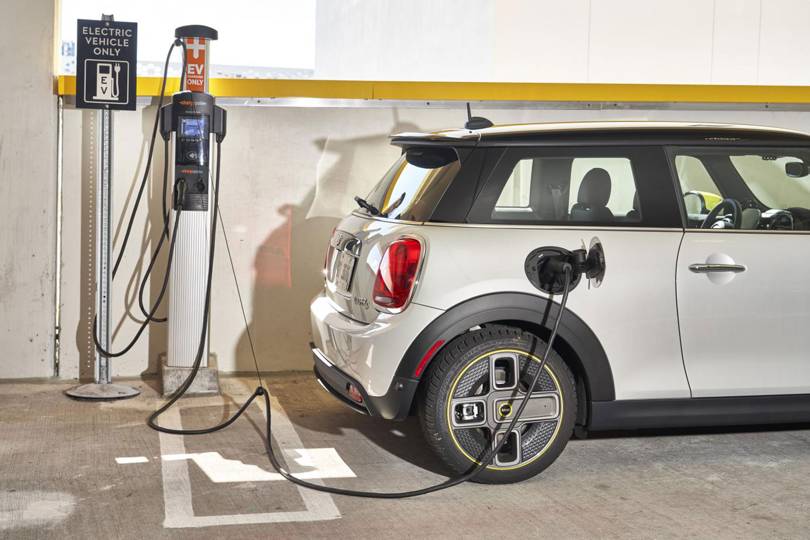
The Electric comes with both home and public charging cables as standard,
for AC and DC charging. At a 50kW DC fast-charging station, the Mini can
supposedly achieve an 80 per cent charge from zero in just 36 minutes. For
11kW AC charging this rises to 150 minutes. At home with a three-pin plug?
You're looking at 12 hours.

One of the main hurdles the Mini engineers had to overcome was to bring the
powertrain from the rear to the front, another was to squeeze in batteries
into the space where the old ICE powertrain and exhaust system used to be
housed. So while some may have wished the Mini Electric to have a longer
range with a bigger battery, the result is a 32.6kWh 12-module lithium-ion
pack arranged in a T-shape in the floor between the front seats and below
the rear seats.

Shoehorning the battery setup into this space has one advantage, however,
the Mini's boot volume has not been compromised, retaining the usual 211
litres. Incidentally, the battery itself has a warranty of eight years or
100,000 miles. Also, based on £0.163 per kWh on average, it costs £5.31 to
top the Mini Electric up to full charge. So one mile should cost you 4p.

BMW Group has taken a gamble with the Mini Electric. There's no getting away
from the fact that corners have been cut compared to the BMW's development
and therefore compromises have been made regarding weight and battery
capacity.

Having said this, the Mini Electric has a winning personality. It's fun to
drive and excitingly responsive. Those looking forward to trying out this
full EV should not be disappointed. And despite the use of the existing
architecture rather than redesigning the car from the ground up for electric
power, this is a worthy replacement to the i3.

But above all, perhaps the best compliment for the Electric is that you very
quickly stop thinking of the change in powertrain altogether. You're just
driving a Mini. A fast one that costs just a fiver to fill up.
[© wired.co.uk]


+
https://finance.yahoo.com/news/mercedes-halves-ev-production-target-125133485.html
Daimler to build 50,000 Mercedes EQC models this year
January 23, 2020  FRANKFURT (Reuters) - Daimler on Thursday said it plans to
build 50,000 Mercedes EQC electric cars this year, denying a report in
Manager Magazin which ...


For EVLN EV-newswire posts use:
 http://www.evdl.org/archive/


{brucedp.neocities.org}

--
Sent from: http://electric-vehicle-discussion-list.413529.n4.nabble.com/
_______________________________________________
UNSUBSCRIBE: http://www.evdl.org/help/index.html#usub
ARCHIVE: http://www.evdl.org/archive/index.html
INFO: http://lists.evdl.org/listinfo.cgi/ev-evdl.org
Please discuss EV drag racing at NEDRA (http://groups.yahoo.com/group/NEDRA)