James,

A) Should we value editors with many edits more than editors with just a few?
Your counter-example (editors who write a long article in one go offline) is
canonical, and probably uncontested, so you're stating the obvious, no need to
use a loaded term like 'offensive', and to spell it out as if WereSpielChequers
wouldn't know this, or would disagree. I use the term 'core community' loosely
myself from time to time, knowing full well that any precise definition would
be incomplete. Incidentally I think 'very active editors' is a misnomer (which
I started) for the same reason. People can be very active editors offline per
the same example. [1]

B) Agreed, we should be careful to interpret a trend (-change) in a very basic
metric, or what that metric actually tells us anyway. But again I think you're
stating the obvious. The only thing that surprises me is your timing: I never
heard you utter these nuances so much when veteran foundation staff and other
core community members overemphasized (in my opinion) countering editor decline
as a primary target (I tried to nuance this all along as much as I could).

So yes, 'editor count' is overly simplistic, and so is 'inflation rate', 'gross
domestic product', 'population count'. All of these are overly simplistic, and
without further breakdown don't tell us much. Yet these simplistic metrics
survive, because everyone understands them, and much less people want to know
the underlying complexity (especially decision makers), and importantly: they
are collected consistently for a long time (more refined numbers suffer more
easily from definition creep, or being en vogue temporarily). The most refined
metrics are often from one-off studies, valuable but not gaining enough
momentum for repeated collection.

I need to explain my statement which was re-quoted in this thread: "The growth seems real to
me". I first and formost meant "To my best knowledge the numbers are reliable". I
expect no bug or other artefact (WereSpielChequers asked me about that specifically). The code is
time-tested and stable. There is always a change that a hidden bug surfaces in a changing
environment, but I see no sign for that. So at face value the growth is real then, more editors
pass the threshold. But giving meaning to that figure is a process of never ending dialectic.

Lastly, a more philosophical comment: shouldn't we rejoice if a partially
understood metric seems to give ground for optimism. IMO we should, as joy (and
fear) provide the incentive to dig deeper. Our news agencies make a living of
incomplete news. Any scientific knowledge is temporary at best, until
falsified. I rejoiced when I read that traffic accidents decreased in last 5
years.Then someone countered that road traffic declined overall due to dip in
economy, so the effect may be temporary and not systemic, so I lost some joy.
But I gained from the exchange.

Cheers,
Erik

--

Notes/details:

[1] I would be interested to see how often this happens: writing an article
offline in one go. My hunch is less and less, as more and more people get
speedier access, and site submits happen faster, thus reducing 'involutarily
offline editing'.

[2] Specifics on the examples you gave:

I find some of your examples in your first mail a bit far-fetched. Very active
editors reversing each other ad infinitum, hmm, when was the last time you
actually saw this? And (spam)bots are excluded from out editor counts anyway as
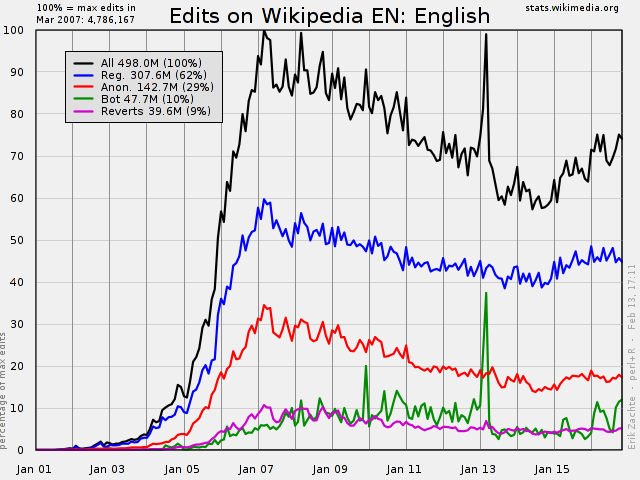
much as feasible. In general edits on wp:en grew in 2015, while reverts stayed
more or less the same: https://stats.wikimedia.org/EN/PlotEditsEN.png

In your second response you name some positive reasons why our editor count
could be growing, and they seem mostly plausible to me. But here is also room
for nuance: 'Faster load/save times make the site feel more responsive and so
people can do more edits in the same amount of time.' would be high on my list
to investigate, and maybe even be reason to question the gain. The uptick in
January conincided with a major site performance boost (faster PHP). I can
imagine people who edit heavy articles like 'Obama' (heavy in terms of links
etc, with iirc almost a minute of submit time), would edit online in one go
without intermittent submits, and now these same people went back to
precautionary intermittent submits, thus accomplishing same amount of work in
more edits, in which case our gain would be mostly our editors' peace of mind.
Building on this: perhaps part of the decline in previous years came from
slowing submits?

(disclaimer : all of the above is only my personal opinion)

-----Original Message-----
From: [email protected]
[mailto:[email protected]] On Behalf Of Robert Rohde
Sent: Thursday, September 10, 2015 21:00
To: Wikimedia Mailing List
Subject: Re: [Wikimedia-l] Increase in size of the core editing community

For enwiki, whose stats I happen to know best, one might say the bottom was actually
around mid-to-late 2013.  The plateau and subsequent modest upward trend was visible
first with occasional/new editing metrics like new active editors (>= 5 edits per
month), but has since also appeared in measures of highly active editors (>100
edits per month).

This timeline would suggest that at least some of the change predates what Lila
put in place, though her team may deserve credit for the continued improvement.

In 2015, we are also poised for something of a transition.  The cohort of
editors who registered on enwiki in 2006 have made more edits to enwiki than
any other annual cohort in every year from 2006 to 2014.  If you choose any
edit at random since 2006, the most likely year that the account registered was
2006.  That cohort, a legacy of Wikipedia's great growth period, has had an
outsized impact on enwiki editing for nearly a decade.
  (2005 and 2007 cohorts also have a strong pattern of continued editing,
though not as huge as 2006.)  If current trends continue, the 2006 cohort will
finally lose their crown in 2015.  The 2015 cohort is likely to make more edits
in 2015 than the 2006 cohort makes in 2015.  It will also be the second year in
a row that first-year accounts have increased their total edit count, after
seven earlier years of declining edit totals for first-year accounts.

I think there are plenty of reasons to be modestly optimistic.  I'm not sure we
should every again expect dramatic growth, but if we can move towards a more
stable or slowly growing community that would seem to make an apocalyptic
collapse less likely.

-Robert Rohde


On Thu, Sep 10, 2015 at 7:56 PM, Pine W <[email protected]> wrote:
James,

Yes, there is more to the story than can be told in the data that we have.
On the other hand, it seems to me that it's a bit harsh to respond
like that to WSC's attempt to share good news. Perhaps you can also
think of positive ways to interpret the data, such as that the
increased speeds of page loads may be having a desirable positive
effect on the productivity of highly active editors.

I believe that Aaron H. is working on ways to measure the "value" of
an editor's contributions. When that work is done, I hope that we'll
have a better measure for how productivity is changing over time for
different cohorts of editors.

Pine

On Sep 10, 2015 8:58 AM, "James Forrester" <[email protected]>
wrote:
On 10 September 2015 at 07:21, WereSpielChequers <
[email protected]> wrote:
A quick follow up to the signpost article of a couple of weeks ago
<
https://en.wikipedia.org/wiki/Wikipedia:Wikipedia_Signpost/2015-08-26/
In_focus
We
now have the August figures
<https://stats.wikimedia.org/EN/TablesWikipediaZZ.htm>, and August
has continued what we might reasonably start calling the new
trend. The
English
Wikipedia has more editors with 100 or more live edits in
mainspace
than
for any August since 2010. Across all Wikipedias combined the
figures
are
up almost as steeply with a near 10% increase on August 2014,
though
this
doesn't quite get us back to 2012 levels.
Interesting data, but it's just data, not a conclusion.
Also, and a bit off-topic, "core editing community" is a pretty
offensive term to use for "editors who make more than 100 edits a
month", disregarding the continuing editors who make fewer than 100
edits as non-core regardless of the value they add to the wikis; the
normal term
is
"very active editors" to avoid implicit disparagement.
[Snip]
editors making 5 or more saves
[is]
down
across Wikipedia generally when comparing August 2015 with 2014.
So, actually, your title is faulty and misleading. Instead, you
could
say:
- "English Wikipedia editor numbers continue to decline but
meta-editors
    are up",
    - "Editor diversity falls as more edits are done by fewer editors", or
    even
    - "Beset by a falling number of editors, existing users of the English
    Wikipedia feel compelled to edit still more in their desperate
attempts to
fix things"?
But it's nice to have one metric be positive.
I'm not sure it is. What is the nature and value of these edits?
Two editors endlessly reverting each other counts as "more edits"
but adds no value; one hundred editors each writing a beautiful
Featured Article in a single edit counts as less "work" than one
admin reverting 101 vandalism edits by a single spambot. What's your next step
to evaluate this?
Yours,
--
James D. Forrester
Lead Product Manager, Editing
Wikimedia Foundation, Inc.
[email protected] | @jdforrester
_______________________________________________
Wikimedia-l mailing list, guidelines at:
https://meta.wikimedia.org/wiki/Mailing_lists/Guidelines
[email protected]
Unsubscribe:
https://lists.wikimedia.org/mailman/listinfo/wikimedia-l,
<mailto:[email protected]?subject=unsubscribe>
_______________________________________________
Wikimedia-l mailing list, guidelines at:
https://meta.wikimedia.org/wiki/Mailing_lists/Guidelines
[email protected]
Unsubscribe: https://lists.wikimedia.org/mailman/listinfo/wikimedia-l,
<mailto:[email protected]?subject=unsubscribe>
_______________________________________________
Wikimedia-l mailing list, guidelines at:
https://meta.wikimedia.org/wiki/Mailing_lists/Guidelines
[email protected]
Unsubscribe: https://lists.wikimedia.org/mailman/listinfo/wikimedia-l,
<mailto:[email protected]?subject=unsubscribe>


_______________________________________________
Wikimedia-l mailing list, guidelines at:
https://meta.wikimedia.org/wiki/Mailing_lists/Guidelines
[email protected]
Unsubscribe: https://lists.wikimedia.org/mailman/listinfo/wikimedia-l,
<mailto:[email protected]?subject=unsubscribe>