Jones put the concept into a generic form that still demonstrated how the
argument hinges on COE. IMHO the mainstream wrongly assumed that the generic
case for random motion of gas expands into a law. I am convinced that this
energy source can be exploited by changes in  Casimir geometry forming a new
type of Maxwellian demon that sorts by mobility of molecular vs atomic hydrogen
using disassociation or other chemical reactions as a rectifier. In the case
for disassociation the thermal energy only need be supplied once to approach
disassociation threshold and then you can ramp up while extracting
Energy via a heat sink to avoid melt down.
Fran
_____________________________________________
From: Jones Beene [mailto:[email protected]]
Sent: Monday, July 22, 2013 10:30 AM
To: [email protected]
Subject: EXTERNAL: [Vo]:Gone with the wind


A modern miracle of ancient technology is happening as we speak. This feat was
witnessed on the SF Bay a few days ago - in winds of 15.8 knots. The New
Zealand catamaran, their entry in the America's Cup, hit a speed of 44.15 knots
- 50.8 mph in this modest wind. Amazing! for a wind-powered device - to be
propelled at almost triple the wind speed. What if wind mills could do this?

http://blog.sfgate.com/americascup/2013/07/19/new-zealand-makes-fastest-vuitton-cup-run-yet/

Of course this is not overunity, speed is not energy, windmills routinely have
tip speeds far in excess of wind speed and so on - but it does hint at one
particular way that real gain can happen in many kinds of bifurcated systems.
In short: order -> disorder.

The "hint" for bifurcation is to take an input which is somewhat disordered,
like wind or heat, and then convert it very efficiently into something similar
but closer to coherency - which has more internal order than the original
input. Order from disorder, done efficiently is the key to the first step. Wind
impinging on the sail at one speed has freedom of movement several axes, but
can be forced by geometry into an altered vector with lowered freedom of
movement at 3x the initial speed. To "pay" for this apparent gain, there will
be large volumes of disordered and more stationary air.

Imagine blackbody radiation at a peak of 600 K being partly converted into
coherent photons which have the equivalent mass-energy of 1500 K. In itself,
this plasmonic reaction is not gainful but it may set the stage for another
derivative reaction. The reaction above is not net gainful since it has
bifurcated thermal energy into two forms - superradiance (hotter photons) and
subradiance (colder phonons). The classic example of this kind of 'natural'
thermal bifurcation is the Ranque-Hilsch vortex tube - which lent its name to
this forum.

The next step - the anomaly - is difficult to imagine and more controversial -
which is deriving net gain from a different interlocking system. But this may
not be technically impossible so long as the mechanism which provides coherency
is efficient and so long as there is another input (often hidden) which comes
from "outside the local system." To avoid CoE concerns, this other input could
be nuclear or it could be the zero point field but it is outside the dynamics
of the main system.

This brings us back to an interesting study of heat produced by lanthanum
nickel alloy absorbing hydrogen-  mentioned last Friday by Jack Cole.  The
authors of this paper may not have produced LENR but when this system is
combined with thermal bifurcation - net gain appears to be possible, on paper.

http://www.micromeritics.com/Repository/Files/The_Heat_of_Adsorption_of_Hydrogen_Gas_on_Lanthanum_Pentanickel.pdf
"The heat of adsorption for hydrogen during physisorption is somewhere between
4 to 10 kJ/mol... but for the LaNi5 sample, the heat of adsorption is
calculated to be 30.3 kJ/mol, almost triple. This increase in the heat of
adsorption over typical enthalpies for the physisorption of hydrogen is the
result of the LaNi5 disassociating and absorbing hydrogen. Unlike most which
employ physisorption to adsorb molecular hydrogen, the LaNi5 employs
chemisorption and actually absorbs atomic hydrogen into the metal structure."
Surprisingly the alloy gives up the protons which were absorbed easily, when
modest heat is applied. This is why the system need to be thermally cycled
between hot and cold.

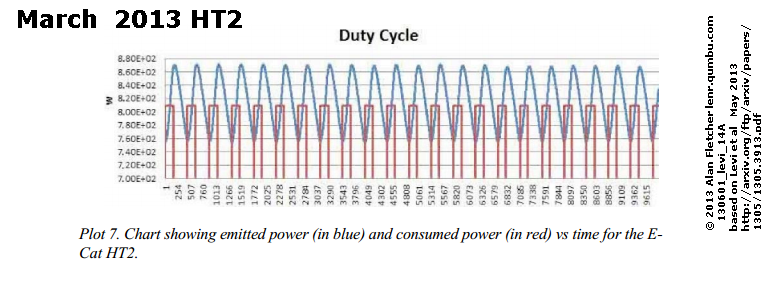
http://lenr.qumbu.com/web_hotcat_pics/130601_levi_14A.png

To understand how this can work together for gain in a bifurcated thermal
system, look at Figure 2 in the context of Figure 1 and imagine a bifurcated
subradiant system supplying colder hydrogen for chemisorption which further
heats the protons, which are then released by the action of the superradiant
photons and then cooled by phonon contact. In plasmon formation, the
bifurcation happens between phonons and photons, so the system is arguably
repeatable with phonons providing the relative cooling during thermal cycling

Of course, this kind of combined interlocking system for net gain has never
been demonstrated before, and mainstream fizzix denies the possibility since it
looks like a CoE violation.

However, the Rossi HT reactor may be the first instance. But if there is net
thermal gain, where does putative excess energy come from precisely?

Fusion? ZPE? Redundant ground states? Relativistic effects? Reversible proton
fusion? We suspect that it cannot come from chemistry alone, but everything
else is in play IF there really is excess heat in the Rossi reactor. I believe
that there is and that the source of gain is completely free of gamma radiation.

We can save that inquiry of "where" for another windy day.

Jones