Jones Beene <[email protected]> wrote:
> Lennart- simply because a large amount of energy ia applied to the fuel at
> the start to achieve “ignition.” Yes, it is true that some devices which
> are labeled as LENR also require plasmas which are relatively hot – at
> least they cannot really be called “cold” (as opposed to small scale).
> Mizuno’s glow discharge would be an example.
>

I agree.

Perhaps as we learn more, this will turn out to be a false distinction, or
an arbitrary dividing line. But based on current knowledge, I think there
are fundamental differences between something like the Tri Alpha Device and
LENR, and Beene has described the most important difference.

This is not LENR, although it may be valuable. Still . . . I would hate to
see any kind of plasma fusion succeed now if it meant the end of cold
fusion. No matter how safe or useful the plasma fusion reactor may be, I
expect it will still be expensive. I think cold fusion has many intrinsic
advantages, so it would be a shame to abandon it.

- - - - - - - - - - - - - - - - - -


To change the subject, here is something I have been thinking about for
some time.

"It would be a shame to abandon it." You can say the same about solar
energy. (Or wind, gas or coal I suppose.) If cold fusion starts to succeed,
people who have devoted years of effort to solar will surely feel regret.
They will say: "Let's hang on to this! There might still be a niche market
for solar!" No, sorry, probably not.

Those people will resemble sailing ship captains in the late 19th century,
who saw the end of their era approaching. They understood, of course, that
steamships were much better in many ways. But naturally they still had
regrets, and a feeling of nostalgia. Around 1935 when my father was in the
merchant marine on a freighter in the Atlantic out of New York, they came
upon a full rigged sailing ship, probably one of the last. The captain of
the steamship hailed the sailing ship, and then slowed down and down, and
steered a course slowly around it, twice. Then he finally pulled out and
headed to the destination. A romantic gesture. My father said the captain
seemed sad, and lost in memories of his youth. I suppose he was in his 50s
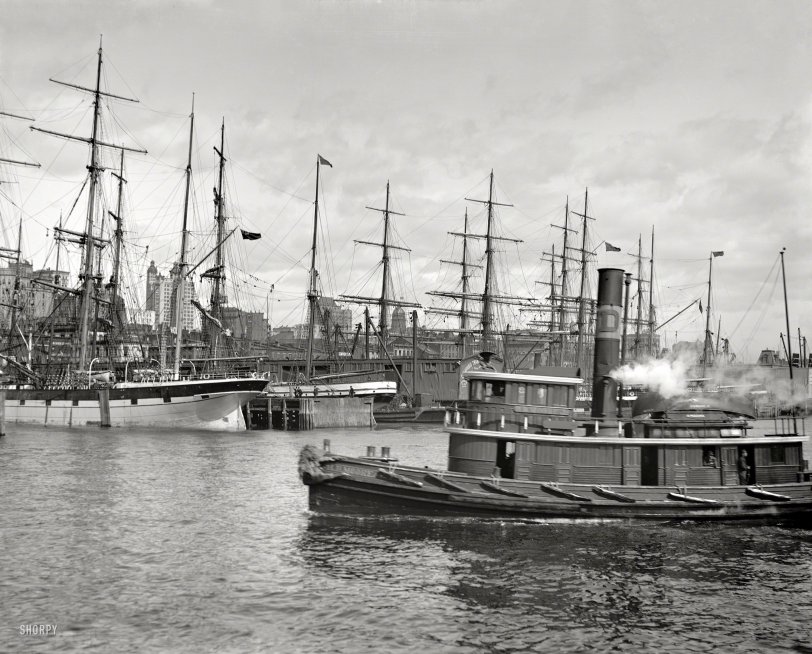
and remembered the late 19th century when the harbors at New York still had
many sailing ships. See:

http://www.shorpy.com/files/images/SHORPY_4a09256a.preview.jpg

(I expect these had steel hulls and auxiliary engines. They were still in
use because it was cheaper -- you did not need coal.)

People usually invest a measure of emotion and love in their jobs and in
the tools they use. You can't help it. I recall a bumper sticker on a big
truck on the highway, "A man and his truck -- it's a beautiful thing."

- Jed