Hi All,

On 11/19/2025 3:49 PM, Ye Li wrote:
Hi Michael, Emanuele,
On 11/12/2025 6:07 PM, Michael Nazzareno Trimarchi wrote:
Hi all

On Wed, Nov 12, 2025 at 10:57 AM Emanuele Ghidoli
<[email protected]> wrote:
On 12/11/2025 09:16, Ye Li wrote:
On 11/11/2025 9:47 PM, Fabio Estevam wrote:
Hi Emanuele,

On Thu, Nov 6, 2025 at 7:22 AM Emanuele Ghidoli
<[email protected]> wrote:
Hi Fabio, Ye,
At Toradex we have been struggling since quite some time (back to
2018) with
Does this problem only affect early i.MX6ULL silicon samples?
Hi Emanuele,
I have same question as Fabio. Are these samples are early? Do
you know
the time of receiving these sample? And could you show the part
number printed
on the chip.
It could take a little to answer to the first two question. I can say
that the
SoM I'm using to validate the patch was assembled in September 2021.
Let me
know if this information are needed giving that I can report the
marking on
the chip:
MCIMX6Y2CVM08AB CTDQ2107 1N70S CHINA QGDQCTA
the temperature readings and the thermal shutdown behavior on
i.MX6ULL. The
issue we observed is that the thermal shutdown seems to trigger
too early.
I have investigated the history around this topic and verified
some internal
notes in our bug tracker. With this revert applied, and on the
devices we have
(all trimmed with value 0), the reported temperature increases by
about 10 °C
compared to before the revert. The absolute accuracy of the
readout is
questionable: for example, on a device kept at around 20 °C, the
temperature
readout was ~19 °C before the revert, and ~31 °C after the revert.
Consider that for devices with fuse value of 6, there is a -10
degrees offset
after this revert (so, the other way around).
I understand that for Sven this revert improves stability during
large XZ
decompression in userspace for few devices, but for us it means
that the
thermal shutdown happens roughly 10 °C earlier, which is a serious
issue in
our case.
I would kindly ask NXP to double-check how these devices were
trimmed. My gut
feeling is that there might be an inconsistency, either the
trimming scheme is
not backward-compatible (e.g. old and new devices behave
differently, and the
code should cope, I don't know how, with this), or this patch must
be reverted
(because introduces a regression).
Peng/Ye Li,

How does NXP suggest we handle this? Were the early i.MX6ULL parts
incorrectly fused?
I need to discuss it internally, will feedback you later.
Can the fuse be read and dynamically adjusted?
The fuse is locked by MEM_TRIM_LOCK. Emanuele, can you help to read
it by
"fuse read 0 0 1".
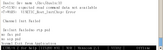
Colibri iMX6ULL # fuse read 0 0 1
Reading bank 0:

Word 0x00000000: 00320003
Colibri iMX6ULL # fuse read 1 0 1
Reading bank 1:

Word 0x00000000: 00000080
As is clear this problem was the same we had some months ago, so we
are on the same page
with Emanuele

Michael
Can you help to measure the VDD_ARM_CAP and VDD_SOC_CAP on your devices
with high temperature read issue, when REFTOP_VBGADJ is set to 3'b000
and 3'b110 respectively. Provide the measured voltage and target voltage.
And please read the Unique ID fuse of this device by "fuse read 0 1 2".


Best regards,
Ye Li
I have confirmed the REFTOP_TRIM fuse is always blank on iMX6ULL.
Because the LDO output voltage has meet the iMX6ULL spec, the bandgap
trim is not needed. For the REFTOP_VBGADJ register, NXP strongly
suggests to use the value from REFTOP_TRIM fuse or keep it default
3'b000. Because ATE test uses the default value, setting to other value
like 3'b110 will reduce the LDO voltage, but may introduce unstable
issue like what Sven reported on some parts.
For the temperature problem,
1. The temp sensor on iMX6ULL is not designed for temperature meter. It
is mainly used for protection at high or low temperature. User can use
it as reference, but there is no precision limited in datasheet.
2. All iMX6ULL parts have been temperature trimmed at 25°C on raw die
and tested at high temperature 105 °C on final productions. From our
factory data, there is no such big gap on 105 °C, the precision looks good.
3. Multiple factors like measurement method, calibration equation,
ambient temperature and chip status have impact to the result. We
suggest to use updated single point equation (already in uboot and
kernel) and below method for board temperature measurement:
a. Using flat thermocouple, better suited for adhering to the
surface of the chip.
b. Shut down board or enter SNVS mode and put the board in chamber
heating 30 mins.
c. Power on, SW print the Temp sensor value in early of uboot to
reduce self-heating impact.
d. Compare the thermocouple value and Temp sensor value.
More information could be found from
https://www.nxp.com.cn/docs/en/application-note/AN5215.pdf
Best regards,
Ye Li
Kind regards,
Emanuele
Best regards,
Ye Li
Please advise, thanks.