My propagation forecast derived from today's NOAA/SWPC
web pages is published five days a week (M-F) in the Daily DX.


Propagation crossing low and mid latitudes is likely to be normal
until likely CME arrival early to mid-day Saturday, then mostly
below normal until at least mid-day Sunday.

Propagation crossing the auroral ovals and polar regions is likely
to be mostly normal until likely CME arrival early to mid-day
Saturday, then below normal until at least mid-day Sunday.

Moderate to strong solar flares may cause moderate to severe
radio blackouts on the sunlit side of the Earth through Sunday.

Click here for today ’s latest planetary Kp Index, updated every three hours.

Click here for N0NBH’s current HF Band Conditions , updated regularly.

We are in the geomagnetically active autumn equinox season
through late October with about twice as many geomagnetically
active days compared to December, January, June and July caused
by the interplanetary magnetic field (IMF) more frequently
persisting in a southward orientation (-Bz).

The solar flux index (SFI) is likely to be at least 113 through Sunday.
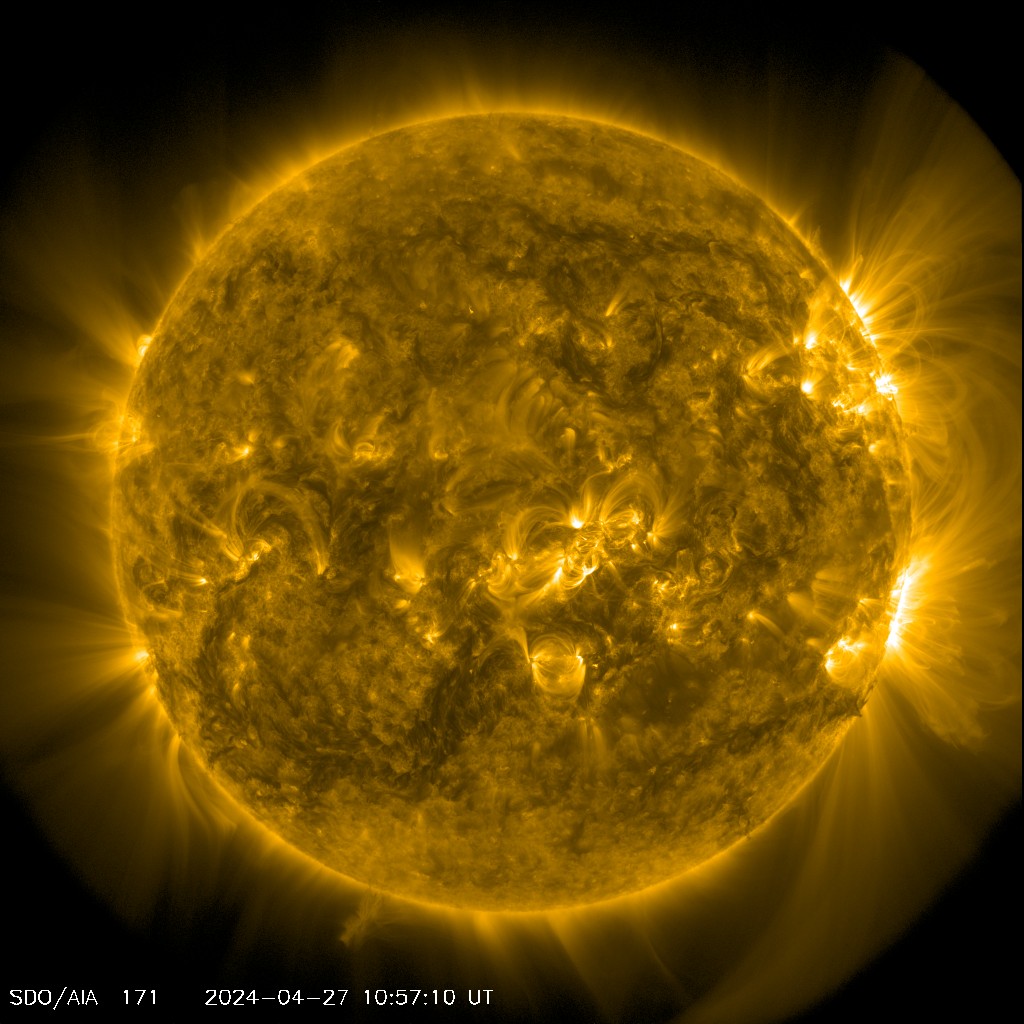
There are five active regions on the visible disk with 46 mostly small
and a few moderate sized sunspots.
https://sdo.gsfc.nasa.gov/assets/img/latest/latest_1024_0171.jpg

160 and 80 meter propagation from North America to VK/ZL and
the south Pacific is likely to be normal until likely CME arrival
early to mid-day Saturday, then mostly below normal until at
least mid-day Sunday.


40 meter short path propagation to south Asia until about 0100Z
is likely to be is likely to be mostly normal until likely CME
arrival early to mid-day Saturday, then below normal until at least
mid-day Sunday. 40 meter short path propagation from North
America to east Asia after about 0800Z is likely to be is likely
to be normal until likely CME arrival early to mid-day Saturday,
then below normal until at least mid-day Sunday

30 meter propagation through the auroral ovals and polar regions
is likely to be mostly normal until likely CME arrival early to
mid-day Saturday, then below normal until at least mid-day Sunday.
30 meter propagation is always significantly degraded within a
few hours of local noon because of E-region blanketing of long
distance F2 propagation.

20 meter daytime and evening propagation through the auroral
ovals and polar regions is likely to be mostly normal until likely
CME arrival early to mid-day Saturday, then mostly below normal
until at least mid-day Sunday. 20 meter transpolar propagation
within a few hours of sunrise and sunset is likely to be normal
until likely CME arrival early to mid-day Saturday, then mostly
below normal until at least mid-day Sunday.

17, 15, 12 and 10 meter long distance propagation is likely to be
mostly normal until likely CME arrival early to mid-day Saturday,
then mostly below normal until at least mid-day Sunday.

Geomagnetic disturbances caused by coronal hole high speed stream
effects are likely to remain mostly brief, minor and somewhat less
frequent through at least late 2021. The southward oriented (-Bz)
component of the interplanetary magnetic field (IMF) plays a
crucial but unpredictable role in triggering all geomagnetic storms.
Brief minor to moderate geomagnetic storms may be gradually
triggered when the IMF persists in a southward orientation (-Bz)
with enhanced IMF field strength for several hours coincident with
the effects of an Earth directed coronal hole high speed stream .
More frequent, longer duration, minor to severe geomagnetic storms
may be triggered suddenly and unpredictably when the IMF persists
in a southward orientation (-Bz) with enhanced IMF field strength
for several hours or more coincident with the effects of an Earth
directed fast CME.

The solar wind is likely to be near background levels until likely
CME arrival early to mid-day Saturday, then likely to increase
to strong wind until at least mid-day Sunday

The geomagnetic field is likely to be normal until probable strong
CME arrival early to mid-day Saturday causing minor to strong
geomagnetic storms until at least early Sunday. Earth directed
coronal hole high speed stream effects are not likely through
Sunday.

Mid-latitude northern hemisphere sunset is 56 minutes earlier and
daylength is 90 minutes shorter than it was on September 22nd.
Daytime ionization and residual nighttime ionization in the
far northern polar region is rapidly declining due to steadily
increasing polar night effects.

Click here for today ’s Penticton 10.7 cm solar flux index updated at 1700Z,
2000Z and 2300Z daily.
Click here for today ’s three-day GFZ Planetary K Index forecast updated every
three hours.
Click here for today 's SIDC Daily Bulletin on Solar and Geomagnetic Activity
updated at 1230Z daily.
Click here for today 's SWPC Solar Activity Forecast Discussion updated at
0030Z and 1230Z daily.

Click here for today 's Australian Space Forecast Centre Summary and Forecast
updated at 2330Z daily.

Perhaps the most useful HF propagation pages for DXers can be found at:
http://dx.qsl.net/propagation and http://www.solarham.net

_________________
Searchable Archives: http://www.contesting.com/_topband - Topband Reflector