According to antenna engineering textbooks (Kraus, Balanis. Johnson &
Jasik etc), the free space, far-field radiation pattern is not a function
of the distance from the radiator, as it is in the near field. The
near-field/far-field boundary conventionally is defined as equal to
2L^2/lambda, where L = the greatest physical dimension of the radiator.
So for a 1/4-wave monopole on 160 meters, that boundary would be located
about 20.25 meters from the radiator.
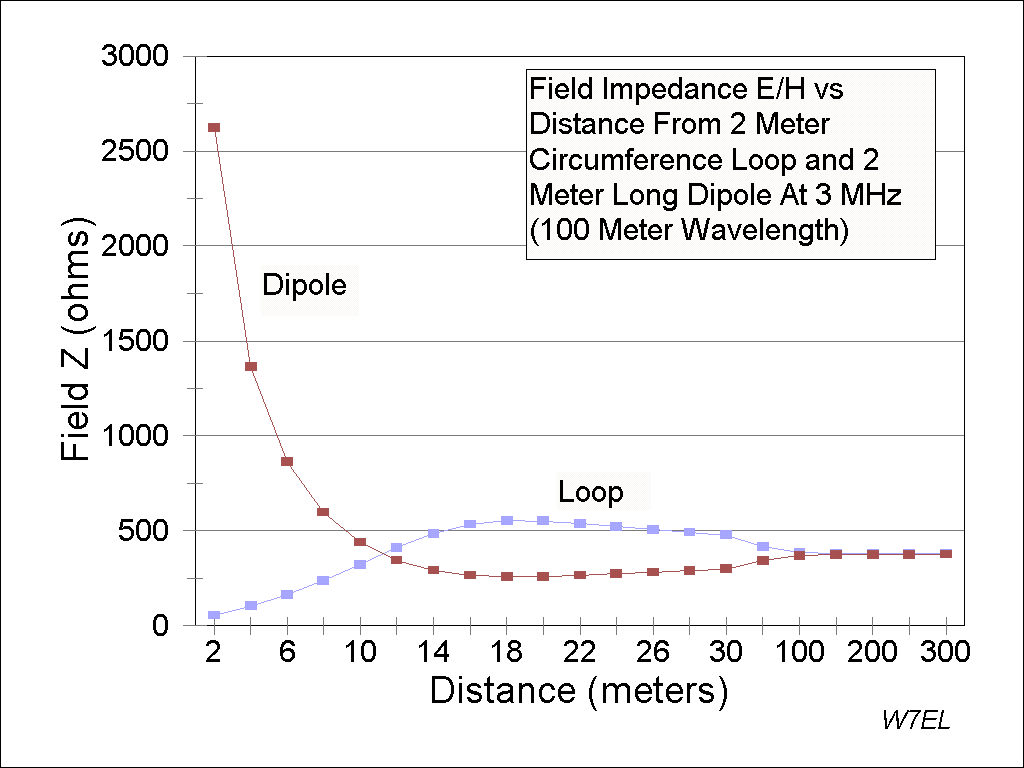
The boundary is around 1 wavelength minimum even for a very small antenna,
like a "magnetic" loop. As a matter of fact a small magnetic loop is
electric field response dominant at a distance of about 1/8th wave from the
antenna outward to about 1 wavelength.
http://www.w8ji.com/images/emfield.gif
Page 341 of Jordon and Balmain ( as with other EM radiator texts) define
farfield boundary as a distance "large with respect to a wavelength and also
large with respect to the largest dimension of the source". A wavelength is
safe for a small antenna, but not a large system. My 4 square on 160 still
behaves slightly like nearfield at a distance of two wavelengths, but my 200
foot omni vertical is settled down about 1 wavelength away.
73 Tom


_______________________________________________
Remember the PreStew coming on October 20th.  http://www.kkn.net/stew for more
info.