A common use for correctly defined NEC models shows the electrical
characteristics of the radiator system itself.  But NEC also will show the
field intensities that system will produce at a given distance for a given
applied power, frequency, and earth characteristics -- and do so quite
accurately.
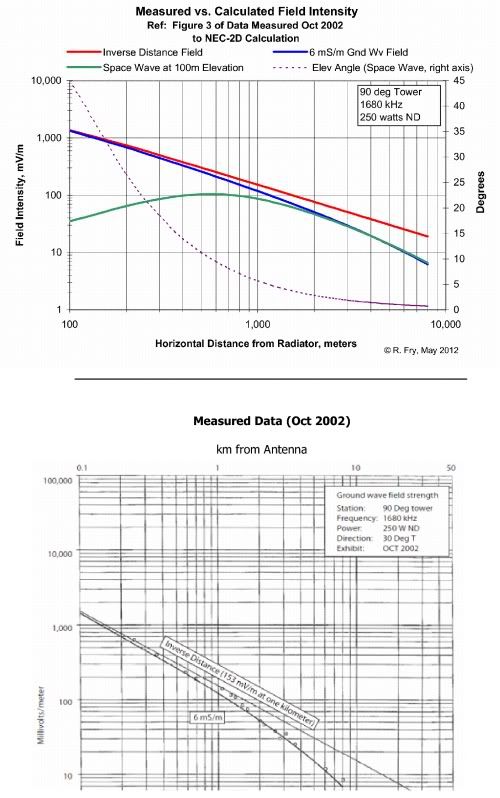
The link below leads to a comparison of the groundwave field measured from a
real-world AM broadcast system by a broadcast consulting engineering firm
vs. the NEC-2D output using those same system parameters.
Included in the NEC analysis is the value of the space wave field at an
elevation of 100 meters above the (level) ground plane, for this
installation -- which should help better understand the points of the
opening post in this thread.

Note that the value of the space wave at 100m elevation and 100m downrange
is lower than the groundwave 100m downrange, and increases as the range
increases.  This is as expected, because the relative field (E/Emax) of the
elevation pattern "launched" by this 1/4-wave monopole reduces as the
elevation angle increases.

Hope this graphic and explanation are useful.

http://i62.photobucket.com/albums/h85/rfry-100/Measured_vs_NEC2D_Fields2.jpg

_______________________________________________
UR RST IS ... ... ..9 QSB QSB - hw? BK