This is an automated email from the ASF dual-hosted git repository.

menghaoran pushed a commit to branch master
in repository https://gitbox.apache.org/repos/asf/shardingsphere.git
The following commit(s) were added to refs/heads/master by this push:
new 6a2d5484bca Update _index.en.md (#19672)
6a2d5484bca is described below
commit 6a2d5484bca845fbf86e3cdcf5b2a5f4a297c222
Author: Mike0601 <[email protected]>
AuthorDate: Fri Jul 29 11:49:11 2022 +0800
Update _index.en.md (#19672)
---
docs/document/content/faq/_index.en.md | 220 ++++++++++++++-------------------
1 file changed, 91 insertions(+), 129 deletions(-)
diff --git a/docs/document/content/faq/_index.en.md
b/docs/document/content/faq/_index.en.md
index 19c52234563..731e06006bd 100644
--- a/docs/document/content/faq/_index.en.md
+++ b/docs/document/content/faq/_index.en.md
@@ -5,73 +5,93 @@ weight = 8
chapter = true
+++
-## [JDBC] Why there may be an error when configure both
shardingsphere-jdbc-spring-boot-starter and a spring-boot-starter of certain
datasource pool(such as druid)?
+## JDBC
+
+### [JDBC] Why there may be an error when configure both
shardingsphere-jdbc-spring-boot-starter and a spring-boot-starter of certain
datasource pool (such as druid)?
Answer:
-1. Because the spring-boot-starter of certain datasource pool (such as druid)
will be configured before shardingsphere-jdbc-spring-boot-starter and create a
default datasource, then conflict occur when ShardingSphere-JDBC create
datasources.
-2. A simple way to solve this issue is removing the spring-boot-starter of
certain datasource pool, shardingsphere-jdbc create datasources with suitable
pools.
+1. Because the spring-boot-starter of certain datasource pool (such as druid)
will be configured before shardingsphere-jdbc-spring-boot-starter and create a
default datasource, causing conflict to occur when ShardingSphere-JDBC create
datasources.
+2. A simple way to solve this issue is removing the spring-boot-starter of
certain datasource pool, allowing shardingsphere-jdbc to create datasources
with suitable pools.
-## [JDBC] Why is xsd unable to be found when Spring Namespace is used?
+### [JDBC] Why is xsd unable to be found when Spring Namespace is used?
Answer:
-The use norm of Spring Namespace does not require to deploy xsd files to the
official website. But considering some users' needs, we will deploy them to
ShardingSphere's official website.
-
+The norm of Spring Namespace does not require deploying xsd files to the
official website. But considering some users' needs, we will deploy them to
ShardingSphere's official website.
Actually, META-INF\spring.schemas in the jar package of
shardingsphere-jdbc-spring-namespace has been configured with the position of
xsd files:
META-INF\namespace\sharding.xsd and META-INF\namespace\replica-query.xsd, so
you only need to make sure that the file is in the jar package.
-## [JDBC] Found a JtaTransactionManager in spring boot project when
integrating with transaction of XA
+### [JDBC] Found a JtaTransactionManager in spring boot project when
integrating with XAtransaction.
Answer:
1. `shardingsphere-transaction-xa-core` include atomikos, it will trigger
auto-configuration mechanism in spring-boot, add
`@SpringBootApplication(exclude = JtaAutoConfiguration.class)` will solve it.
-## [Proxy] In Windows environment, could not find or load main class
org.apache.shardingsphere.proxy.Bootstrap, how to solve it?
+### [JDBC] The tableName and columnName configured in yaml or properties
leading incorrect result when loading Oracle metadata?
+
+Answer:
+
+Note that, in Oracle's metadata, the tableName and columnName is default
UPPERCASE, while double-quoted such as `CREATE TABLE "TableName"("Id" number)`
the tableName and columnName is the actual content double-quoted, refer to the
following SQL for the reality in metadata:
+```
+SELECT OWNER, TABLE_NAME, COLUMN_NAME, DATA_TYPE FROM ALL_TAB_COLUMNS WHERE
TABLE_NAME IN ('TableName')
+```
+ShardingSphere uses the `OracleTableMetaDataLoader` to load the metadata, keep
the tableName and columnName in the yaml or properties consistent with the
metadata.
+ShardingSphere assembled the SQL using the following code:
+```
+ private String getTableMetaDataSQL(final Collection<String> tables, final
DatabaseMetaData metaData) throws SQLException {
+ StringBuilder stringBuilder = new StringBuilder(28);
+ if (versionContainsIdentityColumn(metaData)) {
+ stringBuilder.append(", IDENTITY_COLUMN");
+ }
+ if (versionContainsCollation(metaData)) {
+ stringBuilder.append(", COLLATION");
+ }
+ String collation = stringBuilder.toString();
+ return tables.isEmpty() ? String.format(TABLE_META_DATA_SQL, collation)
+ : String.format(TABLE_META_DATA_SQL_IN_TABLES, collation,
tables.stream().map(each -> String.format("'%s'",
each)).collect(Collectors.joining(",")));
+ }
+```
+## Proxy
+
+### [Proxy] In Windows environment, could not find or load main class
org.apache.shardingsphere.proxy.Bootstrap, how to solve it?
Answer:
Some decompression tools may truncate the file name when decompressing the
ShardingSphere-Proxy binary package, resulting in some classes not being found.
-
The solutions:
-
Open cmd.exe and execute the following command:
```
tar zxvf
apache-shardingsphere-${RELEASE.VERSION}-shardingsphere-proxy-bin.tar.gz
```
-## [Proxy] How to add a new logic database dynamically when use
ShardingSphere-Proxy?
+### [Proxy] How to add a new logic database dynamically when use
ShardingSphere-Proxy?
Answer:
When using ShardingSphere-Proxy, users can dynamically create or drop logic
database through `DistSQL`, the syntax is as follows:
-
```sql
CREATE DATABASE [IF NOT EXISTS] databaseName;
-
DROP DATABASE [IF EXISTS] databaseName;
```
-
Example:
-
```sql
CREATE DATABASE sharding_db;
-
DROP DATABASE sharding_db;
```
-## [Proxy] How to use a suitable database tools connecting
ShardingSphere-Proxy?
+### [Proxy] How to use suitable database tools connecting ShardingSphere-Proxy?
Answer:
-1. ShardingSphere-Proxy could be considered as a mysql sever, so we recommend
using mysql command line tool to connect to and operate it.
-2. If users would like use a third-party database tool, there may be some
errors cause of the certain implementation/options.
+1. ShardingSphere-Proxy could be considered as a MySQL server, so we recommend
using MySQL command line tool to connect to and operate it.
+2. If users would like to use a third-party database tool, there may be some
errors cause of the certain implementation/options.
3. The currently tested third-party database tools are as follows:
- - Navicat:11.1.13, 15.0.20.
- - DataGrip:2020.1, 2021.1 (turn on "introspect using jdbc metadata" in idea
or datagrip).
- - WorkBench:8.0.25.
+ - Navicat: 11.1.13, 15.0.20.
+ - DataGrip: 2020.1, 2021.1 (turn on "introspect using jdbc metadata" in
idea or datagrip).
+ - WorkBench: 8.0.25.
-## [Proxy] When using a client such as Navicat to connect to
ShardingSphere-Proxy, if ShardingSphere-Proxy does not create a database or
does not add a resource, the client connection will fail?
+### [Proxy] When using a client such as Navicat to connect to
ShardingSphere-Proxy, if ShardingSphere-Proxy does not create a database or
does not add a resource, the client connection will fail?
Answer:
@@ -79,48 +99,49 @@ Answer:
2. It is recommended to create `database` and `resource` first, and then use
third-party database tools to connect.
3. Please refer to [Related
introduction](/en/user-manual/shardingsphere-proxy/distsql/syntax/rdl/resource-definition/)
the details about `resource`.
-## [Sharding] How to solve `Cloud not resolve placeholder … in string value …`
error?
+## Sharding
+
+
+### [Sharding] How to solve `Cloud not resolve placeholder … in string value
…` error?
Answer:
`${...}` or `$->{...}` can be used in inline expression identifiers, but the
former one clashes with place holders in Spring property files, so `$->{...}`
is recommended to be used in Spring as inline expression identifiers.
-## [Sharding] Why does float number appear in the return result of inline
expression?
+### [Sharding] Why does float number appear in the return result of inline
expression?
Answer:
The division result of Java integers is also integer, but in Groovy syntax of
inline expression, the division result of integers is float number.
To obtain integer division result, A/B needs to be modified as A.intdiv(B).
-## [Sharding] If sharding database is partial, should tables without sharding
database & table configured in sharding rules?
+### [Sharding] If sharding database is partial, should tables without sharding
database & table configured in sharding rules?
Answer:
No, ShardingSphere will recognize it automatically.
-## [Sharding] When generic Long type `SingleKeyTableShardingAlgorithm` is
used, why does`ClassCastException: Integer can not cast to Long` exception
appear?
+### [Sharding] When generic Long type `SingleKeyTableShardingAlgorithm` is
used, why does the `ClassCastException: Integer can not cast to Long` exception
appear?
Answer:
-You must make sure the field in database table consistent with that in
sharding algorithms. For example, the field type in database is int(11) and the
sharding type corresponds to genetic type is Integer, if you want to configure
Long type, please make sure the field type in the database is bigint.
+You must make sure the field in the database table is consistent with that in
the sharding algorithms. For example, the field type in database is int(11) and
the sharding type corresponds to genetic type is Integer. If you want to
configure Long type, please make sure the field type in the database is bigint.
-## [Sharding\PROXY] When implementing the `StandardShardingAlgorithm` custom
algorithm, the specific type of `Comparable` is specified as Long, and the
field type in the database table is bigint, a `ClassCastException: Integer can
not cast to Long` exception occurs.
+### [Sharding\PROXY] When implementing the `StandardShardingAlgorithm` custom
algorithm, the specific type of `Comparable` is specified as Long, and the
field type in the database table is bigint, a `ClassCastException: Integer can
not cast to Long` exception occurs.
Answer:
When implementing the `doSharding` method, it is not recommended to specify
the specific type of `Comparable` in the method declaration, but to convert the
type in the implementation of the `doSharding` method. You can refer to the
`ModShardingAlgorithm#doSharding` method.
-## [Sharding] Why are the default distributed auto-augment key strategy
provided by ShardingSphere not continuous and most of them end with even
numbers?
+### [Sharding] Why is the default distributed auto-augment key strategy
provided by ShardingSphere not continuous and most of them end with even
numbers?
Answer:
ShardingSphere uses snowflake algorithms as the default distributed
auto-augment key strategy to make sure unrepeated and decentralized
auto-augment sequence is generated under the distributed situations. Therefore,
auto-augment keys can be incremental but not continuous.
-
But the last four numbers of snowflake algorithm are incremental value within
one millisecond. Thus, if concurrency degree in one millisecond is not high,
the last four numbers are likely to be zero, which explains why the rate of
even end number is higher.
-
In 3.1.0 version, the problem of ending with even numbers has been totally
solved, please refer to: https://github.com/apache/shardingsphere/issues/1617
-## [Sharding] How to allow range query with using inline sharding
strategy(BETWEEN AND, \>, \<, \>=, \<=)?
+### [Sharding] How to allow range query with using inline sharding strategy
(BETWEEN AND, \>, \<, \>=, \<=)?
Answer:
@@ -129,39 +150,37 @@ Answer:
- Version 4.x: `allow.range.query.with.inline.sharding` to `true` (Default
value is `false`).
- Version 5.x: `allow-range-query-with-inline-sharding` to `true` in
InlineShardingStrategy (Default value is `false`).
-## [Sharding] Why does my custom distributed primary key do not work after
implementing `KeyGenerateAlgorithm` interface and configuring `type` property?
+### [Sharding] Why does my custom distributed primary key do not work after
implementing `KeyGenerateAlgorithm` interface and configuring `type` property?
Answer:
[Service Provider Interface
(SPI)](https://docs.oracle.com/javase/tutorial/sound/SPI-intro.html) is a kind
of API for the third party to implement or expand. Except implementing
interface, you also need to create a corresponding file in `META-INF/services`
to make the JVM load these SPI implementations.
-
More detail for SPI usage, please search by yourself.
-
Other ShardingSphere [functionality implementation](/en/concepts/pluggable/)
will take effect in the same way.
-## [Sharding] In addition to internal distributed primary key, does
ShardingSphere support other native auto-increment keys?
+### [Sharding] In addition to internal distributed primary key, does
ShardingSphere support other native auto-increment keys?
Answer:
Yes. But there is restriction to the use of native auto-increment keys, which
means they cannot be used as sharding keys at the same time.
-
Since ShardingSphere does not have the database table structure and native
auto-increment key is not included in original SQL, it cannot parse that field
to the sharding field. If the auto-increment key is not sharding key, it can be
returned normally and is needless to be cared. But if the auto-increment key is
also used as sharding key, ShardingSphere cannot parse its sharding value,
which will make SQL routed to multiple tables and influence the rightness of
the application.
-
The premise for returning native auto-increment key is that INSERT SQL is
eventually routed to one table. Therefore, auto-increment key will return zero
when INSERT SQL returns multiple tables.
-## [Encryption] How to solve that `data encryption` can't work with JPA?
+## Encryption
+
+### [Encryption] How to solve that `data encryption` can't work with JPA?
Answer:
Because DDL for data encryption has not yet finished, JPA Entity cannot meet
the DDL and DML at the same time, when JPA that automatically generates DDL is
used with data encryption.
-
The solutions are as follows:
-
1. Create JPA Entity with logicColumn which needs to encrypt.
2. Disable JPA auto-ddl, For example setting auto-ddl=none.
3. Create table manually. Table structure should use
`cipherColumn`,`plainColumn` and `assistedQueryColumn` to replace the
logicColumn.
-## [DistSQL] How to set custom JDBC connection properties or connection pool
properties when adding a data source using DistSQL?
+## DistSQL
+
+### [DistSQL] How to set custom JDBC connection properties or connection pool
properties when adding a data source using DistSQL?
Answer:
@@ -169,79 +188,67 @@ Answer:
2. ShardingSphere presets necessary connection pool properties, such as
`maxPoolSize`, `idleTimeout`, etc. If you need to add or overwrite the
properties, please specify it with `PROPERTIES` in the `dataSource`.
3. Please refer to [Related
introduction](/en/user-manual/shardingsphere-proxy/distsql/syntax/rdl/resource-definition/)
for above rules.
-## [DistSQL] How to solve ` Resource [xxx] is still used by
[SingleTableRule].` exception when dropping a data source using DistSQL?
+### [DistSQL] How to solve ` Resource [xxx] is still used by
[SingleTableRule].` exception when dropping a data source using DistSQL?
Answer:
1. Resources referenced by rules cannot be deleted
-
2. If the resource is only referenced by single table rule, and the user
confirms that the restriction can be ignored, the optional parameter ignore
single tables can be added to perform forced deletion
-
```
DROP RESOURCE dataSourceName [, dataSourceName] ... [ignore single tables]
```
-## [DistSQL] How to solve ` Failed to get driver instance for jdbcURL=xxx.`
exception when adding a data source using DistSQL?
+### [DistSQL] How to solve ` Failed to get driver instance for jdbcURL=xxx.`
exception when adding a data source using DistSQL?
Answer:
ShardingSphere Proxy do not have jdbc driver during deployment. Some example
of this include `mysql-connector`. To use it otherwise following syntax can be
used:
-
```
ADD RESOURCE dataSourceName [..., dataSourceName]
```
-## [Other] How to debug when SQL can not be executed rightly in ShardingSphere?
+## Other
+
+### [Other] How to debug when SQL can not be executed rightly in
ShardingSphere?
Answer:
`sql.show` configuration is provided in ShardingSphere-Proxy and post-1.5.0
version of ShardingSphere-JDBC, enabling the context parsing, rewritten SQL and
the routed data source printed to info log. `sql.show` configuration is off in
default, and users can turn it on in configurations.
-
A Tip: Property `sql.show` has changed to `sql-show` in version 5.x.
-## [Other] Why do some compiling errors appear? Why did not the IDEA index the
generated codes?
+### [Other] Why do some compiling errors appear? Why did not the IDEA index
the generated codes?
Answer:
ShardingSphere uses lombok to enable minimal coding. For more details about
using and installment, please refer to the official website of
[lombok](https://projectlombok.org/download.html).
-
The codes under the package `org.apache.shardingsphere.sql.parser.autogen` are
generated by ANTLR. You may execute the following command to generate codes:
-
```bash
./mvnw -Dcheckstyle.skip=true -Drat.skip=true -Dmaven.javadoc.skip=true
-Djacoco.skip=true -DskipITs -DskipTests install -T1C
```
-
The generated codes such as
`org.apache.shardingsphere.sql.parser.autogen.PostgreSQLStatementParser` may be
too large to be indexed by the IDEA.
You may configure the IDEA's property `idea.max.intellisense.filesize=10000`.
-## [Other] In SQLSever and PostgreSQL, why does the aggregation column without
alias throw exception?
+### [Other] In SQLSever and PostgreSQL, why does the aggregation column
without alias throw exception?
Answer:
SQLServer and PostgreSQL will rename aggregation columns acquired without
alias, such as the following SQL:
-
```sql
SELECT SUM(num), SUM(num2) FROM tablexxx;
```
-
Columns acquired by SQLServer are empty string and (2); columns acquired by
PostgreSQL are empty sum and sum(2). It will cause error because ShardingSphere
is unable to find the corresponding column.
-
The right SQL should be written as:
-
```sql
SELECT SUM(num) AS sum_num, SUM(num2) AS sum_num2 FROM tablexxx;
```
-## [Other] Why does Oracle database throw “Order by value must implements
Comparable” exception when using Timestamp Order By?
+### [Other] Why does Oracle database throw “Order by value must implements
Comparable” exception when using Timestamp Order By?
Answer:
There are two solutions for the above problem: 1. Configure JVM parameter
“-oracle.jdbc.J2EE13Compliant=true” 2. Set
System.getProperties().setProperty(“oracle.jdbc.J2EE13Compliant”, “true”) codes
in the initialization of the project.
-
Reasons:
-
`org.apache.shardingsphere.sharding.merge.dql.orderby.OrderByValue#getOrderValues()`:
-
```java
private List<Comparable<?>> getOrderValues() throws SQLException {
List<Comparable<?>> result = new ArrayList<>(orderByItems.size());
@@ -253,16 +260,13 @@ Reasons:
return result;
}
```
-
After using resultSet.getObject(int index), for TimeStamp oracle, the system
will decide whether to return java.sql.TimeStamp or define oralce.sql.TIMESTAMP
according to the property of oracle.jdbc.J2EE13Compliant. See
oracle.jdbc.driver.TimestampAccessor#getObject(int var1) method in ojdbc codes
for more detail:
-
```java
Object getObject(int var1) throws SQLException {
Object var2 = null;
if(this.rowSpaceIndicator == null) {
DatabaseError.throwSqlException(21);
}
-
if(this.rowSpaceIndicator[this.indicatorIndex + var1] != -1) {
if(this.externalType != 0) {
switch(this.externalType) {
@@ -273,49 +277,41 @@ After using resultSet.getObject(int index), for TimeStamp
oracle, the system wil
return null;
}
}
-
if(this.statement.connection.j2ee13Compliant) {
var2 = this.getTimestamp(var1);
} else {
var2 = this.getTIMESTAMP(var1);
}
}
-
return var2;
}
```
-## [Other] In Windows environment,when cloning ShardingSphere source code
through Git, why prompt filename too long and how to solve it?
+### [Other] In Windows environment,when cloning ShardingSphere source code
through Git, why prompt filename too long and how to solve it?
Answer:
-To ensure the readability of source code,the ShardingSphere Coding
Specification requires that the naming of classes,methods and variables be
literal and avoid abbreviations,which may result in Some source files have
long names.
-
+To ensure the readability of source code,the ShardingSphere Coding
Specification requires that the naming of classes,methods and variables be
literal and avoid abbreviations,which may result in some source files have
long names.
Since the Git version of Windows is compiled using msys,it uses the old
version of Windows Api,limiting the file name to no more than 260 characters.
-
The solutions are as follows:
-
Open cmd.exe (you need to add git to environment variables) and execute the
following command to allow git supporting log paths:
```
git config --global core.longpaths true
```
-
If we use windows 10, also need enable win32 log paths in registry editor or
group strategy(need reboot):
> Create the registry key `HKLM\SYSTEM\CurrentControlSet\Control\FileSystem
> LongPathsEnabled` (Type: REG_DWORD) in registry editor, and be set to 1.
> Or click "setting" button in system menu, print "Group Policy" to open a new
> window "Edit Group Policy", and then click 'Computer Configuration' >
> 'Administrative Templates' > 'System' > 'Filesystem', and then turn on
> 'Enable Win32 long paths' option.
-
Reference material:
-
https://docs.microsoft.com/zh-cn/windows/desktop/FileIO/naming-a-file
https://ourcodeworld.com/articles/read/109/how-to-solve-filename-too-long-error-in-git-powershell-and-github-application-for-windows
-## [Other] How to solve `Type is required` error?
+### [Other] How to solve `Type is required` error?
Answer:
In Apache ShardingSphere, many functionality implementation are uploaded
through [SPI](/en/concepts/pluggable/), such as Distributed Primary Key. These
functions load SPI implementation by configuring the `type`, so the `type` must
be specified in the configuration file.
-## [Other] How to speed up the metadata loading when service starts up?
+### [Other] How to speed up the metadata loading when service starts up?
Answer:
@@ -324,40 +320,33 @@ Answer:
- `max.connections.size.per.query`(Default value is 1) higher referring to
connection pool you adopt(Version >= 3.0.0.M3 & Version < 5.0.0).
- `max-connections-size-per-query`(Default value is 1) higher referring to
connection pool you adopt(Version >= 5.0.0).
-## [Other] The ANTLR plugin generates codes in the same level directory as
src, which is easy to commit by mistake. How to avoid it?
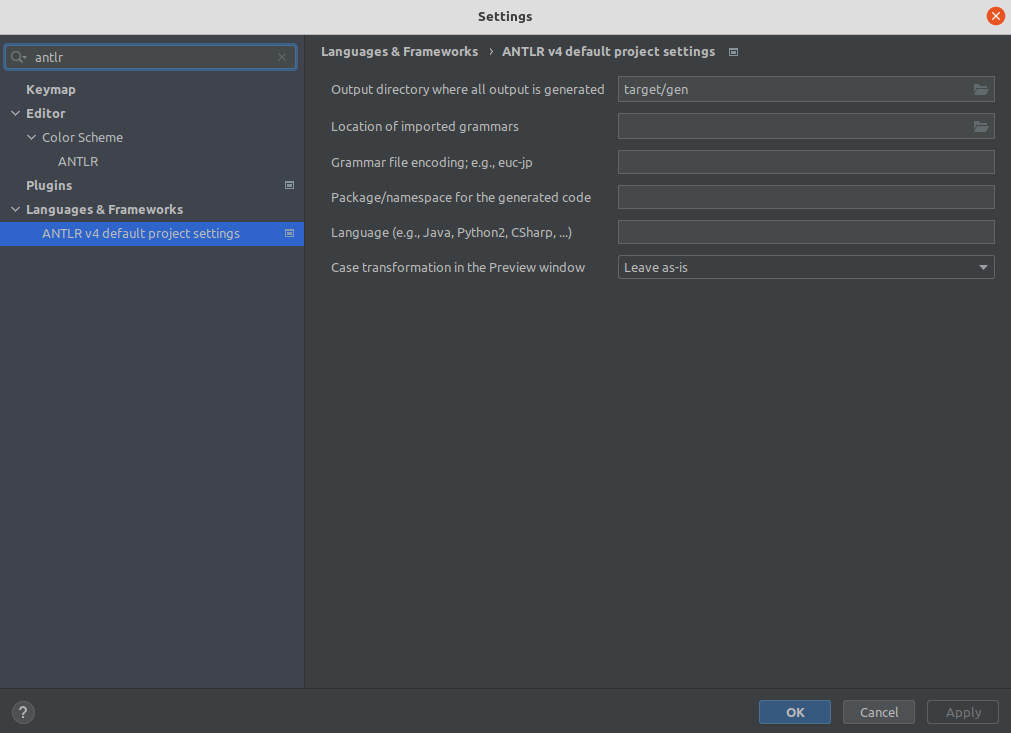
+### [Other] The ANTLR plugin generates codes in the same level directory as
src, which is easy to commit by mistake. How to avoid it?
Answer:
Goto [Settings -> Languages & Frameworks -> ANTLR v4 default project
settings](jetbrains://idea/settings?name=Languages+%26+Frameworks--ANTLR+v4+default+project+settings)
and configure the output directory of the generated code as `target/gen` as
shown:
-
-## [Other] Why is the database sharding result not correct when using
`Proxool`?
+### [Other] Why is the database sharding result not correct when using
`Proxool`?
Answer:
When using `Proxool` to configure multiple data sources, each one of them
should be configured with alias. It is because `Proxool` would check whether
existing alias is included in the connection pool or not when acquiring
connections, so without alias, each connection will be acquired from the same
data source.
-
The followings are core codes from ProxoolDataSource getConnection method in
`Proxool`:
-
```java
if(!ConnectionPoolManager.getInstance().isPoolExists(this.alias)) {
this.registerPool();
}
```
-
For more alias usages, please refer to
[Proxool](http://proxool.sourceforge.net/configure.html) official website.
-## [Other] The property settings in the configuration file do not take effect
when integrating ShardingSphere with Spring Boot 2.x ?
+### [Other] The property settings in the configuration file do not take effect
when integrating ShardingSphere with Spring Boot 2.x ?
Answer:
Note that the property name in the Spring Boot 2.x environment is constrained
to allow only lowercase letters, numbers and short transverse lines,
`[a-z][0-9]` and `-`.
-
Reasons:
-
In the Spring Boot 2.x environment, ShardingSphere binds the properties
through Binder, and the unsatisfied property name (such as camel case or
underscore.) can throw a `NullPointerException` exception when the property
setting does not work to check the property value. Refer to the following error
examples:
-
Underscore case: database_inline
```
spring.shardingsphere.rules.sharding.sharding-algorithms.database_inline.type=INLINE
@@ -365,14 +354,14 @@
spring.shardingsphere.rules.sharding.sharding-algorithms.database_inline.props.a
```
```
Caused by: org.springframework.beans.factory.BeanCreationException: Error
creating bean with name 'database_inline': Initialization of bean failed;
nested exception is java.lang.NullPointerException: Inline sharding algorithm
expression cannot be null.
- ...
+ ...
Caused by: java.lang.NullPointerException: Inline sharding algorithm
expression cannot be null.
- at
com.google.common.base.Preconditions.checkNotNull(Preconditions.java:897)
- at
org.apache.shardingsphere.sharding.algorithm.sharding.inline.InlineShardingAlgorithm.getAlgorithmExpression(InlineShardingAlgorithm.java:58)
- at
org.apache.shardingsphere.sharding.algorithm.sharding.inline.InlineShardingAlgorithm.init(InlineShardingAlgorithm.java:52)
- at
org.apache.shardingsphere.spring.boot.registry.AbstractAlgorithmProvidedBeanRegistry.postProcessAfterInitialization(AbstractAlgorithmProvidedBeanRegistry.java:98)
- at
org.springframework.beans.factory.support.AbstractAutowireCapableBeanFactory.applyBeanPostProcessorsAfterInitialization(AbstractAutowireCapableBeanFactory.java:431)
- ...
+ at
com.google.common.base.Preconditions.checkNotNull(Preconditions.java:897)
+ at
org.apache.shardingsphere.sharding.algorithm.sharding.inline.InlineShardingAlgorithm.getAlgorithmExpression(InlineShardingAlgorithm.java:58)
+ at
org.apache.shardingsphere.sharding.algorithm.sharding.inline.InlineShardingAlgorithm.init(InlineShardingAlgorithm.java:52)
+ at
org.apache.shardingsphere.spring.boot.registry.AbstractAlgorithmProvidedBeanRegistry.postProcessAfterInitialization(AbstractAlgorithmProvidedBeanRegistry.java:98)
+ at
org.springframework.beans.factory.support.AbstractAutowireCapableBeanFactory.applyBeanPostProcessorsAfterInitialization(AbstractAutowireCapableBeanFactory.java:431)
+ ...
```
Camel case:databaseInline
```
@@ -381,40 +370,13 @@
spring.shardingsphere.rules.sharding.sharding-algorithms.databaseInline.props.al
```
```
Caused by: org.springframework.beans.factory.BeanCreationException: Error
creating bean with name 'databaseInline': Initialization of bean failed; nested
exception is java.lang.NullPointerException: Inline sharding algorithm
expression cannot be null.
- ...
+ ...
Caused by: java.lang.NullPointerException: Inline sharding algorithm
expression cannot be null.
- at
com.google.common.base.Preconditions.checkNotNull(Preconditions.java:897)
- at
org.apache.shardingsphere.sharding.algorithm.sharding.inline.InlineShardingAlgorithm.getAlgorithmExpression(InlineShardingAlgorithm.java:58)
- at
org.apache.shardingsphere.sharding.algorithm.sharding.inline.InlineShardingAlgorithm.init(InlineShardingAlgorithm.java:52)
- at
org.apache.shardingsphere.spring.boot.registry.AbstractAlgorithmProvidedBeanRegistry.postProcessAfterInitialization(AbstractAlgorithmProvidedBeanRegistry.java:98)
- at
org.springframework.beans.factory.support.AbstractAutowireCapableBeanFactory.applyBeanPostProcessorsAfterInitialization(AbstractAutowireCapableBeanFactory.java:431)
- ...
+ at
com.google.common.base.Preconditions.checkNotNull(Preconditions.java:897)
+ at
org.apache.shardingsphere.sharding.algorithm.sharding.inline.InlineShardingAlgorithm.getAlgorithmExpression(InlineShardingAlgorithm.java:58)
+ at
org.apache.shardingsphere.sharding.algorithm.sharding.inline.InlineShardingAlgorithm.init(InlineShardingAlgorithm.java:52)
+ at
org.apache.shardingsphere.spring.boot.registry.AbstractAlgorithmProvidedBeanRegistry.postProcessAfterInitialization(AbstractAlgorithmProvidedBeanRegistry.java:98)
+ at
org.springframework.beans.factory.support.AbstractAutowireCapableBeanFactory.applyBeanPostProcessorsAfterInitialization(AbstractAutowireCapableBeanFactory.java:431)
+ ...
```
From the exception stack, the
`AbstractAlgorithmProvidedBeanRegistry.registerBean` method calls
`PropertyUtil.containPropertyPrefix (environment, prefix)` , and
`PropertyUtil.containPropertyPrefix (environment, prefix)` determines that the
configuration of the specified prefix does not exist, while the method uses
Binder in an unsatisfied property name (such as camelcase or underscore)
causing property settings does not to take effect.
-
-## [ShardingSphere-JDBC] The tableName and columnName configured in yaml or
properties leading incorrect result when loading Oracle metadata?
-
-Answer:
-
-Note that, in Oracle's metadata, the tableName and columnName is default
UPPERCASE, while double-quoted such as `CREATE TABLE "TableName"("Id" number)`
the tableName and columnName is the actual content double-quoted, refer to the
following SQL for the reality in metadata:
-```
-SELECT OWNER, TABLE_NAME, COLUMN_NAME, DATA_TYPE FROM ALL_TAB_COLUMNS WHERE
TABLE_NAME IN ('TableName')
-```
-
-The ShardingSphere uses the `OracleTableMetaDataLoader` to load the metadata,
keep the tableName and columnName in the yaml or properties consistent with the
metadata.
-
-The ShardingSphere assembled the SQL using the following code:
-```
- private String getTableMetaDataSQL(final Collection<String> tables, final
DatabaseMetaData metaData) throws SQLException {
- StringBuilder stringBuilder = new StringBuilder(28);
- if (versionContainsIdentityColumn(metaData)) {
- stringBuilder.append(", IDENTITY_COLUMN");
- }
- if (versionContainsCollation(metaData)) {
- stringBuilder.append(", COLLATION");
- }
- String collation = stringBuilder.toString();
- return tables.isEmpty() ? String.format(TABLE_META_DATA_SQL, collation)
- : String.format(TABLE_META_DATA_SQL_IN_TABLES, collation,
tables.stream().map(each -> String.format("'%s'",
each)).collect(Collectors.joining(",")));
- }
-```

