This is an automated email from the ASF dual-hosted git repository.

zhangliang pushed a commit to branch master
in repository https://gitbox.apache.org/repos/asf/shardingsphere.git
The following commit(s) were added to refs/heads/master by this push:
new dcf1865 Update seata.en.md (#7255)
dcf1865 is described below
commit dcf186531d464e55facc59fde380ba65ab8d3fd9
Author: yang-7777 <[email protected]>
AuthorDate: Tue Sep 8 12:15:38 2020 +0800
Update seata.en.md (#7255)
* Update seata.en.md
---
docs/blog/content/material/seata.en.md | 63 +++++++++++++++++++++++++++++++++-
1 file changed, 62 insertions(+), 1 deletion(-)
diff --git a/docs/blog/content/material/seata.en.md
b/docs/blog/content/material/seata.en.md
index bc7508d..9efa5d7 100644
--- a/docs/blog/content/material/seata.en.md
+++ b/docs/blog/content/material/seata.en.md
@@ -4,4 +4,65 @@ weight = 7
chapter = true
+++
-## TODO
+## Apache ShardingSphere merged Seata AT distributed transactions
+
+### Background
+
+Seata is a distributed transaction framework that jointly created by Ali group
and Ant Financial services group. The current version of seata includes AT and
TCC transaction. The goal of AT transaction is to provide incremental
transaction ACID semantics under the micro service architecture, which let the
users use distributed transactions just like local transactions. The core
concept is the same as ShardingSphere.
+
+GitHub: https://github.com/seata/seata
+
+### Seata AT model
+
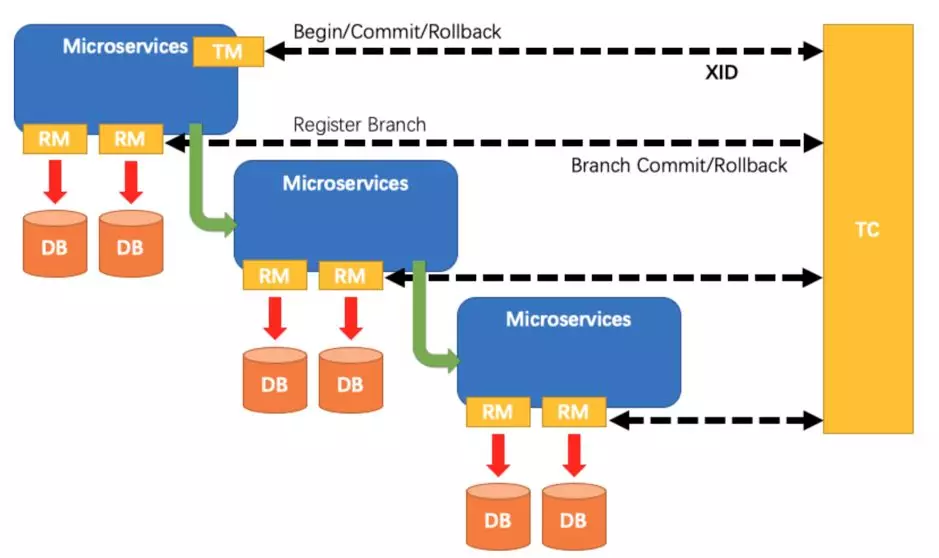
+The Seata AT transaction model includes TM (Transaction manager), RM (Resource
manager) and TC (Transaction coordinator).
+
+TC is an independent service and needs to be deployed separately, but TM and
RM are deployed together with business applications in the form of a jar
package, they establish a long-term connection with the TC and maintain RPC
communication in the whole transaction life cycle.
+
+Among this model, the initiator of the global transaction is TM and it is
responsible for the “begin” and commit/rollback of global transactions, the
participant of the global transaction is RM and it is responsible for the
execution and commit/rollback of branch transactions.
+
+
+
+### SPI the distributed transaction of ShardingSphere
+
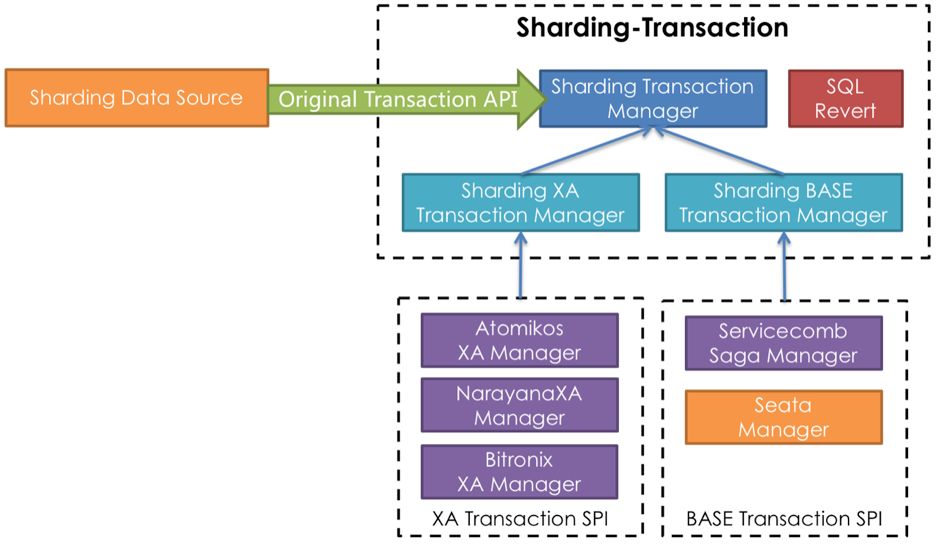
+ShardingSphere provides a set of SPIs for accessing distributed transactions.
The goal of this design is to ensure the ACID semantics of transactions after
data fragmentation. The realization of distributed transactions mainly includes
2PC XA and BASE transaction. As an implementation of BASE transaction, Seata AT
transaction can be seamlessly connected to the ShardingSphere ecosystem.
+
+
+
+For 2PC XA transaction, we have integrated Atomikos, Narayana, Bitronix
transaction mangers. The bottom layer of XA transaction depends on the support
of specific database vendors for the 2PC XA commit protocol, usually XA
protocol doing 2PL (2 phase Lock) throughout Prepare and Commit which
guarantees the ACID of distributed transactions. This usually suitable for
short transaction and non-cloud environments (cloud environment takes around
20ms to do next IO, 2PL will lock resources up [...]
+
+In terms of BASE transactions, we have now completed the integration of
ServiceComb Saga. Saga has improved the performance of the overall transaction
through one-phase commit plus compensation. The compensation method is roughly
the same as Seata, that is, the physical SQL after fragmentation Revert is used
to generate compensated SQL, but the Saga model does not support isolation
levels in theory, and is suitable for businesses with high performance
requirements and low consistency req [...]
+
+### Integrated solution
+
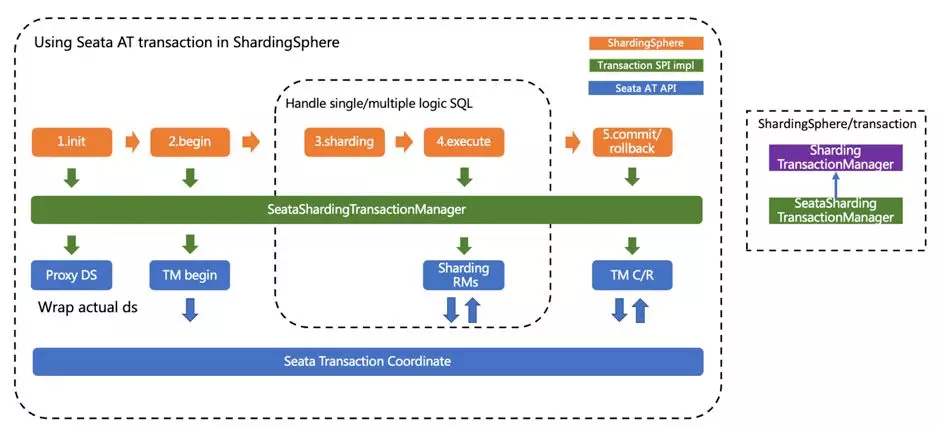
+When integrating Seata AT transactions, we need to integrate TM, RM and TC
models into the ShardingSphere distributed transaction SPI ecosystem. For
database resource, Seata allows JDBC operations to communicate with TC through
RPC by docking with DataSource interface. Similarly, ShardingSphere also
integrate physical DataSource that configured by the user into DataSource
interface. Therefore, after the physical DataSource is repacked as Seata’s
DataSource, Seata AT transactions can be i [...]
+
+In the model of Seata, the context of global transaction is stored in thread
variable, the transfer between thread variables can be completed by extending
the transport between services, branch transaction determines whether or not
join in entire Seata global transaction by thread variable. The sharding
execution engine of ShardingSphere is usually executed in multiple threads.
Therefore, when integrating Seata AT transactions, it is necessary to extend
the transaction context transfer o [...]
+
+
+
+### Quick start
+
+We have implemented base-seata-raw-jdbc-example, you can have a try on your
own.
+https://github.com/apache/incubator-shardingsphere-example/tree/dev/sharding-jdbc-example/transaction-example/transaction-base-seata-example/transaction-base-seata-raw-jdbc-example
+
+Operation Manual
+
+1. Follow the steps in seata-work-shop, download and start seata server.
+
+ https://github.com/seata/seata-workshop
+
+ This refers to step6 and step7.
+
+2. Execute the script resources/sql/undo_log.sql in each database sharding,
and create undo_log table.
+
+3. Run YamlConfigurationTransactionExample.java
+
+### Items to be optimized
+
+When the Seata AT transaction is Revert SQL, we needs to parsed the physical
SQL twice after the ShardingSphere fragmentation, so we needs to design an SPI
to avoid the loss of the performance in the second SQL parsing.
+
+Reference paper
+
+[1]: Transactions for Distributed Actors in the Cloud
+
+https://www.microsoft.com/en-us/research/wp-content/uploads/2016/10/EldeebBernstein-TransactionalActors-MSR-TR-1.pdf



