This is an automated email from the ASF dual-hosted git repository.

tuichenchuxin pushed a commit to branch master
in repository https://gitbox.apache.org/repos/asf/shardingsphere.git
The following commit(s) were added to refs/heads/master by this push:
new fb40ef02461 2.28 upload articles (#24371)
fb40ef02461 is described below
commit fb40ef02461e5c0bb27df5a3c61791681835b64d
Author: FPokerFace <[email protected]>
AuthorDate: Tue Feb 28 13:38:44 2023 +0800
2.28 upload articles (#24371)
* upload 1 article
* Update
2022_10_14_ShardingSphere_5.2.0_Audit_for_sharding_intercepts_unreasonable_requests_in_multi-shards_scenarios.en.md
---
...s_unreasonable_requests_in_multi-shards_scenarios.en.md | 14 +++++++-------
1 file changed, 7 insertions(+), 7 deletions(-)
diff --git
a/docs/blog/content/material/2022_10_14_ShardingSphere_5.2.0_Audit_for_sharding_intercepts_unreasonable_requests_in_multi-shards_scenarios.en.md
b/docs/blog/content/material/2022_10_14_ShardingSphere_5.2.0_Audit_for_sharding_intercepts_unreasonable_requests_in_multi-shards_scenarios.en.md
index 7446c94ecee..61256b5e756 100644
---
a/docs/blog/content/material/2022_10_14_ShardingSphere_5.2.0_Audit_for_sharding_intercepts_unreasonable_requests_in_multi-shards_scenarios.en.md
+++
b/docs/blog/content/material/2022_10_14_ShardingSphere_5.2.0_Audit_for_sharding_intercepts_unreasonable_requests_in_multi-shards_scenarios.en.md
@@ -9,7 +9,7 @@ chapter = true
## 1. Background
-Thanks to our continuous review of the
[ShardingSphere](https://shardingsphere.apache.org/)’s community feedback that
we use to develop features such as data sharding and read/write splitting, we
found that some users create a large number of shards when using the data
sharding feature.
+Thanks to our continuous review of the
[ShardingSphere](https://shardingsphere.apache.org/)'s community feedback that
we use to develop features such as data sharding and read/write splitting, we
found that some users create a large number of shards when using the data
sharding feature.
In such cases, there can be 1,000 physical tables corresponding to a sharding
logical table, which largely disturbs users.
@@ -19,15 +19,15 @@ However, if users are not familiar with Proxy, or write a
`where` condition and
A full route can lower the performance of Proxy and even result in the failure
of a reasonable request. Imagine that there are 1000 shards in a physical
database, if they are executed in parallel, 1,000 connections are needed — and
if in serial, the request can lead to a timeout. In this regard, community
users requested whether the unreasonable request can be intercepted directly.
-We’ve considered the issue for a while. If we simply block the full-route
operation, we just need to check it in the code and add a switch to the
configuration file. On the other hand, if the user later needs to set a table
to read-only or requires the update operation to carry a `limit`, does that
mean we need to change the code and configuration again? This obviously goes
against the pluggable logic of Proxy.
+We've considered the issue for a while. If we simply block the full-route
operation, we just need to check it in the code and add a switch to the
configuration file. On the other hand, if the user later needs to set a table
to read-only or requires the update operation to carry a `limit`, does that
mean we need to change the code and configuration again? This obviously goes
against the pluggable logic of Proxy.
In response to the above problems, the [recently released Apache
ShardingSphere
5.2.0](https://faun.pub/apache-shardingsphere-5-2-0-is-released-bringing-new-cloud-native-possibilities-8d674d964a93?source=your_stories_page-------------------------------------)
provides users with SQL audit for the sharding function. The audit can either
be an interception operation or a statistical operation. Similar to the
sharding and unique key generation algorithms, the audit algorithm is also
plugin- [...]
-Next, we will elaborate on the implementation logic for data sharding’s audit,
with specific SQL examples.
+Next, we will elaborate on the implementation logic for data sharding's audit,
with specific SQL examples.
## **2. Audit for sharding interface**
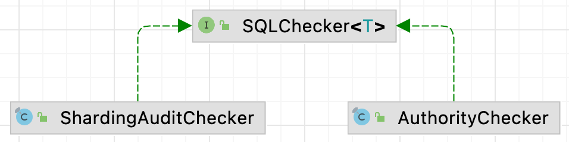
-The entrance to Apache ShardingSphere’s audit is in the
`org.apache.shardingsphere.infra.executor.check.SQLCheckEngine` class, which
will invoke the `check` method of the `SQLChecker` interface. Currently,
ShardingSphere audit contains audit for permission (verify username and
password) and audit for sharding.
+The entrance to Apache ShardingSphere's audit is in the
`org.apache.shardingsphere.infra.executor.check.SQLCheckEngine` class, which
will invoke the `check` method of the `SQLChecker` interface. Currently,
ShardingSphere audit contains audit for permission (verify username and
password) and audit for sharding.
Here we focus on the parent interface implemented in `ShardingAuditChecker` of
audit for sharding.
@@ -59,7 +59,7 @@ For this reason, we provide `Hint: disableAuditNames` to skip
audit interception
## **3. Audit for sharding algorithm**
-The audit for sharding algorithm interface
`org.apache.shardingsphere.sharding.spi.ShardingAuditAlgorithm` is inherited
from SPI class `ShardingSphereAlgorithm`. It inherits `type` and `props`
properties and defines its own `check` method. If you‘re looking to customize
your own audit algorithm, just implement the interface and add it to
`INF.services`.
+The audit for sharding algorithm interface
`org.apache.shardingsphere.sharding.spi.ShardingAuditAlgorithm` is inherited
from SPI class `ShardingSphereAlgorithm`. It inherits `type` and `props`
properties and defines its own `check` method. If you're looking to customize
your own audit algorithm, just implement the interface and add it to
`INF.services`.
@@ -118,7 +118,7 @@ public final class
DMLShardingConditionsShardingAuditAlgorithm implements Shardi
}
```
-Here we’d like to introduce another audit for sharding algorithm:
`LimitRequiredShardingAuditAlgorithm`. This algorithm can intercept SQL without
carrying `limit` in the `update` and `delete` operations.
+Here we'd like to introduce another audit for sharding algorithm:
`LimitRequiredShardingAuditAlgorithm`. This algorithm can intercept SQL without
carrying `limit` in the `update` and `delete` operations.
As this algorithm is less universal, it is not currently integrated into
Apache ShardingSphere. As you can see, it is very easy to implement a custom
algorithm, which is why we need to design the audit for sharding framework.
Thanks to its plugin-oriented architecture, ShardingSphere boasts great
scalability.
@@ -237,7 +237,7 @@ CREATE SHARDING TABLE RULE # including AUDIT_STRATEGY
This post introduced how audit for sharding works with specific examples. I
believe you already have basic understanding of this function, and you can use
it whenever you need or use custom algorithm.
-You are also welcome to submit general algorithms to the community. If you
have any ideas you’d like to contribute or you encounter any issues with your
ShardingSphere, feel free to post them on
[GitHub](https://github.com/apache/shardingsphere).
+You are also welcome to submit general algorithms to the community. If you
have any ideas you'd like to contribute or you encounter any issues with your
ShardingSphere, feel free to post them on
[GitHub](https://github.com/apache/shardingsphere).
# Author

