Dear MARMAM community,
On behalf of all the co-authors and I, I am very pleased to share our recent
publication entitled "An approach to using stranding data to monitor cetacean
population trends and guide conservation strategies" in Scientific Reports.
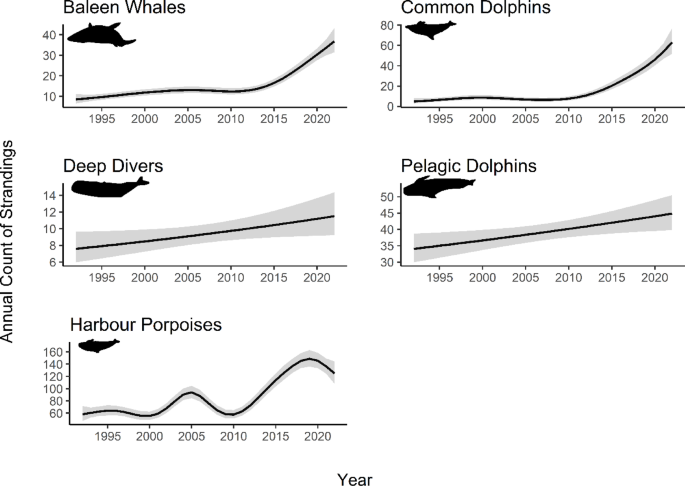
Authors: Rachel L. Lennon, Rosie S. Williams, Kathryn J. Allan, Mariel T.I. ten Doeschate, Nicholas J. Davison, Simon A. Babayan and Andrew C. Brownlow Abstract: Growing anthropogenic pressures increasingly impact marine wildlife, with cetaceans being particularly vulnerable to cumulative effects of stressors due to their position as top predators. As sensors and sentinels of ocean health, cetaceans offer critical insight into known and emerging threats to marine ecosystems. Stranding schemes provide a cost-effective means to assess mortality rates and population demographics, offering insights that are often challenging to obtain through live monitoring. Using a 30-year dataset from the Scottish Marine Animal Stranding Scheme (SMASS) we demonstrate how opportunistically obtained stranding data can be used to monitor populations and guide conservation strategies. Species were clustered into broad ecological groups - baleen whales, short-beaked common dolphins, deep divers, harbour porpoises and pelagic dolphins - for spatiotemporal analysis of stranding patterns. All groups showed increases in annual stranding rates over the study period, with common dolphins and baleen whales exhibiting exponential increases, suggesting these species may be facing heightened pressures. Distinct seasonal and spatial trends were detected, with harbour porpoises predominantly stranding on the east coast and other groups clustering to Scotland’s west coast. Identifying these trends helps focus surveillance and mitigation efforts, underscoring the importance of this approach for monitoring vulnerable species. You can find the full publication (open access) here: [https://media.springernature.com/m685/springer-static/image/art%3A10.1038%2Fs41598-025-12928-1/MediaObjects/41598_2025_12928_Fig2_HTML.png]<https://doi.org/10.1038/s41598-025-12928-1> An approach to using stranding data to monitor cetacean population trends and guide conservation strategies - Scientific Reports<https://doi.org/10.1038/s41598-025-12928-1> doi.org https://doi.org/10.1038/s41598-025-12928-1 Please don't hesitate to reach out if you have any questions. Happy reading! Best wishes, Rachel Rachel Lennon (She/Her) PhD Researcher | Marine Animal Health Scottish Marine Animal Stranding Scheme (SMASS) School of Biodiversity, One Health and Veterinary Medicine University of Glasgow | Graham Kerr | Room 321 BlueSky: @@rachlenn.bsky.social | Tel: 07955233464
_______________________________________________
MARMAM mailing list
[email protected]
https://lists.uvic.ca/mailman/listinfo/marmam