GitHub user wenjin272 closed a discussion: Mem0 Backend for Long-Term Memory
## Introduction ### Long-Term Memory in Flink-Agents Flink-Agents introduced Long-Term Memory support in version 0.2, providing the ability to store and retrieve information persistently. **Base Interface** — Long-Term Memory exposes the following operations: - **Memory Set level** — a memory set is a named collection of memory items - `create_memory_set` - `get_memory_set` - `delete_memory_set` - **Memory Item level** — a memory item holds the stored data and its associated metadata - `add` - `get` - `delete` - `search` In version 0.2, we shipped a vector-store-based Long-Term Memory backend and an automatic compaction mechanism for managing memory sets. --- ### Mem0 Mem0 is an intelligent memory layer specifically designed for AI agents. It provides built-in mechanisms for data compression and retrieval, supporting storage, automatic compaction, and semantic search. **Write path:** 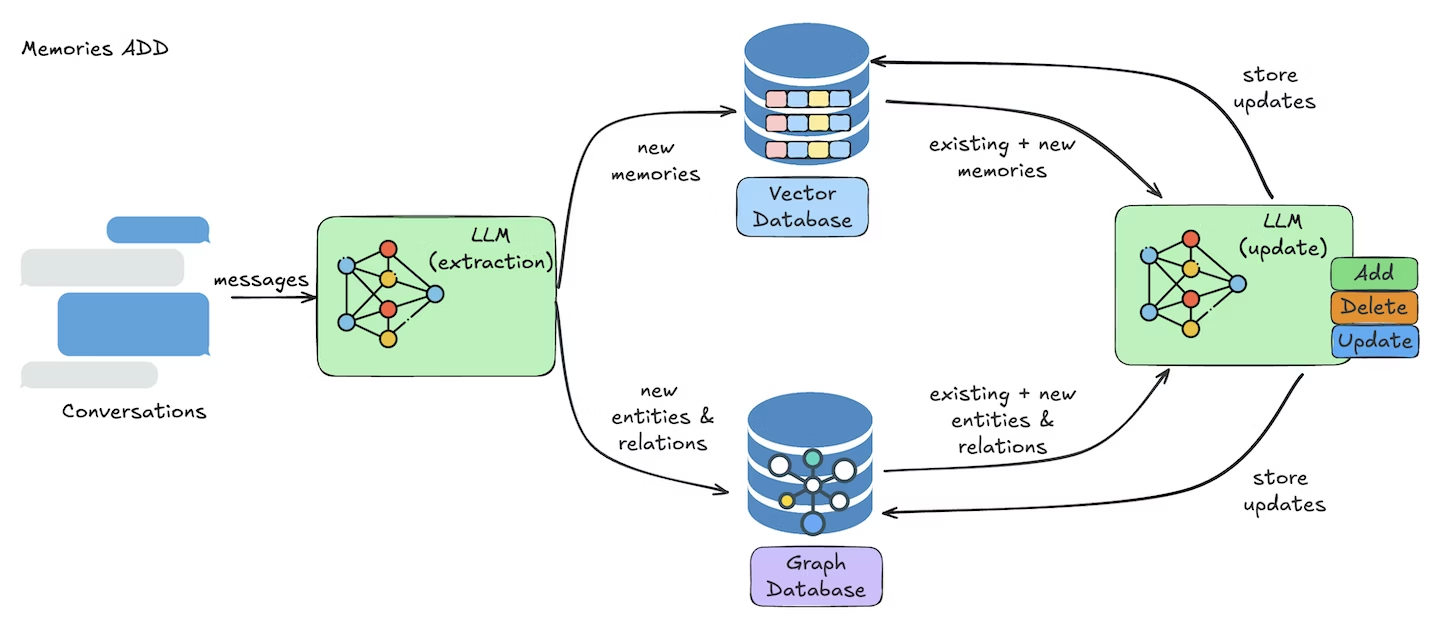 1. **Information extraction** — Mem0 sends the messages through an LLM that pulls out key facts, decisions, or preferences to remember. 2. **Conflict resolution** — Existing memories are checked for duplicates or contradictions so the latest truth wins. 3. **Storage** — The resulting memories land in managed vector storage (and optional graph storage) so future searches return them quickly. **Read path:** 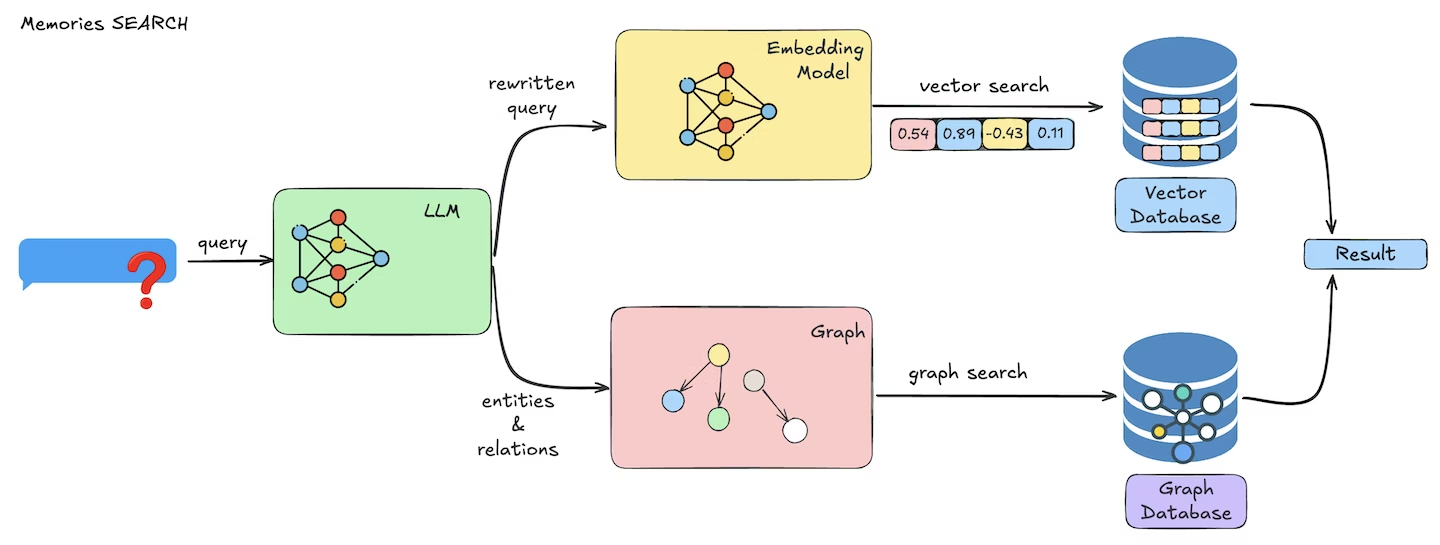 1. **Query processing** — Mem0 cleans and enriches your natural-language query so the downstream embedding search is accurate. 2. **Vector search** — Embeddings locate the closest memories using cosine similarity across your scoped dataset. 3. **Filtering & reranking** — Logical filters narrow candidates; rerankers or thresholds fine-tune ordering. 4. **Results delivery** — Formatted memories (with metadata and timestamps) return to your agent or calling service. --- ### Why Mem0 as the Long-Term Memory Backend Building a production-grade Long-Term Memory system requires significant engineering effort. Since this capability is not a differentiating feature of Flink-Agents relative to other agent frameworks, integrating a mature and widely adopted third-party solution is preferable to reinventing the wheel. After evaluating several popular memory frameworks, we chose to integrate Mem0 first, for the following reasons: 1. **Popularity** — Mem0 has over 46.6k GitHub stars and is already used as the Long-Term Memory backend in other agent frameworks such as AgentScope. 2. **API alignment** — Mem0's API is intuitive and closely maps to the Long-Term Memory interface in Flink-Agents, making integration straightforward. --- ## User Interface ### Configuration Users configure Long-Term Memory parameters through the `Configuration`: ```python agents_env = AgentsExecutionEnvironment.get_execution_environment(env=env) agents_config = agents_env.get_config() agents_config.set(LongTermMemoryOptions.CHAT_MODEL_SETUP, "my_chat_model") agents_config.set(LongTermMemoryOptions.EMBEDDING_MODEL_SETUP, "my_embedding_model") agents_config.set(LongTermMemoryOptions.VECTOR_STORE, {"provider": "chroma", "config": {"collection_name": "context"}}) ``` - A chat model, an embedding model, and a vector store are all required to use Long-Term Memory. - Users must declare the relevant resources in their Agent class and reference them in the Long-Term Memory configuration: ```python class MyAgent(Agent): @chat_model_setup @staticmethod def my_chat_model() -> ResourceDescriptor: return ResourceDescriptor( clazz=ResourceName.ChatModel.OLLAMA_SETUP, connection="ollama_connection", model=OLLAMA_CHAT_MODEL, extract_reasoning=True, think=False, ) @embedding_model_setup @staticmethod def my_embedding_model() -> ResourceDescriptor: return ResourceDescriptor( clazz=ResourceName.EmbeddingModel.OLLAMA_SETUP, connection="ollama_embedding_connection", model=OLLAMA_EMBEDDING_MODEL, ) ``` **Vector store configuration** will be delivered in two PRs due to implementation complexity: - **PR 1** — Users declare the vector store inline in the Long-Term Memory configuration: ```python agents_config.set(LongTermMemoryOptions.VECTOR_STORE, {"provider": "chroma", "config": {"collection_name": "context"}}) ``` - **PR 2** — Users can reference a named vector store declared in the Agent class, consistent with how chat models and embedding models are referenced: ```python agents_config.set(LongTermMemoryOptions.VECTOR_STORE, "my_vector_store") ``` > **NOTE:** Both PRs will be included in version 0.3. PR 2 involves a refactor > of the vector store interface — including updates to three Java > implementations and one Python implementation — which is independent of the > Long-Term Memory logic itself. See [Use Flink-Agents > ChatModel/EmbeddingModel/VectorStore in > Mem0](#use-flink-agents-chatmodelembeddingmodelvectorstore-in-mem0) for > details. --- ### Breaking Changes - The `EXTERNAL_VECTOR_STORE` backend is deprecated and will be removed. - `LongTermMemoryOptions.Backend` is no longer configurable; the Mem0 backend is now the default. - The `BaseLongTermMemory` interface signature will be slightly updated to align with Mem0's interface, while preserving equivalent capabilities. - `LongTermMemory` will only support reading and writing `str` values. Users are responsible for encoding/decoding other types before writing and after reading. --- ### `BaseLongTermMemory` Interface Changes #### Memory Set Operations The following parameters are removed from `get_or_create_memory_set`: - **`capacity`** — Mem0 performs eager compaction on every insert, making explicit capacity management unnecessary. - **`CompactionConfig`** — Mem0 uses a global compaction policy. - **`item_type`** — Mem0 only supports `str`. While automatic serialization/deserialization could be preserved, it would require storing `item_type` as collection metadata — which introduces complexity and potential inconsistency across vector stores (e.g., S3Vector, Elasticsearch, OpenSearch do not natively support collection-level metadata). Other agent frameworks such as AgentScope and LangChain also restrict Long-Term Memory to `str` only. Therefore, we adopt the same approach and leave serialization to the user. ```python # Before def get_or_create_memory_set( self, name: str, item_type: type[str] | Type[ChatMessage], capacity: int, compaction_config: CompactionConfig, ) -> MemorySet: ... # After def get_or_create_memory_set( self, name: str, ) -> MemorySet: ... ``` #### Memory Item Operations Mem0 always generates a random ID on insert; specifying a custom ID is not supported. Users can still access specific items using the ID returned by Mem0. ```python # Before def add( self, memory_set: MemorySet, memory_items: ItemType | List[ItemType], ids: str | List[str] | None = None, metadatas: Dict[str, Any] | List[Dict[str, Any]] | None = None, ) -> List[str]: ... # After def add( self, memory_set: MemorySet, memory_items: str | List[str], metadatas: Dict[str, Any] | List[Dict[str, Any]] | None = None, ) -> List[str]: ... ``` --- ## Implementation This section covers the key implementation considerations for integrating Mem0 into Flink-Agents. ### Visibility Isolation Mem0 supports data scoping via `user_id`, `agent_id`, and `run_id` filters. We map these to `job_id`, `key`, and `memory_set.name` respectively, ensuring that Long-Term Memory data is not visible across different keys within the same Flink job. ```python @override def search( self, memory_set: MemorySet, query: str, limit: int, **kwargs: Any ) -> List[MemorySetItem]: """Search for memories related to the query.""" result = self.mem0.search( query=query, user_id=self.job_id, agent_id=self.key, run_id=memory_set.name, limit=limit, **kwargs, ) ``` --- ### Use Flink-Agents ChatModel / EmbeddingModel / VectorStore in Mem0 Mem0 requires a chat model, an embedding model, and a vector store at initialization. Although Mem0 ships its own implementations, we want Flink-Agents' implementations to be used inside Mem0. #### Chat Model & Embedding Model We wrap Flink-Agents' ChatModel and EmbeddingModel by implementing Mem0's corresponding interfaces. Using ChatModel as an example: 1. Extend Mem0's `LLMBase` and implement `generate_response`, delegating to the Flink-Agents chat model: ```python class FlinkAgentsLLM(LLMBase): """Wrapper for the Flink-Agents chat model. This class wraps the Flink-Agents LLM to generate responses within Mem0 using Flink-Agents' chat model implementation. """ model: BaseChatModelSetup def __init__(self, config: BaseLlmConfig | None = None): """Initialize the Mem0 LLM wrapper. Args: config (`BaseLlmConfig | None`, optional): Configuration object for the LLM. Defaults to None. """ super().__init__(config) self.model = self.config.model def generate_response( self, messages: List[Dict[str, str]], response_format: Any | None = None, tools: List[Dict] | None = None, tool_choice: str = "auto", ) -> str | dict: """Generate a response using the Flink-Agents chat model.""" ``` 2. Register the wrapper with Mem0's `LlmFactory`: ```python from mem0.utils.factory import LlmFactory LlmFactory.provider_to_class["flink_agents"] = ( "flink_agents.api.memory.utils.FlinkAgentsLLM", BaseLlmConfig, ) ``` The EmbeddingModel wrapper follows the same pattern — only the `embed` method needs to be implemented. #### VectorStore Wrapping the VectorStore follows the same approach: extend Mem0's `VectorStoreBase` and implement the required methods. **Mem0's `VectorStoreBase`:** ```python class VectorStoreBase(ABC): @abstractmethod def create_col(self, name, vector_size, distance): """Create a new collection.""" @abstractmethod def insert(self, vectors, payloads=None, ids=None): """Insert vectors into a collection.""" @abstractmethod def search(self, query, vectors, limit=5, filters=None): """Search for similar vectors.""" @abstractmethod def delete(self, vector_id): """Delete a vector by ID.""" @abstractmethod def update(self, vector_id, vector=None, payload=None): """Update a vector and its payload.""" @abstractmethod def get(self, vector_id): """Retrieve a vector by ID.""" @abstractmethod def list_cols(self): """List all collections.""" @abstractmethod def delete_col(self): """Delete a collection.""" @abstractmethod def col_info(self): """Get information about a collection.""" @abstractmethod def list(self, filters=None, limit=None): """List all memories.""" @abstractmethod def reset(self): """Reset by deleting and recreating the collection.""" ``` **Flink-Agents' `BaseVectorStore` and `CollectionManageableVectorStore`:** ```python class BaseVectorStore(Resource, ABC): """Base abstract class for vector store.""" def add( self, documents: Document | List[Document], collection_name: str | None = None, **kwargs: Any, ) -> List[str]: """Add documents to the vector store.""" def query(self, query: VectorStoreQuery) -> VectorStoreQueryResult: """Perform vector search using a structured query object.""" @abstractmethod def size(self, collection_name: str | None = None) -> int: """Return the number of items in the collection.""" @abstractmethod def get( self, ids: str | List[str] | None = None, collection_name: str | None = None, **kwargs: Any, ) -> List[Document]: """Retrieve documents by ID.""" @abstractmethod def delete( self, ids: str | List[str] | None = None, collection_name: str | None = None, **kwargs: Any, ) -> None: """Delete documents by ID.""" class CollectionManageableVectorStore(BaseVectorStore, ABC): """Base abstract class for vector stores that support collection management.""" @abstractmethod def get_or_create_collection( self, name: str, metadata: Dict[str, Any] | None = None ) -> Collection: """Get a collection, creating it if it does not exist.""" @abstractmethod def get_collection(self, name: str) -> Collection: """Get a collection; raise an exception if it does not exist.""" @abstractmethod def delete_collection(self, name: str) -> Collection: """Delete a collection.""" ``` To bridge the two interfaces, Flink-Agents' VectorStore needs to add support for: - Search filters - `update` - `reset` - `col_info` **Extending the supported vector store ecosystem:** Currently, Flink-Agents supports only a limited set of vector stores: - Python: Chroma - Java: Elasticsearch, OpenSearch, S3Vector To broaden this, we plan to expose Mem0's vector store ecosystem within Flink-Agents via a `Mem0VectorStore` adapter. This approach: - Adds support for Milvus, pgvector, Redis, Qdrant, and more. - Gives users who use `Mem0VectorStore` in Long-Term Memory a consistent experience aligned with native Mem0 usage. ```python from mem0.vector_stores.base import VectorStoreBase from flink_agents.api.vector_stores.vector_store import CollectionManageableVectorStore class Mem0VectorStore(CollectionManageableVectorStore): """Flink-Agents vector store backed by a Mem0 vector store implementation.""" store: VectorStoreBase ``` --- ### Java Implementation The Mem0 SDK only provides a Python implementation, so the Mem0-based Long-Term Memory backend will be implemented in Python only. Java-side usage of Long-Term Memory will delegate to the Python implementation via Pemja. There are two cross-language call sites to handle: 1. The Java Long-Term Memory calling the corresponding Python Long-Term Memory methods. 2. The Python Long-Term Memory calling Java ChatModel / EmbeddingModel / VectorStore implementations. Flink-Agents already supports cross-language resource invocation, so neither site presents a fundamental technical blocker. However, the call paths differ from existing cross-language resource calls and will require targeted handling. GitHub link: https://github.com/apache/flink-agents/discussions/613 ---- This is an automatically sent email for [email protected]. To unsubscribe, please send an email to: [email protected]


