WHY ACTIVISTS WANT PRISONS DECONGESTED
<https://kafila.online/2020/05/02/why-activists-want-prisons-decongested/>
The Supreme Court also wants to reduce the Covid-19 risks posed by
overcrowded jails, but there is little progress so far.
Subhash Gatade <https://www.newsclick.in/author/Subhash%20Gatade>
02 May 2020 (
https://www.newsclick.in/Prisons-during-lockdown-needs-to-be-decongested)
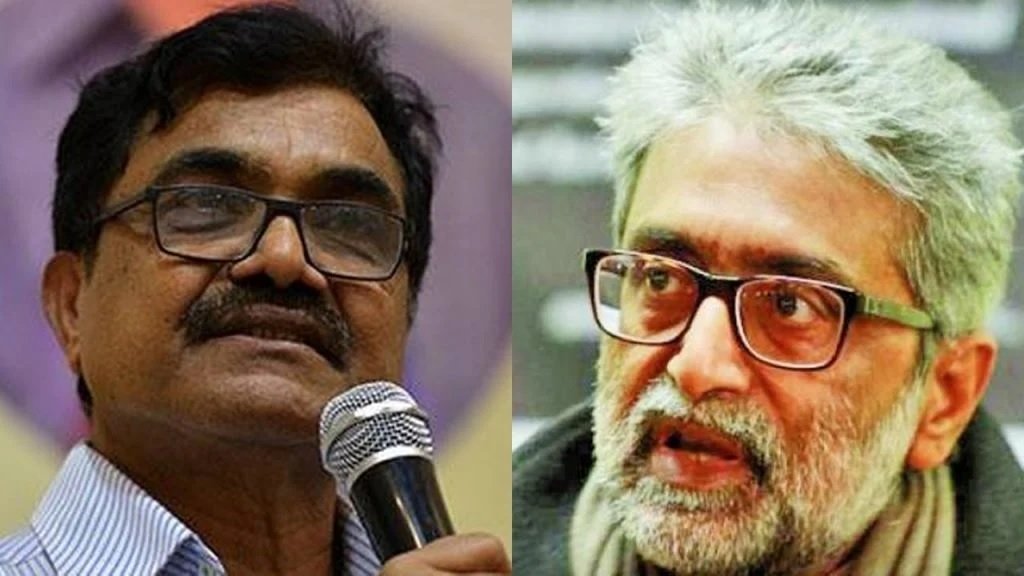
[image: Navlakha and Teltumbde]
<https://www.newsclick.in/sites/default/files/2020-05/Navlakha%20and%20Teltumbde.jpg>

Late in March, Sirous Asgari, a materials science and engineering professor
from Iran, who is at present detained by the United States Immigration and
Customs Enforcement (ICE), had warned about the “inhumane” conditions at
the ICE facility that could turn it into a hot spot
<https://www.theguardian.com/world/2020/mar/26/sirous-asgari-coronavirus-us-ice-immigration-detention>
of
Covid-19 fatalities.

April has made his worst nightmares come true. Asgari, who has a history of
respiratory problems, has been infected
<https://www.theguardian.com/world/2020/apr/28/iran-scientist-us-detention-coronavirus-sirous-asgari>
by
the Novel Coronavirus, which causes the Covid-19 disease. The news created
international outrage last month. Not only the Iranian foreign ministry,
many United States lawmakers and human rights groups also demanded his
release, but it was not to be.

At the facility in which Asgari is still lodged (though he has been
exonerated of all the charges he faced in the United States), people are
usually detained for no more than 72 hours, but the Coronavirus outbreak
has delayed deportations. People like him are simply caught up in the
system. Asgari can leave the United States and resume work in Iran—where
the viral epidemic has already claimed more than 60,000 lives—because he
simply isn’t being taken before a judge.

Asgari’s plight reminds of another incarceration, this one in an Indian
jail; that of Anand Teltumbde, who has been arrested in the Bhima-Koregaon
case. On 26 April, noted activist-filmmaker Anand Patwardhan had, in a Facebook
post <https://www.facebook.com/anand.patwardhan.52>, expressed deep concern
about the health of 70-year-old Teltumbde, who also suffers from
respiratory problems.

Patwardhan has drawn attention to Teltumbde’s condition after it was
revealed that NIA personnel at the same Pedder Road (now Gopalrao Deshmukh
Marg) premises of the NIA, where he was temporarily lodged, had tested
positive for Covid-19. Teltumbde has since been shifted to Taloja Jail in
Navi Mumbai, but this is an overcrowded prison that is full to more than
50% capacity by the state government’s own account.

Early in April, Taloja Jail authorities had asked various district and
sessions courts in Maharashtra not to send any more prisoners there. The
letter specifically mentioned that this jail, with a capacity to house
2,124, has over 3,000 inmates and that doctors had advised authorities that
with Covid-19 on the cusp of “community spread
<https://timesofindia.indiatimes.com/city/mumbai/mumbai-taloja-jail-says-it-cannot-take-more-inmates/articleshow/75000855.cms>”
would make accommodating more inmates dangerous.

This is the same Taloja Jail where a few other accused in the same
Bhima-Koregaon case have been lodged. This includes 80-year-old
poet-activist-journalist Varavara Rao, who told his family in the first
week of April about the many hardships he was facing in prisons and the
growing fears
<https://www.outlookindia.com/website/story/india-news-bhima-koregaon-case-how-2-minute-phone-call-keeps-families-of-jailed-activist-in-touch-with-each-other/350142>
among
the detainees of contracting Covid-19 infections.

Pavana, the poet’s daughter, reported that her father spoke of water
scarcity inside the prison and no scope for sanitation or social
distancing. The over-crowded barracks which lack basic hygiene exacerbate
the chances of virus spread. Koel, daughter of retired professor Shoma Sen
who is also lodged there in the same case, narrated similar experiences of
the conditions there. Her mother reportedly told her
<https://www.outlookindia.com/website/story/india-news-bhima-koregaon-case-how-2-minute-phone-call-keeps-families-of-jailed-activist-in-touch-with-each-other/350142>
that
they are not being provided masks or any other protective measures. “She
stays with 30 people in one cell and they sleep like sardines. How will
they keep social distancing?” Koel said.

Everyone who is lodged there, whether facing trial or convicted, is under
the threat of being infected with this virus. A health emergency will
become an additional punishment for those incarcerated—and everybody in
their proximity.

One does not know why the order of the Supreme Court last month, to release
some prisoners on parole to reduce the crowding in prisons during the
Covid-19 outbreak, is not being followed in true spirit. Chief Justice AS
Bobde had asked every state to constitute a high-powered committee to
determine which class of prisoners can be released
<https://www.businesstoday.in/current/economy-politics/coronavirus-supreme-court-orders-release-of-prisoners-to-decongest-jails/story/398982.html>
on
parole or interim bail. The apex court had made it clear that prisoners
convicted or charged with offences having a jail term of up to seven years
can be released on parole to avoid overcrowding in jails during the
Covid-19 outbreak.

“The Maharashtra state government had announced that it would soon release
11,000 incarcerated persons from the state’s 60 prisons. But over a month
later, the home department has only released a little over 4,000
prisoners,” the court noted
<https://thewire.in/law/anand-teltumbde-denied-interim-bail-sent-to-judicial-custody-for-14-days>.
Going by the latest (February 2020) data, there were 36,713 prisoners
incarcerated in the state and if 11,000 had been released, as it has
promised, the burden would have reduced by 25%.

It needs to be emphasised that overcrowding of jails is a serious problem
in India. Jails often accommodate twice as many prisoners
<https://qz.com/india/1743852/overcrowded-indian-prisons-are-understaffed-underfunded>
than
they have room or financial resources for. The first of its kind India
Justice Report released in 2019 by civil society organisations narrates how
court rulings over the years have “repeatedly highlighted overcrowding
<https://www.tatatrusts.org/insights/survey-reports/India-justice-report>;
poor sanitation and nutrition; prisoner overstays; the shortage of prison
staff, doctors and escorts to bring prisoners to court; the unavailability
of timely, quality legal aid; poor mechanisms to review prisoner status;
the absence of mandated statutory mechanisms of prison oversight, as well
as the near absence of correctional and aftercare services for released
prisoners.”

The alarming situation in jails and the health risk that Covid-19 poses to
inmates is the reason why civil liberty and democratic rights organisations
are raising the cry to decongest jails drastically so as to avoid
unnecessary tragedies. The People’s Union for Democratic Rights has said
that it has sent representations to the government and its high powered
committees demanding provision of bail, irrespective of the nature of the
charges, to elderly inmates and those with health issues
<https://www.pudr.org/release-vulnerable-prisoners-now>.

Their urgency is on account of the fact that jails in India are known to be
amongst fertile breeding grounds for infectious diseases and the risk to
life is obvious for those who are more vulnerable.

It has also appealed to the central government and the courts to recognise
the extraordinary circumstances created by the Covid-19 pandemic and to
permit interim bail for Anand Teltumbde, Gautam Navlakha and the many
others of advanced age and with existing ailments.

Whether such voices can gain more strength in coming days remains to be
seen. The national and international community must speak out about the
health risk to all prisoners, especially those still facing trial, who have
not been found guilty, and demand their release. Perhaps the emphasis needs
to be on what Patwardhan has said in his Facebook post: “State has no right
to jeopardise the lives of anyone, let alone prisoners who have not yet
been tried and must be presumed innocent.”

--
You received this message because you are subscribed to the Google Groups
"humanrights movement" group.
To unsubscribe from this group and stop receiving emails from it, send an email
to [email protected].
To view this discussion on the web visit
https://groups.google.com/d/msgid/humanrights-movement/CAJGPqcYpjFfC1yi%3DdsE2HHn2OZeKRZaarmLPLhbgvKZS%3DWrLDw%40mail.gmail.com.