---------- Forwarded message ---------
From: 'hasina khan' via Hum Aazaadiyon Ke Haq Mein <[email protected]
>
Women Speak From Margins of Ayodhya Dispute
<https://www.newsclick.in/Women-Speak-Margins-Ayodhya-Dispute>
Not the loss of a mosque, but the disregard for Muslims causes anguish.
Hasina Khan <https://www.newsclick.in/author/Hasina%20Khan>, Sana Contractor
<https://www.newsclick.in/author/Sana%20Contractor>
26 Nov 2019
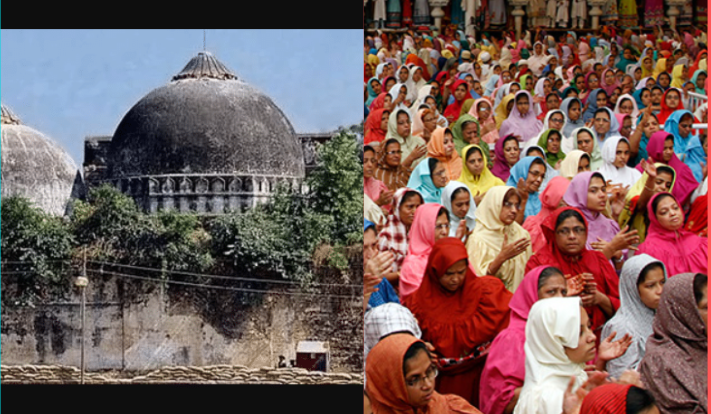
[image: Women Speak From Margins]
<https://www.newsclick.in/sites/default/files/2019-11/muslim%20womens%20ayodhyas.PNG>

We, two Muslim women born and raised in Bombay, residents of Bhendi Bazaar,
relived the pain and trauma of the 1992 riots on the day the Supreme Court
ruled on the Ayodhya dispute. The judgment rekindled within us the memories
of 6 December 1992, the day the Babri masjid was demolished, and what
followed thereafter.

Etched in the landscape of our minds is the Bhendi Bazaar of the turbulent
nineties that unfolded after the demolition. This area witnessed the worst
police atrocities and the city’s most prolonged curfews. We did not just
witness that theater of cruelty, but also got involved in rehabilitating
members of the Muslim community who ended up in relief camps.

Cut to 2019 and we are witnesses again. Again we are seeing the Muslims
rise to the occasion, striving to prove their loyalty to the country,
offering proof of being good citizens. The manifestation of this desire of
the Muslims is how they are working to maintain peace and acceptance of the
Supreme Court’s verdict.

But we women, who are constantly battling to uphold constitutional rather
than religious principles, we who have urged our communities to have faith
in the Constitution of India and not Sharia law, are left wondering by this
judgment. Having witnessed the bloodstained journey that has brought India
from Jai Siya Ram to Jai Shri Ram, we are wondering where we stand today in
our fight for constitutional values.

The demolition of Babri, the ensuing riots in Bombay city and the 13 bomb
blasts marked a turning point in how we saw ourselves—as Indians, as
Muslims, and most importantly, as women. We saw the façade of
cosmopolitanism that elite Bombayites like to romanticise torn down. We saw
the landscape of Mumbai change, as Muslims migrated from one part of the
city to another *en masse* to gain a sense of security. Ghettoisation
deepened and the two communities were further alienated from each other.
Muslims lost lives and property, but most of all, their faith in the state
has steadily dissipated ever since.

It is against this background—beyond the “dispassionate prism of the
law”—that the proposal from the All India Muslim Personal Law Board
(AIMPLB) to seek a review of the Ayodhya judgment needs to be understood.
Irrespective of whether their petition is admitted or not, given that the
AIMPLB is not a party in the Ayodhya case, one thing is clear: this matter
is far from at rest.

When the court ruled in favour of building a temple at the site of the
demolished masjid, everyone from Prime Minister Narendra Modi to the Home
Minister Amit Shah to the Opposition parties and even the petitioners in
the Ayodhya case said that a “peaceful” solution to an issue that had
caused bitter strife between the Hindus and Muslims of India has been
found. We were told that everyone must respect the ruling and move on.

Curiously, the BJP leaders did not want the same “respect” accorded to the
Supreme Court’s Sabarimala ruling. In the Sabarimala case, the BJP has
already rationalised the violence as a ‘matter of faith’. Of course, the
judgment in the Ayodhya case is in their favour, and so its standards for
evaluating the impact of both rulings does not appear to be the same.

Nevertheless, these exhortations for tranquility ignore the role that the
Babri masjid’s demolition played in the Hindu-Muslim polarisation in the
country. Along with that polarisation came the political ascendancy of the
BJP. It is this journey—which began with BJP leader LK Advani’s infamous
rath yatra in 1989—which has culminated in redefining the body politic of
our nation in 2019. It took this long for muscular Hindutva to completely
efface Sita, whose husband is the Hindu god Lord Rama, from the mental map
of Hindu divinity. It took this long also to turn Lord Rama into the symbol
of a Talibanised form of Hindutva.

Yes, the violence that we saw in 1992-93 had incited shock, anger, fear and
hurt. The same emotions are resurfacing now, but this time they are
emerging in a time of “peace”. Over these three-odd decades, the very
nature of communal violence changed. There were large-scale riots during
the 1980s and 1990s, but now an all-pervasive atmosphere of fear engulfs
Muslims, especially the most marginalised among them. This fear unfolds as
violence in the name of beef on one day, or their refusal to chant ‘Jai
Shri Ram’ the next day.

This is the background against which we are being told that the Supreme
Court’s decision has brought to an end a bitter battle between two
communities. In fact, the ruling has sent the message to minorities that
they can never expect justice from a secular institution. Then what is the
value of these pronouncements of peace and exhortations to “move on”? Only
those making these claims can answer this question.

What would have been most just was rebuilding the mosque that was
demolished. But it would be naïve for Muslims in present-day India to think
that the mosque would be restored. The Allahabad High Court’s ruling to
divide the land between the claimants had seemed like a compromise. Now,
handing over the land where the mosque once stood to the perpetrators who
broke it seems like a cruel joke.

True, the Supreme Court has acknowledged that the demolition of the mosque
was illegal. This remark is somehow supposed to make the judgment “fair”.
But what we see before our eyes is a party that had two seats in Parliament
in the 1980s rise, with the temple agenda, to assume two thumping
majorities in 2014 and 2019. Following the Bombay riots, the Shiv Sena came
to power too, openly asserting its majoritarian ideology in Mumbai and
alienating many who had built this city.

What we also see is that those charged with involvement in the bomb blasts
of 1993 were given the most severe of punishments, even the death penalty.
But those who brought down a historical monument in broad daylight have
faced no consequences. On the contrary, they have now been rewarded. Mere
suspicion is enough to get Muslim men imprisoned, for decades together,
without evidence of their having committed any crime. But if the alleged
perpetrators are Hindus then it seems that all the evidence in the world
cannot implicate them.

As feminists, we find ourselves at an odd position. Our anguish is not at
the loss of a place of religious worship, but at the sheer blatant
disregard for any sense of justice towards the Muslims as a community. What
we see is a show of majoritarian strength and the loss of dignity for
ordinary Muslims. The game of religion is played by men, and women are made
the pawns in it. Majoritarian politics has played on masculinities,
painting the Muslim as the “foreigner”, the infiltrator, the *ghuspetia*, a
collective against Shri Ram (and not Siya Ram).

Muslim women have to face the dual brunt of this Othering of their
community. With issues such as instant triple talaq, the Hindu Right has
co-opted the agenda of Muslim women’s groups and is going to great lengths
to allegedly offer them protection. But, somehow, the same Right is not
interested in the lives of Muslims when they become victims of communal
violence. Nor do they even attempt to contribute to their economic
well-being by, say, implementing the recommendations of the Sachar
Committee report.

Hence, the decision to file a review petition does not signal closure of
the mandir-masjid debate. If anything, the issue seems to be alive and
well. It will be used by bodies such as the AIMPLB to mire the Muslim
community in fear and insecurity and it simultaneously portends huge
political gains for the Hindu right. *Mandir wahin banega* (we will build
the temple in Ayodhya) has been the BJP’s long-standing election agenda. It
has followed through on its promise. Even as it fails at delivering on
anything on its “development agenda”, this issue will remain a feather in
its cap, firmly securing its position as the ruling party.

The court has ordered the state to set up a trust and use public money to
build a temple, but not a mosque. What does this bode for the future of
secular India? Now that the BJP seems to have established itself as the
savior of Hindus and Hinduism, what more can we expect in the coming years
as women?

*The authors are feminist activists with the Bebaak Collective. The views
are personal views.*
https://www.newsclick.in/Women-Speak-Margins-Ayodhya-Dispute

Sent from Yahoo Mail on Android
<https://go.onelink.me/107872968?pid=InProduct&c=Global_Internal_YGrowth_AndroidEmailSig__AndroidUsers&af_wl=ym&af_sub1=Internal&af_sub2=Global_YGrowth&af_sub3=EmailSignature>

--
This is a closed democratic group constituted of all its members. The views
exchanged between members of this group reflect the personal opinions of
the addressor members. Each member respects and unconditionally accepts the
freedom of speech and expression of the other members.

If you are not a member of the group and have access to this email, you are
requested to delete the same if you find it offensive. The contents of this
email are not addressed to or meant for the access of non members and the
group and/or its members shall not be held liable in respect of the
contents of this email to non members or to anybody whatsoever on account
of the access of this email by non members. Access in this context shall
not be limited to unauthorised access alone. Authorised access through
member/s shall not exempt the non member from this disclaimer.
---
You received this message because you are subscribed to the Google Groups
"Hum Aazaadiyon Ke Haq Mein" group.
To unsubscribe from this group and stop receiving emails from it, send an
email to [email protected].
To view this discussion on the web, visit
https://groups.google.com/d/msgid/haqmein/1561713771.664226.1574834531519%40mail.yahoo.com
<https://groups.google.com/d/msgid/haqmein/1561713771.664226.1574834531519%40mail.yahoo.com?utm_medium=email&utm_source=footer>
.

--
You received this message because you are subscribed to the Google Groups
"humanrights movement" group.
To unsubscribe from this group and stop receiving emails from it, send an email
to [email protected].
To view this discussion on the web visit
https://groups.google.com/d/msgid/humanrights-movement/CAKa3rYHxOBC_TNAxQFZ591FfpjDz1w6spfVBh%2Bbu4W%2Ba_JROOg%40mail.gmail.com.