> Yep. For what it's worth, it's been enabled for about one month on
> haproxy.org and till now we didn't get any bad report, which is pretty
> encouraging.
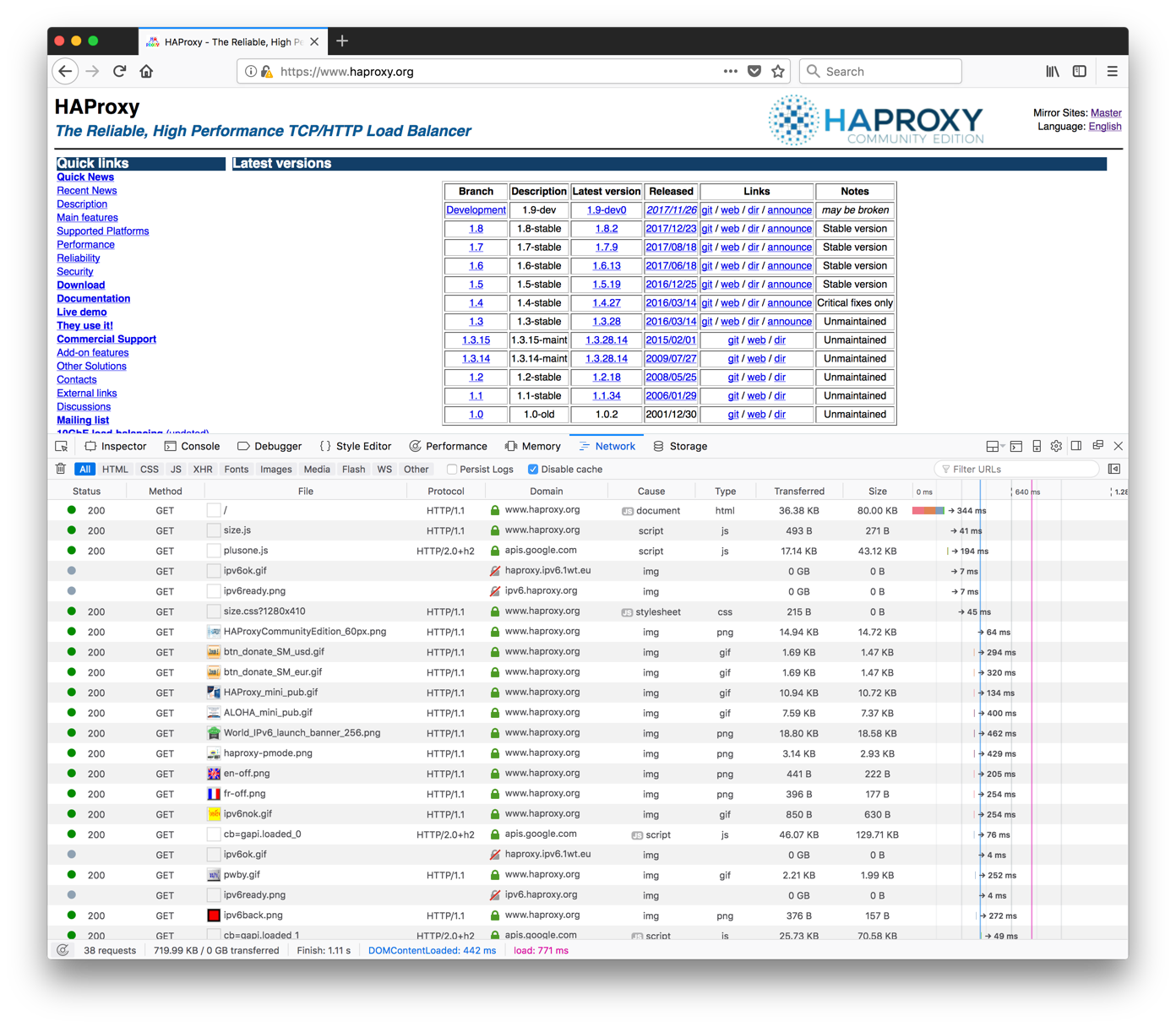
Can I ask where? The negotiated protocol I get on https://haproxy.org/ is
http/1.1 in both Google Chrome and Firefox as an example.

If I use curl, I can see it has ALPN enabled with http2 – however, mentioned
browsers doesn’t seem to actually establish the http2 connection, but rather a
1.1 connection.

> If this is met in production it definitely is a problem that we have to
> address. Could you please try the attached patch to see if it fixes the issue
> for you ? If so, I would at least like that we can keep some statistics on
> it, and maybe even condition it.

For POST requests, it’s not resolved with the patch, what I did find when
getting the 400 Bad Request on POST, it sometimes actually arrive at the
backend:

So haproxy:

Dec 29 08:01:36 localhost haproxy[4432]: 92.70.20.xx:52949
[29/Dec/2017:08:01:36.800] https_frontend~ cdn-backend/mycdn 0/0/1/-1/3 400 187
- - CH-- 1/1/0/0/0 0/0 "POST /login HTTP/1.1"
Dec 29 08:01:36 localhost haproxy[4432]: 92.70.20.xx:52949
[29/Dec/2017:08:01:36.806] https_frontend~ cdn-backend/mycdn 0/0/0/-1/2 400 187
- - CH-- 1/1/0/0/0 0/0 "POST /login HTTP/1.1"

Backend:

2017/12/29 08:01:36 [info] 7701#7701: *1191 epoll_wait() reported that client
prematurely closed connection, so upstream connection is closed too while
sending request to upstream, client: 92.70.20.xxx, server:
dashboard.domain.com, request: "POST /login HTTP/1.1", upstream:
"fastcgi://unix:/var/run/php-fpm/php5.sock:", host: "dashboard.domain.com",
referrer: "https://dashboard.domain.com/login";
2017/12/29 08:01:36 [info] 7701#7701: *1193 epoll_wait() reported that client
prematurely closed connection, so upstream connection is closed too while
sending request to upstream, client: 92.70.20.xxx, server:
dashboard.domain.com, request: "POST /login HTTP/1.1", upstream:
"fastcgi://unix:/var/run/php-fpm/php5.sock:", host: "dashboard.domain.com",
referrer: https://dashboard.domain.com/login

So haproxy says the client aborted while waiting for the server to start
responding.

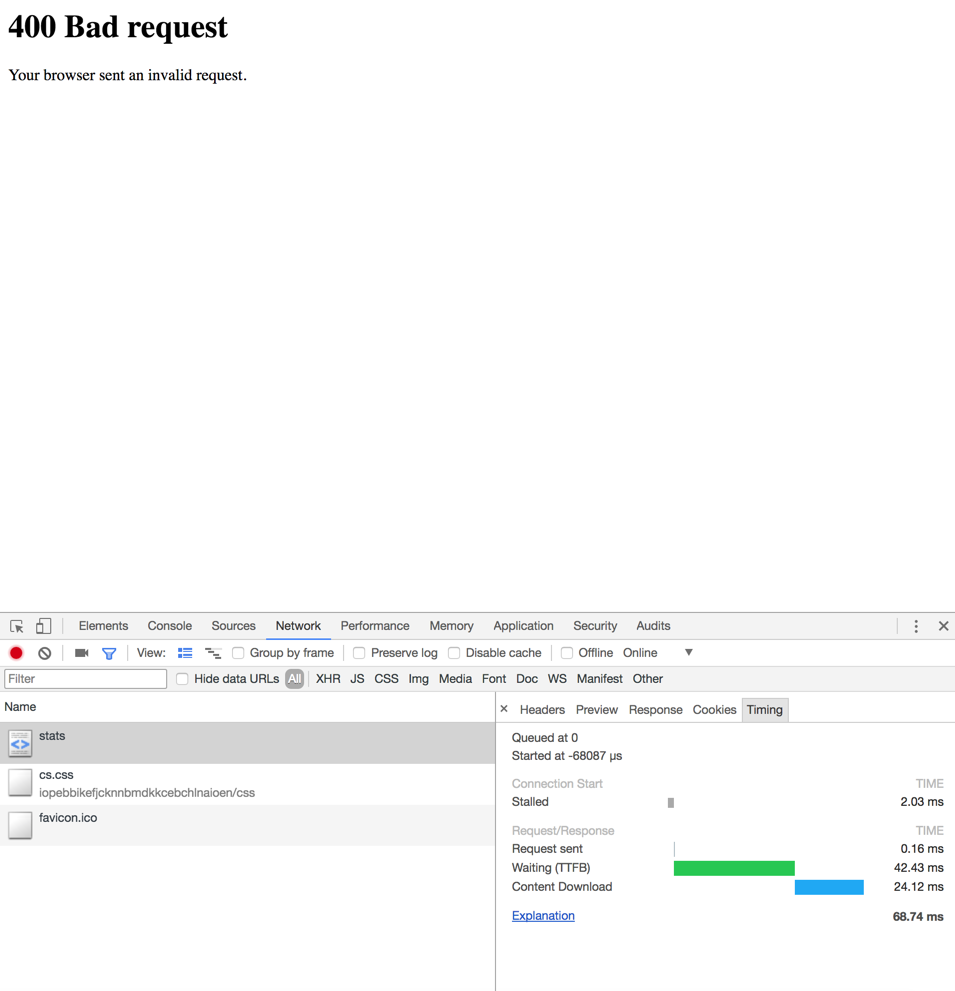
https://snaps.hcdn.dk/AONBkWojDFwuErMjxF66Mg4VxJl9jz4KUM61jPpgcL.png - however
the request is ~ 68-69 ms, and that browser is Google Chrome, so in that
regard, the 400 Bad Request for POST/PUT also happens in Google Chrome.

Which is the case for 1.8.2 and latest master.

If I do the patch for 1.8.1 I still get BADREQ sometimes in haproxy with the
“empty” GET requests.

On nginx backend it looks like this:

https://gist.github.com/lucasRolff/5eb0ae277c97b7457fbe546a1118e34f

I do see a few connection resets, however these happen also when things work.

However, that also confirms that “connection” header isn’t actually sent,
despite Firefox says it’s sent in their dev tools.

So, just so no misunderstandings happen, it seems there’s two things going
wrong:

=======
1.8.1:
- Firefox sometimes has issues with GET requests failing under http2 (Confirmed
by Maximilian B)
- Haproxy log shows: Dec 29 08:17:50 localhost haproxy[4881]: 92.70.20.xx:56726
[29/Dec/2017:08:17:17.178] https_frontend~ https_frontend/<NOSRV>
-1/-1/-1/-1/33388 400 0 - - CR-- 24/1/0/0/0 0/0 "<BADREQ>" (CR == The client
aborted before sending a full HTTP request)

1.8.2 and git master:
- All browsers seem to suffer with occasional issues with POST/PUT requests,
the GET requests issue still persist). (POST confirmed by Lukas T)
- Haproxy log shows (for POST requests): Dec 29 08:09:27 localhost
haproxy[4432]: 92.70.20.xx:54951 [29/Dec/2017:08:09:27.167] https_frontend~
cdn-backend/mycdn 0/0/0/-1/2 400 187 - - CH-- 1/1/0/0/0 0/0 "POST /login
HTTP/1.1" (CH == The client aborted while waiting for the server to start
responding), while backend server will see the request as aborted by the client
as well.
- - Client in scope of haproxy == browser
- - Client in scope of backend == haproxy

Semi conclusion:
- Connection headers are not sent by Firefox, Safari or Webkit, despite webdev
tools say so (in current versions at least)
- Not able to replicate GET request failures in other browsers than Firefox
despite doing thousands of requests (Tested Chrome, Safari, Opera, Webkit)
- Some bug seems like it got introduced between 1.8.1 and 1.8.2 causing
POST/PUT requests to fail in some cases

What I’d like to know:
- URL on haproxy.org that negotiates http2 correctly for Chrome and Firefox
(not exactly sure why it doesn’t do it already?) (
https://snaps.hcdn.dk/JFsEzPmxspw9hnXuFyM5G4QGYst7Q6R2zXmkZbRRjz.png )

Best Regards,
Lucas Rolff

On 29/12/2017, 08.13, "Willy Tarreau" <[email protected]> wrote:

    Hi Lucas,

    On Fri, Dec 29, 2017 at 06:06:49AM +0000, Lucas Rolff wrote:
    > As much as I agree about that specs should be followed, I realized that
even
    > if there's people that want to follow the spec 100%, there will always be
    > implementations used in large scale that won't be following the spec 100%
-

    Absolutely, and the general principle always applies : "be strict in what
you
    send, be liberal in what you accept".

    > the reasoning behind this can be multiple - one I could imagine is the
fact
    > when browsers or servers start implementing a new protocol (h2 is a good
    > example) before the spec is actually 100% finalized - when it's then
    > finalized, the vendor might end up with a implementation that is slightly
    > violating the actual spec, but however either won't fix it because the
    > violations are minor or because the violations are not by any way
"breaking"
    > when you also compare it to the other implementations done.

    Oh I know this pretty well, and you forget one of the most important aspects
    which is that browsers first implemented SPDY and then modified it to create
    H2. So some of the H2 rules were not closely followed initially because they
    were not possible to implement with the initial SPDY code. Also this early
    implementation before the protocol is 100% finalized is responsible for some
    of the dirty things that were promised to be fixed before the RFC but were
    rejected by some implementers who had already deployed (hpack header
ordering,
    hpack encoding).

    > In this case if I understand you correctly, the errors are related to the
    > fact that certain clients didn't implement the spec correctly in first
place.

    Yes but here we were speaking about a very recent client, which doesn't make
    much sense, especially with such an important header.

    > I was very curious why e.g. the Connection header (even if it isn't sent
by
    > Firefox or Safari/Webkit even though their webdev tools say it is), would
    > work in nginx, and Apache for that matter, so I asked on their mailing
list
    > why they were violating the spec.
    >
    > Valentin gave a rather interesting answer why they in their software
actually
    > decided to sometimes violate specific parts, it all boiled down to client
    > support, because they also realized the fact that many browsers (that
might
    > be EOL and never get updated), might have implementations that would not
work
    > with http2 in that case.
    >
    > http://mailman.nginx.org/pipermail/nginx/2017-December/055356.html

    Oh I totally agree with all the points Valentin made there. We've all been
    forced to swallow a lot of ugly stuff to be compatible with existing
    deployments. Look at "option accept-invalid-http-requests/responses"
    to get an idea. Such ugly things even ended up as relaxed rules in the
    updated HTTP spec (723x), like support for multiple content-length headers
    that some clients or servers send and that we check for correctness.

    > I know that it's different software, and that how others decide to design
    > their software is completely up to them.

    It's important to keep in mind that haproxy's H2 support came very late. I
    participated a lot to the spec, even authored a proposal 6 years ago. But
    despite this I didn't have enough time to start implementing in haproxy by
    then. Most implementers already had a working SPDY implementation to start
    from, allowing them to progress much faster. Nginx was one of them, and as
    such they had to face all the early implementations and their issues. It's
    totally normal that they had to proceed like this.

    > Violating specs on purpose is generally bad, no doubt about that - but if
    > it's a requirement to be able to get good coverage in regards to clients
    > (both new and old browsers that are actually in use), then I understand
why
    > one would go to such lengths as having to "hack" a bit to make sure
generally
    > used browsers can use the protocol.

    We're always doing the same. Violating the specs on stuff you send is a big
    interoperability problem because you force all other ones to in turn violate
    the spec to support you. But violating the specs on stuff you accept is less
    big of a deal as long as it doesn't cause vulnerabilities. Silently dropping
    the connection-specific headers is no big deal, and clearly something we may
    have to do in the future if some trouble with existing clients are reported.
    Similarly when you run h2spec you'll see that sometimes we prefer to close
    using RST_STREAM than GOAWAY because the latter would require us to keep the
    stream "long enough" to remember about it, and we're not going to keep
    millions of streams in memory just for the sake of not breaking a connection
    once in a while.

    > > So at least my analysis for now is that for a reason still to be
    > > determined, this version of firefox didn't correctly interoperate with
    > > haproxy in a given environment
    >
    > Downgrading Firefox to earlier versions (such as 55, which is
"pre"-quantum)
    > reveals the same issue with bad requests.

    Then I don't understand as it seems that different people are seeing
different
    things. And even for me, 45.7, 52.0.2 and 57alpha never caused this to
happen.
    I'm wondering if any browser plugin could be responsible for this header
being
    emitted. This should clearly be asked on some firefox support list to
confirm
    when this happens and why.

    > Hopefully you'll not have to violate the http2 spec in any way - but I do
see
    > a valid point explained by Valentin - the fact that you cannot guarantee
all
    > clients to be 100% compliant by the spec, and there might be a bunch of
    > (used) EOL devices around.

    I have no problem with this, and I agree with him about the fact that most
    of the rules result from overengineering, and from a wish to let the
protocol
    fail very quickly on bad implementations to help all of them converge
quickly.
    It's just that I want to have a *clear* and *reliable* report of the issue
    before starting to open holes in the spec and deal with complaints from
    people reporting that we're not compliant. And till now we don't know why
    this version of FF sometimes works and sometimes fails.

    > I used to work at a place where haproxy were used extensively, so seeing
    > http2 support getting better and better is a really awesome thing,
because it
    > would actually mean that http2 could be implemented in that specific
    > environment - I do hope in a few releases that http2 in haproxy gets to a
    > point where we could rate it as "production ready", with no real visible
bugs
    > from a customer perspective, at that point I think it would be good to
    > implement in a large scale environment (for a percentage of the requests)
to
    > see how much traffic might actually get dropped in case the spec is
followed
    > - to see from some real world workload how many clients actually violate
the
    > spec.

    Yep. For what it's worth, it's been enabled for about one month on
haproxy.org
    and till now we didn't get any bad report, which is pretty encouraging.

    > For now, I'll personally leave http2 support disabled - since it's
breaking
    > my applications for a big percentage of my users, and I'll have to find an
    > intermediate solution until at least the bug in regards to Firefox losing
    > connections (this thing):
    >
    > Dec 28 21:22:35 localhost haproxy[1534]: 80.61.160.xxx:64921
[28/Dec/2017:21:22:12.309] https_frontend~ https_frontend/<NOSRV>
-1/-1/-1/-1/22978 400 0 - - CR-- 1/1/0/0/0 0/0 "<BADREQ>"
    > Dec 28 21:22:40 localhost haproxy[1534]: 80.61.160.xxx:64972
[28/Dec/2017:21:22:35.329] https_frontend~ cdn-backend/mycdn 0/0/1/0/5001 200
995 - - ---- 1/1/0/1/0 0/0 "GET /js/app.js?v=1 HTTP/1.1"

    If this is met in production it definitely is a problem that we have to
    address. Could you please try the attached patch to see if it fixes the
    issue for you ? If so, I would at least like that we can keep some
    statistics on it, and maybe even condition it.

    > I never expect software to be bug free - but at this given point, this
    > specific issue that happens causes too much visible "trouble" for
end-users
    > for me to be able to keep it enabled

    I'm all for working around visible issues. We're among the rare software on
    which the finger is always pointed because it's inserted in the middle of a
    chain and when something changes it's haproxy's fault (while sometimes it
    only reveals a long problem), forcing us to adapt. So if the attached patch
    fixes the problem for you we'll have to adapt. I still would like to figure
    when the browsers send this and why because I would hate it that the patch
    is later reverted because someone tries version 60 saying "look the header
    is not sent anymore" while it's not in the same condition.

    > I'll figure out if I can replicate the same issue in more browsers
(without
    > connection: keep-alive header), maybe that would give us more insight.

    That could indeed help.

    Cheers,
    Willy