I'm glad you found SQL, it is certainly more productive than python for
querying your data. Although I tend to write SQL by hand the LLMs seem
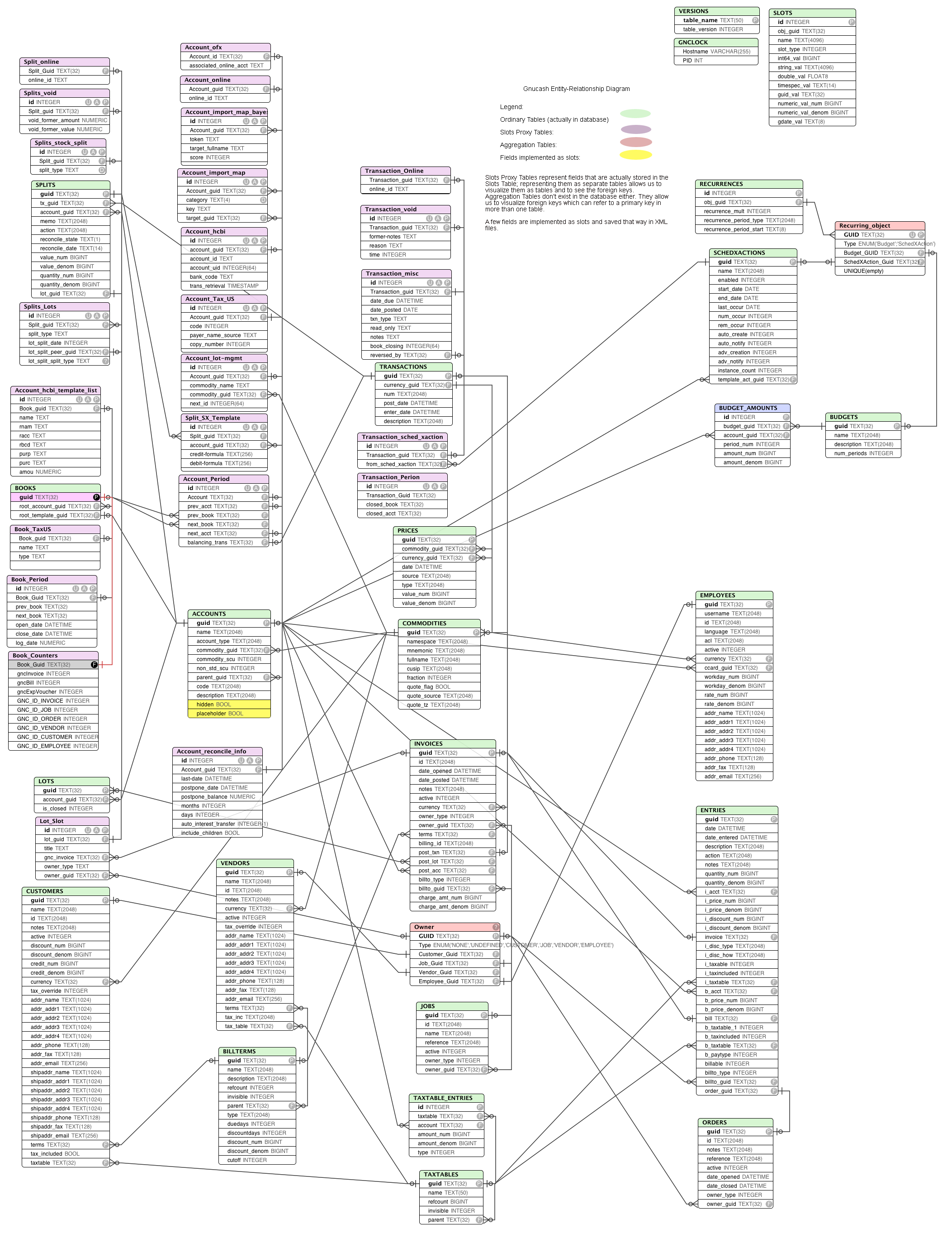
to have a very good understanding of GnuCash's data relationships which
you can see here if you ever get curious
Gnucash_erd.png (2105×2736)
<https://wiki.gnucash.org/wiki/images/8/86/Gnucash_erd.png>
Something like gnucash-mcp (see prev msg) takes the AI a lot further,
you can just type in "what are my 5 biggest assets" and get an answer.
Very simple to install even on Windows if you take the suggested Claude
desktop / .mpcb route.
Wm

On 2026-11-03 22:17, Paul Kroitor wrote:
If there's any general interest, and after a trying a few approaches,
here's my current best / easiest way of doing ad hoc analyses of
Gnucash data:
1. Save file as SQLite
2. Connect to the file from a Database Studio app (my favourite is
DBeaver community edition)
3. Ask Google Gemini for an appropriate SQL query (eg: "write a sql
query for dbeaver to report the five largest asset accounts in a
gnucash sqlite file")
4. Use SQL Editor > New SQL Script and paste the output from 3 above

5. Run the query
I choose this approach because it seems to give the correct results
the first time, whereas other things I tried need a little cajoling to
run correctly. No promises though!
Paul


On 2026-11-03 1:28 p.m., Paul Kroitor wrote:
Thank you, that's very helpful.
I was more wondering how close to useful AI now is answering
arbitrary questions like this, rather than any specific interest in
Piecash or SQLAlchemy. I really only chose Gnucash as the data source
for the experiment because I had lots of data handy.
In one of Arthur C Clarke's books, I think Imperial Earth, a
character casually poses a pentaminos question to a computer
terminal, which writes and runs a suitable algorithm in seconds. I
wondered how close we now were to this dream (nightmare?).
FWIW Gemini also suggested an SQL Query to answer the question, which
worked perfectly immediately.
I conclude that it's nearly there, but it's still simpler to use
tried-and-true (possibly more manual) techniques for many such ad hoc
questions.
Thanks again, Paul


On 2026-11-03 2:35 a.m., Wm Tarr wrote:
There are a number of layers here.
The warning is from SQLAlchemy which piecash uses, you should ask
the current maintainers of piecash about that rather than here.
Further, if you want to use AI to interact with a gnucash book why
don't you try something like
ninetails-io/gnucash-mcp: MCP server enabling AI assistants to read
and write GnuCash accounting data
<https://github.com/ninetails-io/gnucash-mcp>
where someone else has already done all the hard work, I've been
playing with it myself (on a copy of my main book) and I like it.
Wm
_______________________________________________
gnucash-user mailing list
[email protected]
To update your subscription preferences or to unsubscribe:
https://lists.gnucash.org/mailman/listinfo/gnucash-user
-----
Please remember to CC this list on all your replies.
You can do this by using Reply-To-List or Reply-All.