Good afternoon everyone from a sunny England - we announced today the launch of
a new project so please do share (to me individually) any relevant material on
fracking or politics that you think we may find useful.
http://www.sussex.ac.uk/bmec/newsandevents/news?id=45248

Major new project to examine the politics of fracking in the UK

A new research project by academics from the Science Policy Research Unit
(SPRU) at the University of Sussex is hoping to shed light on the politics of
fracking and the utilisation of shale gas within the UK, primarily England.

A hotly contested issue since its emergence on the scene in 2010, the study
will assess the scope for public opinion to influence policy and
decision-making on shale site development in the UK, and whether this is likely
to reduce or amplify controversy.

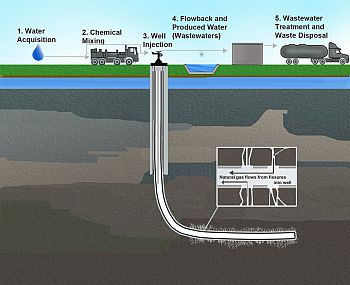
[http://www.sussex.ac.uk/wcm/assets/media/25/content/54840.350x285.jpg]

Fracking is a technology that allows the extraction of unconventional fossil
fuel resources (oil and gas). The technology has widely been used in North
America over the last decade but it is in a much earlier stage of development
in the UK.

Current UK Government policy actively encourages the use of hydraulic
fracturing ('fracking) as a means to meet the triple challenge of
decarbonisation (a challenge which fracking partially overcomes due to its
lower carbon output in comparison to coal, according to a report by the
Department of Energy), affordability and energy security.

However, many other members of the public view fracking as a risky technology
with the potential to adversely affect public health and the natural
environment, a development that would be a backwards step towards fossil fuels
and away from renewable energy sources.

The project, entitled 'Fracking, Framing and Effective Participation', will
analyse the opinions held by different groups and how this divide represents a
key challenge for shale gas development in the UK.

The study will also look at the governance of shale development, and the
varying ideas about the ways and extent to which local communities should have
a say in processes of decision-making.

Governance is often a source of conflict, which most visibly manifests itself
in public protests and police presence at shale gas sites.

Mr Laurence Williams<http://www.sussex.ac.uk/profiles/341438>, Research Fellow
working on the project remarked: "'Stop fracking democracy' has been a common
slogan amongst anti-fracking groups, reminding us that this controversy is
about the governance of this new technology as well as perceived risks to
health and the environment. This project will help shed light on whether
opportunities for publics to participate in decision-making work to resolve or
amplify such grievances."

The study aims to improve the understanding of the nature of the challenge
fracking presents through the analysis of three connected areas:

1) Public perceptions - An analysis of evolving public perceptions of fracking,
shale gas, and the governance of its development at both national and local
levels.

2) Policy debates and commitments - An analysis of UK policy debates on
fracking, how these debates led to a policy commitment to support fracking, and
how this position continues to be contested by various stakeholders.

3) Processes of public engagement and participation - An assessment of the
extent to which policies shape and are shaped by formal processes of public
participation and engagement.

Professor Andrew Stirling<http://www.sussex.ac.uk/profiles/7513>, a
co-Investigator of the project, said:

"One of the trickiest issues in technological controversies like UK fracking
debates is that deciding the best way forward is not just a technical matter
for expert-led 'evidence-based policy'. Complexities, uncertainties and
contending political values and interests extend deeply into the science
itself. This is why this project will pay careful attention to the practical
implications of different ways of framing the issue - and so help inform onward
public debate in ways that are not only more rigorous but more accountable
about which values and interests have been attended to, and which have been
sidelined."

The primary benefit of the research will be to provide both a better
understanding of the scale and nature of the social and political challenges
and a better understanding of the potential of public participation and
engagement to help address these challenges.

Professor Benjamin Sovacool<http://www.sussex.ac.uk/profiles/373957>, who is
leading the project, said "Shale gas could be a bridge to a low carbon future,
or a costly detour. This project will enable us to better assess the social and
political dynamics of this emerging innovation, as well as policy processes and
potential risks."

The research, which will begin on the 1st July and is funded by the NERC and
ESRC, involves a number of SPRU faculty; Benjamin Sovacool, Andy Stirling, Phil
Johnstone and Laurence Williams, as well as Jonn Axsen from Simon Frasier
University, Canada.

--
You received this message because you are subscribed to the Google Groups
"gep-ed" group.
To unsubscribe from this group and stop receiving emails from it, send an email
to [email protected].
For more options, visit https://groups.google.com/d/optout.