https://www.futurefarming.com/Machinery/Articles/2020/3/John-Deere-We-believe-in-electric-tractors-100-552869E/
John Deere: ‘We believe in electric tractors. 100%’
12 Mar 2020  René Koerhuis, Bas van Hattum
[image
https://www.futurefarming.com/Resizes/560x420/PageFiles/62/18/1862/001/003_637_IMG_20trk377_int01joker_2.jpg
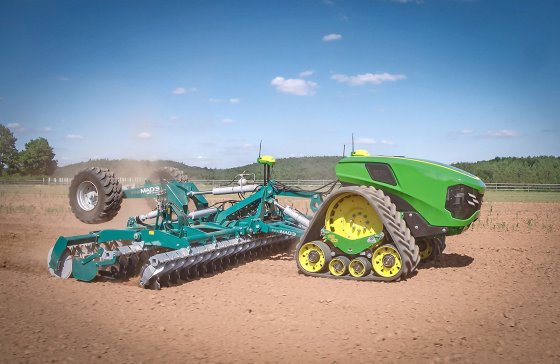
John Deere's Joker is a fully autonomous electric tractor with articulated
steering and a tracked single axle. - Photo: John Deere


videos
https://youtu.be/gMaQq_vRaa8
The potential of electrification

https://youtu.be/OJ9xKxAtDa8
GridCon Kabeltraktor von John Deere
]

If it was up to the engineers at John Deere, electricity will become the
power source of the future. For more efficiency, better traction, lower
costs and lower ground pressure. An interview with three experts.

Future Farming had the chance to exclusively talk to three leading experts
at John Deere’s European Technology Innovation Center in Kaiserslautern
(Germany) to hear all about the company’s vision on future farming.

Three technology fields

“At the Agritechnica exhibition, we showed nine different technology
projects in the Future Technology Zone,” says Peter Pickel. “It was the
first time ever that John Deere displayed non-commercially available
machines and equipment to a public audience. And although all of the
exhibits concern autonomous vehicles/robots, our vision of future farming is
about a lot more than robots. That vision is centred around three technology
fields:

    Electrification
    Artificial Intelligence (AI) and
    Automation and autonomy

The latter basically relates to the journey from automation to autonomy. The
best example of that is the ‘Joker’, the fully autonomous electric tractor
with articulated steering and a tracked single axle that we showed.”

“This will however not be a commercial product within the coming decade.
Instead, it is our vision incorporating the three technology fields I
mentioned. Many visitors crawled under the Joker to try and find engines,
drive lines and batteries, whereas it didn’t have any dedicated powertrain
yet.”

Imagine packing 500 kilowatts in a vehicle the size of a 200 kilowatts
tractor! And this is all scalable to 1 megawatt!

“We have several ideas about the power-supply on tractors, which still
includes the version with cable and separate energy supply vehicles. Those
could also provide energy to other future electric vehicles, like a
self-propelled forage harvester. Imagine packing 500 kilowatts in a vehicle
the size of a 200 kilowatts tractor! And this is all scalable to 1
megawatt!”

The potential of electrification

Nicolai Tarasinski has been involved in the development of electrical drive
lines and tractors (like the 7530 E Premium from 2008 and the GridCON from
2018) for over 20 years. According to him, electrification offers advantages
on three different aspects: productivity, power ranges and energy supply.

“Electrically driven vehicles are very efficient when it comes to energy
consumption and the weight to power ratio / power density. The drivelines
are very easy and fast to control – a requirement for autonomy. Furthermore,
the absence of emissions and of engine and gear oil is a crucial
(environmental) benefit.”

Biodiesel not the best solution

“In the long run, biodiesel will not be the best solution. In 2030 we will
see the first bans on combustion engines in cars in Europe and on garden and
park machinery in the US. We believe that, in the long run, farmers and
contractors will generate more and more electricity themselves, on their
premises.”

“All in all, prices for electricity will continue to decrease, and this is
an important aspect. While 20 years ago, we really placed our bets on
(hydrogen) fuel cells as the (near) future technology, we now believe that
fuel cells as well as biogas/methane powered tractors are too limited. You
can’t carry enough fuel for a day’s work, and they will not reduce the
CO2-footprint with the big steps that society wants to see… Power from fuel
cells is similar to power from batteries.”
Electrification as a key enabling technology

Pickel: “We see electrification as a key enabling technology. Electric
actuators enable farmers to apply inputs in the most efficient way: at the
right amount and in the right place. Take for instance our ExactEmerge seed
drill technology. It ensures correct singulation and acceleration of the
seeds to such a speed that there’s no speed difference with the soil, for
correct placement of the seeds.”

[image]  From left to right: Nicolai Tarasinski, manager advanced
engineering: “Electrically driven vehicles are very efficient when it comes
to energy consumption and the weight to power ratio. The drivelines are very
easy and fast to control and that is a requirement for autonomy.” Professor
Peter Pickel, manager external relations / deputy director ETIC: “John Deere
believes in electrification. At the next Agritechnica in 2021, we will show
a lot more electrified machinery.” Jørgen Audenaert, product line marketing
manager region 2: “The eAutoPower transmission we showed at Agritechnica, is
really different from anything else before, and you can consider that an
omen/sign.” - Photo: Bas van Hattum

Why make parts only for a cvt electrical?

Jørgen Audenaert: “The eAutoPower transmission we showed at Agritechnica is
really different from anything else previously seen, and you can consider
that an omen. Being awarded the golden innovation medal, means that we will
have to bring that product to the market before November 2021. It offers a
higher productivity than traditional drivelines and will therefore be very
interesting for large scale farm enterprises and contractors.”

“John Deere believes in electrification. At the next Agritechnica in 2021,
we will show a lot more electrified machinery,” Pickel adds.

Farming will follow the trend currently seen in the car industry

Tarasinski: “Production quantities and economies of scale will set the pace
of the introduction, and are a fundamental enabler for manufacturers. I
believe that farming will follow the trend currently seen in the car
industry. In 10 years’ time, we will see market introduction and penetration
of electrically powered tractors and farm vehicles.”
Do we need disruptive start-ups like Tesla to disrupt the market and
radically change it?

Tarasinski: “John Deere is the Tesla of agriculture as far as
electrification is concerned! Take for instance the previously mentioned E
Premium and GridCON tractors as well as the Joker. The Joker weighs under 5
tons, has a 250 kilowatts electric drive, a 250 kilowatts PTO drive and two
250 kilowatts power outputs for implements and machines. That’s 1 megawatt
combined.”

“GridCON is a concept for how we could power the Joker, with a long power
supply cable. In this concept, autonomy is ideal, as for a driver it’s
difficult to manage the logistics of the power supply cable. We got inspired
by similar technologies from a 100 years ago and from the Dutch, who use a
long drag hose to deliver slurry from a depot or tank to an injector in the
field.”

Does electric power require additional software development?

Tarasinski: “In fact, software nowadays is used right from the start of any
research and development project. It isn’t considered a bottleneck. Software
is an absolute necessity for managing and controlling projects, and is not
only used to develop virtual tractors and machines. It is also used for
extensive simulation of the operation, and that is crucial for the
controllability of projects.”

I believe that a self-propelled (autonomous) machine can and should be
cheaper than a multi-purpose vehicle like a tractor

“Simulation will also help us combine electrical power with autonomy, and
that will enable higher operating speeds. Why not drive (much) faster in the
field? If we can drive faster, we can limit the working width and develop
more affordable vehicles and machines. I believe that a self-propelled
(autonomous) machine can and should be cheaper than a multi-purpose vehicle
like a tractor. However, the limited production numbers keep the prices
high.”

Joker with lowest ground pressure

“The Joker isn’t meant to lift any implements,” says Nicolai Tarasinski.
“It’s designed as a pulling vehicle with the potential of powering
implements and machines. Maybe we will add another drive axle at the rear.
The development is part of the four-year public development Feldschwarm
project and a forerunner of new types of farm vehicles.”

“The articulated concept was chosen as it is easier to construct/build, has
a lower ground pressure, and it has a very small turning radius (beneficial
on headlands). The modular design offers a cost advantage as we intend to
sell more modules in the future. Modules that will unite/combine tractors
and implements into one machine. These will eventually replace the current
day concepts of tractors with separate implements and machines.”

“Besides, it enables us to connect machines intended for 8R sized tractors
to a 6R sized chassis. Using (electrical) modules and components in numerous
vehicles will also offer a cost advantage. Nonetheless, hydraulic systems
and cylinders will remain, as these can provide much more power and pressure
than electrical actuators.”

We will see lighter vehicles with more driven axles to lower the impact on
the soil. Trafficability is a major element in this

“Robots are just actuators in a larger automation system,” explains Peter
Pickel. “Eventually, each plant will be treated individually with the
optimum amount of fertiliser, irrigation and crop protection. We will see
lighter vehicles with more driven axles to lower the impact on the soil.
Trafficability is a major element in this. Yet, the first robots will be
able to replace manned tractors, as skilled labour remains to be the
limiting factor. Besides, most accidents in agriculture are due to human
error. As soon as humans have accepted that autonomous vehicles are safer
than manned vehicles, lawmakers will follow and that will speed up the
acceptance of autonomous vehicles. I believe this will happen.”
[© futurefarming.com]
...
http://electric-vehicle-discussion-list.413529.n4.nabble.com/template/NamlServlet.jtp?macro=search_page&node=413529&query=John+Deere


+ (ot  ice tractor, related> right-to-repair movement)
https://www.msn.com/en-us/finance/companies/farmers-fight-john-deere-over-who-gets-to-fix-an-24800000-tractor/ar-BB10MABk
Farmers Fight John Deere Over Who Gets to Fix an $800,000 Tractor
3/5/2020  The right-to-repair movement has come to the heartland, where some
farmers are demanding access to the software that runs ... grassroots
campaign in the heart of the heartland to restore a fundamental right most
people don’t realize they’ve lost—the right to repair their own farm
equipment. By sheer dint of personal passion, he’s taking on John Deere and
the other global equipment manufacturers in a bid to preserve mechanical
skills on the American farm ...


For EVLN EV-newswire posts view:
 http://www.evdl.org/archive/
https://mail-archive.com/[email protected]/maillist.html


{brucedp.neocities.org}

--
Sent from: http://electric-vehicle-discussion-list.413529.n4.nabble.com/
_______________________________________________
UNSUBSCRIBE: http://www.evdl.org/help/index.html#usub
ARCHIVE: http://www.evdl.org/archive/index.html
INFO: http://lists.evdl.org/listinfo.cgi/ev-evdl.org
Please discuss EV drag racing at NEDRA (http://groups.yahoo.com/group/NEDRA)