https://singularityhub.com/2019/10/13/this-startup-wants-to-store-grid-energy-by-lifting-concrete-blocks/
This Startup Wants to Store Grid Energy by Lifting Concrete Blocks
Oct 13, 2019  Thomas Hornigold
[image  / Rex Xu on Unsplash
https://singularityhub.com/wp-content/uploads/2019/10/Energy-Vault-PV-and-Wind-Storage-1.jpg
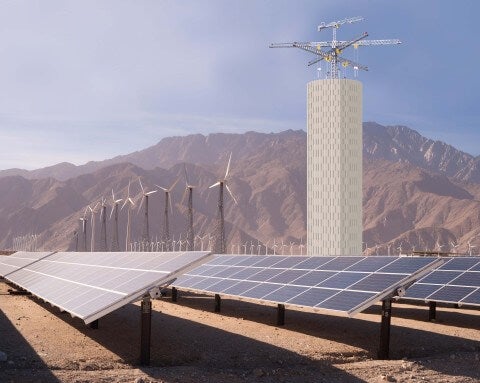
 Energy Vault’s storage solution rendering
]

The energy transition is underway. It’s not just crucial for climate change
that we kick our fossil fuel habit—it will soon be more expensive not to. In
the UK, for example, it’ll soon be cheaper to build new offshore wind farms
than even to run existing natural gas power plants. This is mirrored by
declining prices for renewables around the world.

However, as we electrify heating and transport, electricity demand will
increase. To match supply and demand with intermittent renewables, it seems
likely that we’ll need a great deal more energy storage. So it will come as
no surprise that Softbank is investing $110 million in a storage startup
called Energy Vault. What may be more surprising is the method they’re
choosing for storage: lifting giant blocks of cement with a crane as a form
of mechanical energy storage.

For once, the physics here is simple enough: lifting the block stores energy
in the form of gravitational potential energy, which can be released as
kinetic energy to spin turbines when the blocks are lowered, essentially
just running the motors in reverse. Energy Vault envisions cranes 35 stories
high, with 6 arms, which will stack the concrete blocks around itself when
power generation exceeds demand.

When complete, Energy Vault expects that each site will be capable of
storing 35 megawatt hours and delivering a peak power of 9 megawatts if
required.

At first glance, it’s a pleasingly low-tech solution to a modern problem.
Batteries require rare-earth metals, which can raise their own supply-chain
issues: child labor digging out cobalt in the Democratic Republic of the
Congo is one notable example, and while the lithium for li-ion batteries is
not expected to run low soon, this may change as demand increases.
Meanwhile, Energy Vault hopes to use mostly waste cement that is likely to
be disposed of anyway, and its material demands are much less complicated.

It’s likely also to be cheaper than lithium-ion, at least for the next
decade or so. The company expects to be able to sell storage for $150 per
kilowatt hours by the time it builds its tenth plant, which is around half
of the $280-350/kWh currently required for lithium-ion storage on the grid.
Unlike batteries, the storage capacity won’t reduce over time as the unit is
“charged” and “discharged,” and so it may well have a longer lifespan than
battery farms, 30-40 years.

It’s also a highly efficient process, limited mostly by friction. Energy
Vault claims that up to 90 percent of the electricity stored can be
recovered, which is substantially better than the 70 percent efficiency of
pumped hydro.

So given that mechanical energy storage uses physics that a schoolkid would
understand, is cheaper and easier to manufacture than batteries, and is
highly efficient, why isn’t it everywhere?

There are plenty of startups out there promising to do mechanical storage;
examples include Gravitricity and Advanced Rail Energy storage, which both
lift weights to store energy. Teraloop would store energy in spinning wheels
held aloft by magnetic levitation. This is similar to the flywheels that
temporarily store energy for the experimental JET fusion reactor so that it
doesn’t cause blackouts in Oxfordshire every time it’s switched on.

Compressed air energy storage has been advocated by many for many years. The
first storage plant was built in 1978 and has successfully operated for
decades. However, it still only accounts for a tiny fraction of total energy
storage, and has seen several startups fail after millions of dollars of
investment, even as new startups continue to spring up. The current adviser
for Energy Vault founded a previous mechanical energy storage company,
called Energy Cache, which generated a lot of hype and a demo project back
in 2012 but never managed to scale up.

Looking at the litany of mechanical energy storage startups that have
petered out in recent years, it’s hard not to question whether we really
will see thousands of cranes providing storage for the grid. Competing with
lithium-ion, now an established industry churning out batteries for electric
vehicles as well as grid storage, will be difficult.

But one advantage mechanical energy storage does have is longevity. Matching
supply and demand for a renewable grid has several different timescales
associated with it. Matching supply and demand over 24 hours, with the
variations in wind, solar, and energy demand might be suited to lithium-ion
batteries. Matching seasonal variations in supply and demand—for heating in
winter, say, when solar generation is at a minimum—will require different
kinds of storage altogether.

Energy storage costs would have to fall substantially to make a 100 percent
renewable grid feasible. But most of those costs come from rare events, like
an unusual period of a few weeks where demand is high and generation is low.

Providing baseload or top-up generation with nuclear power, or biomass plus
carbon capture, is one option to reduce these costs. Cheap, long-term
storage could provide another. While the capacity of batteries degrades over
time, and installing enough of them to cover seasonal demand is materially
costly, mechanical solutions like Energy Vault may be able to fill the gap.

Ironically, energy storage may be the victim of its own success. For grids
with, say, 30-40 percent renewables and baseload from fossil fuels or
nuclear power, short-term storage is in higher demand than long-term
storage. As that renewable fraction creeps higher, long-term storage becomes
more important—but if the short-term storage is cheaper than new long-term
storage technologies, they may struggle to find a market niche at first,
which means failed startups and no scaling-up/learning curve that allows the
cost of the technology to come down.

There’s a growing demand for energy storage, and no shortage of clever ideas
for how to achieve it. Time will tell which method ultimately proves to be
the holy grail for the grid. But one must imagine Sisyphus happy—after all,
it turns out his predicament was worth millions of dollars of venture
capital.
[© singularityhub.com]


+
https://www.washingtonpost.com/news/national/wp/2019/10/09/scientists-who-developed-lithium-ion-batteries-were-awarded-the-nobel-prize-in-chemistry-for-creating-a-rechargeable-world/
Scientists who developed lithium-ion batteries were awarded the Nobel Prize
in Chemistry for creating ‘a rechargeable world’
Stanley Whittingham and Akira Yoshino will share the prize. The lightweight
batteries make portable electronics possible, including mobile phones,
pacemakers and electric cars ...


For EVLN EV-newswire posts use:
 http://evdl.org/


{brucedp.neocities.org}

--
Sent from: http://electric-vehicle-discussion-list.413529.n4.nabble.com/
_______________________________________________
UNSUBSCRIBE: http://www.evdl.org/help/index.html#usub
ARCHIVE: http://www.evdl.org/archive/index.html
INFO: http://lists.evdl.org/listinfo.cgi/ev-evdl.org
Please discuss EV drag racing at NEDRA (http://groups.yahoo.com/group/NEDRA)