https://www.bloomberg.com/news/articles/2019-09-18/this-robo-tuk-tuk-will-zip-about-an-upscale-bangkok-neighborhood
This Robo Tuk-Tuk Will Zip About an Upscale Bangkok Neighborhood
September 18, 2019  Randy Thanthong-Knight
[images
https://assets.bwbx.io/images/users/iqjWHBFdfxIU/iWquSEccDwZM/v1/800x-1.jpg
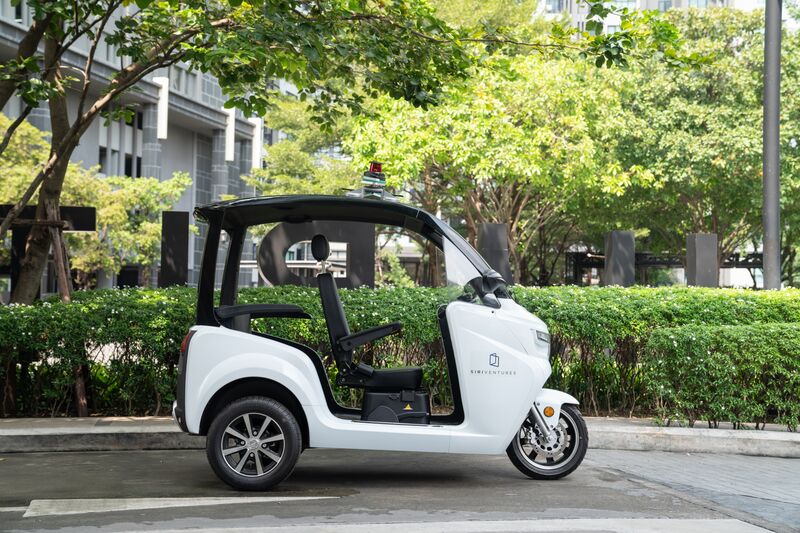
The self-driving tuk-tuk prototype in Bangkok. Photographer: Nicolas
Axelrod/Bloomberg

https://assets.bwbx.io/images/users/iqjWHBFdfxIU/iV9Du_kq79Og/v1/600x-1.jpg
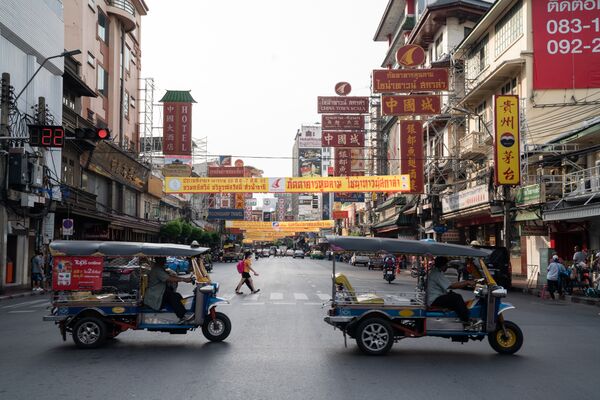
Tuk-tuks drive in Bangkok  Photographer: Nicolas Axelrod/Bloomberg
]

    Startup teams with government for road tests starting November
    Thai industry trying to keep pace with China, Japan robocars

Thailand Jumps on Autonomous Rides With Its Electric Tuk-Tuk

Thailand’s ubiquitous tuk-tuk, the noisy, colorful three-wheeled taxi that’s
been belching exhaust on local roads for almost a century, is getting a
cutting-edge makeover to help carry the local auto industry into the future.

Beginning in November, a public-private partnership will test the nation’s
first self-driving tuk-tuk in an effort to nudge Thailand toward the
forefront of developing autonomous-vehicle technology in Southeast Asia.
Startup Airovr, investor Siri Ventures and the Thai government will run the
monthslong trial inside a gated Bangkok community, hoping that what they
learn can be transferred into bigger vehicles like minibuses.

Most autonomous-driving advancements in Asia come from Chinese and Japanese
companies –- such as Baidu Inc., Pony.ai and Toyota Motor Corp. -– spending
billions of dollars on software development, partnerships and road tests.
Southeast Asia doesn’t have a local champion, so Thailand views the
technology as a way to bolster -- and keep relevant –- an auto industry
generating 12% of its gross domestic product.

“The program can build confidence among regulators and users that these
vehicles can be used on public roads,” said Ekkarut Viyanit, principal
researcher for the government’s National Science and Technology Development
Agency. “This will accelerate acceptance of the technology in Thailand.”

The tuk-tuk was chosen as a test vehicle because the three-wheeler is more
energy-efficient than a car, requires fewer parts, is cheaper and is more
suitable for the country’s hot weather, said Amares Chumsai Na Ayudhya,
founder of Bangkok-based Airovr.

But this isn’t the usual ornate three-wheeler you see on the chaotic streets
of Bangkok and other tourist spots in Thailand. The Airovr model has a
minimalist design, with screens depicting speed and how much electricity is
in the tank.

The 3D mapping system on the roof resembles police sirens, and the interior
has handlebars so the tester can take control if necessary.

Because city streets may be too challenging for early-stage AVs, tests will
be done inside a gated community of 10,000 people owned by Siri Ventures’
parent, property developer Sansiri Pcl.

But that doesn’t mean the tuk-tuk will have an easy ride. The testing area
covers about eight hectares (about 20 acres) and includes eight condominium
towers, a mall, a dental hospital and a school. Cars, motorbikes, bicycles
and pedestrians ply the streets.


“The tuk-tuk will allow us to gather data in a real environment with mixed
traffic,” said Jirapat Janjerdsak, Siri Ventures’ chief technology officer.
“After thousands of rides, we can analyze all of the feedback and
information to scale up the project with bigger vehicles.”

The trial could last as many as six months. Developers will analyze the data
with the intention of scaling up the program with its next-generation
autonomous vehicles -- 15-seat minibuses that Ekkarut calls “shuttlepods.”
They will be manufactured by the government and a local automaker.

Those could be ready for service by as early as 2021.

The end result may resemble the driverless shuttles cruising New York’s
Brooklyn Navy Yard, where four-passenger vehicles travel between the
entrance and a new ferry dock.
May Mobility shuttle

In Detroit, startup May Mobility Inc. runs a small fleet of six-seat
robotaxis taking workers from a parking garage to their office.

Thailand already is Southeast Asia’s car production hub, making almost 2.2
million vehicles last year, and the government is trying to boost investment
in EVs and AVs as the global industry moves in those directions.

Thailand was the first country in the region to offer incentives to EV
manufacturers and to reduce taxes on sales of their cars.

Driverless vehicles will be built on EV platforms, and autonomous technology
will supplement the competitiveness of EVs, said Yossapong Laoonual,
president of the Electric Vehicle Association of Thailand.

With total global sales of self-driving cars expected to reach 21 million
units in 2035, according to IHS Markit, the country could become the
region’s production hub.

“We’re not starting from zero,” Amares said. “We already have an auto
industry with big companies and a pool of talent, and that’s an advantageous
position.”
Production Base

Thailand is Southeast Asia's biggest automaker, and Asia's fifth biggest.

Yet it won’t be easy to move that technology outside the gates. Like many
countries, Thailand doesn’t have many regulations governing the use of
self-driving vehicles on public roads.

A KPMG index measuring countries’ level of preparedness for autonomous
vehicles this year doesn’t include Thailand in the top 25. Singapore ranks
second, Japan 10th, South Korea 13th and China 20th.

The nation’s development agency is working with at least six other offices,
including the Department of Land Transport and the Department of Highways,
to formulate plans for Thai roads.

The earliest Thailand could see AVs on public roads would be 2024, Ekkarut
said. The early adopters are expected to be operators of public fleets and
ride-hailing services.

GrabTaxi Holdings Pte Ltd, Thailand’s main ride-sharing provider, plans to
put robotaxis on the road before 2022. The service likely will launch in
Singapore, where the company is based.

There are about 1,000 test robotaxis on roads worldwide today, according to
BloombergNEF, but that fleet could expand to as many as 27 million vehicles
by 2040.

Sansiri’s goal is to develop self-driving shuttles that can carry residents
of its communities between their home and the nearest mall or train station.
The program then could be expanded throughout Bangkok and into other cities.

“We’re starting now to prepare for the technology that will change how we
travel the last mile,” Jirapat said. “We hope to be part of a small force in
making that happen in Thailand soon.”
[© bloomberg.com]


+
https://www.financialexpress.com/industry/tata-motors-announces-ziptron-technology-to-usher-in-its-future-electric-vehicles/1711735/
Tata Motors announces Ziptron technology to usher in its future electric
vehicles
September 20, 2019  Tata Motors ... electric vehicle powertrain technology
Ziptron, tailor-made for India, which will power a range of Tata electric
cars, ... launch in early 2020 ... every component which converts power into
movement ... e-motor, axles, transmission, and driveshaft ...
https://images.financialexpress.com/2019/09/ev-2.jpg


For EVLN EV-newswire posts use:
 http://evdl.org/archive/


{brucedp.neocities.org}

--
Sent from: http://electric-vehicle-discussion-list.413529.n4.nabble.com/
_______________________________________________
UNSUBSCRIBE: http://www.evdl.org/help/index.html#usub
ARCHIVE: http://www.evdl.org/archive/index.html
INFO: http://lists.evdl.org/listinfo.cgi/ev-evdl.org
Please discuss EV drag racing at NEDRA (http://groups.yahoo.com/group/NEDRA)