https://africageographic.com/blog/electric-wilderness-conservation-sustainable-game-viewing/
Electric vehicles for wilderness conservation and sustainable game viewing
25 September, 2018  Carolin Giarra
[images  / © Mats Ingelborn
https://africageographic.com/wp-content/uploads/2018/09/Mats-Ingelborn.jpg

https://africageographic.com/wp-content/uploads/2018/09/Electric-game-drive-vehicle.jpg
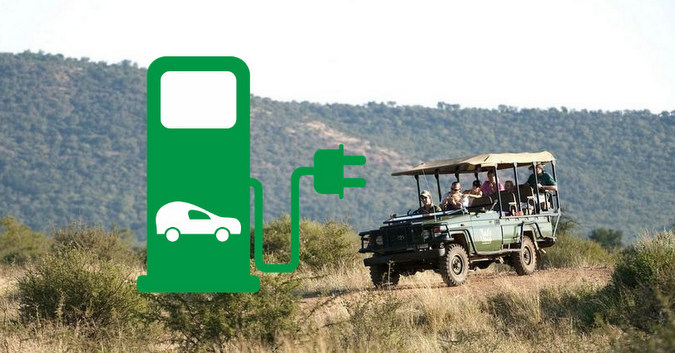
Electric vehicle vector with game drive vehicle
]

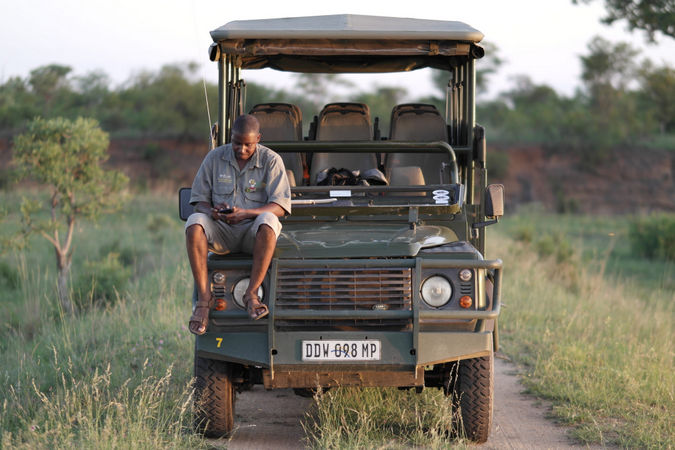
Field guide sitting on game drive vehicle

Written by Carolin Giarra, a student studying towards a Bachelor of
Technology in Tourism Management at the Durban University of Technology

South Africa currently faces the challenge of managing its rich
biodiversity, whilst facing the threat of increased environmental
degradation. The threats are varied, complex and multi-faceted, with climate
change probably one of the most dangerous.

As a result of climate change, temperatures have rapidly increased within
the Kruger National Park region, which experienced the worst drought season
recorded in 2016. Rising temperatures of between 2.5 and 3 degrees Celsius
could lead to an approximate loss of 66% of all animal species in the Kruger
National Park.

National parks are not able to prevent this phenomenon from happening, and
therefore the implementation of mitigation and adaptation strategies is
crucial.

[image] Zebra in Kruger National Park  © Carolin Giarra

The field guides and trackers who are working in the environment and with
the game viewing product every day are at the frontline of implementing
suitable mitigation and adaptation strategies. The work of a field guide has
become more diverse and complex overtime, as they have to face new
challenges each day and lead the way in conserving South Africa’s natural
wonders – from battling wildfires and poachers, to playing an important role
in rehabilitation of land and habitats, and acting as an educational force
in wildlife conservation.

The change in temperature has a significant influence on the behaviour and
activity of animals. Generally, it can be said that animal activity is
higher during the cooler times of the day as the majority of animals prefer
to hide during the heat. This heat factor also impacts on tourism
operations, with game viewing mostly occurring during the cooler times of
day.

Field guides already adjust the times and lengths of the game drive on a
daily basis to cope with changes in temperatures and seasonality. Not only
to ensure a more engaging game viewing environment as animal activity will
be greater, but also to ensure guest comfort. They further adapt to changes
in the environment by restricting the accessibility of certain areas or
roads in times of temperature change as the ground, soil and the vegetation
is affected. These are all efficient responses to adapt to changes, however
field guides should consider campaigning for more future-oriented solutions.

The world has seen a lot of technological development focused on making
operations more sustainable. A lot of research is dedicated to the possible
use of hybrid or electric vehicles for game drives. This development would
bring a number of environmental benefits, ranging from the positive effects
on the carbon footprint as vehicle emissions will be reduced, to the
positive effect of no engine noise during a drive.

An average car emits 280% more carbon per mile than an electric vehicle,
even if the electric vehicle is charged with electricity that was generated
mostly using coal. An electric car charged with renewable energy emits zero
carbon per mile. This will have a great impact on a region which already
faces a diminished volume of greenhouse gas emissions and would also
positively affect the sensitive environment within the conservation areas.

A number of interviewed field guides share the opinion that the
technological development is not yet feasible. A game viewing vehicle is
required to reach a certain transport distance and at the same time also
provide the same 4×4 experience. The field guides mentioned a required
distance of up to 100 kilometres per viewing, requiring technology to
provide for these demands.

[image] Elephant in Kruger National Park  © Carolin Giarra

Additional concerns were brought forward regarding the effect of no engine
noise. The field guides insist that it would be a positive feature of the
game viewing experience as it would reduce the noise pollution caused whilst
on drive, which can reduce the serenity of the game reserves. But it would
unfortunately also remove the ‘alarming’ factor of a game vehicle. With no
noise coming from the vehicle, animals will not be aware of a vehicle
approaching and the sudden intrusion could, according to the field guides,
give the animals reason to behave in an aggressive, protective and defensive
manner. These opinions contradict each other vastly in how game viewing
should be conducted. Nevertheless, electric vehicles are an attractive
alternative, specifically for tourism within protected areas.

It is no question that climate change is the greatest challenge of our time,
and also threatens the steadily growing safari industry in South Africa.
Field guides should campaign and create an increased demand for hybrid or
electric game viewing vehicles, and push to raise awareness that this
development is needed and can be tested in a real-life environment.

Every small step counts and the field guides, trackers and everyone else
working in the growing safari industry in South Africa should campaign for
more efficient and sustainable development.
[© africageographic.com]


+
https://venturebeat.com/2018/09/26/uber-launches-jump-electric-bike-charging-stations-as-part-of-sustainable-mobility-push/
Uber launches Jump electric bike charging stations as part of sustainable
mobility push
2018/09/26  It signaled Uber’s long-term mission to provide urban transport
options for all scenarios, where cars maybe aren’t the best ...
https://venturebeat.com/wp-content/uploads/2018/09/JUMP-charging-stations-at-Sac.-city-college-light-rail-station.jpg?fit=578%2C322&strip=all


For EVLN EV-newswire posts use:
 http://evdl.org/archive/


{brucedp.neocities.org}

--
Sent from: http://electric-vehicle-discussion-list.413529.n4.nabble.com/
_______________________________________________
UNSUBSCRIBE: http://www.evdl.org/help/index.html#usub
http://lists.evdl.org/listinfo.cgi/ev-evdl.org
Please discuss EV drag racing at NEDRA (http://groups.yahoo.com/group/NEDRA)