https://www.sfchronicle.com/business/article/Touring-Tesla-s-Model-3-production-line-the-13089341.php
Touring Tesla’s Model 3 production line, ‘the machine to build the machine’
July 19, 2018  David R. Baker
[images  / Lea Suzuki, The Chronicle
https://s.hdnux.com/photos/74/47/56/15891370/5/rawImage.jpg
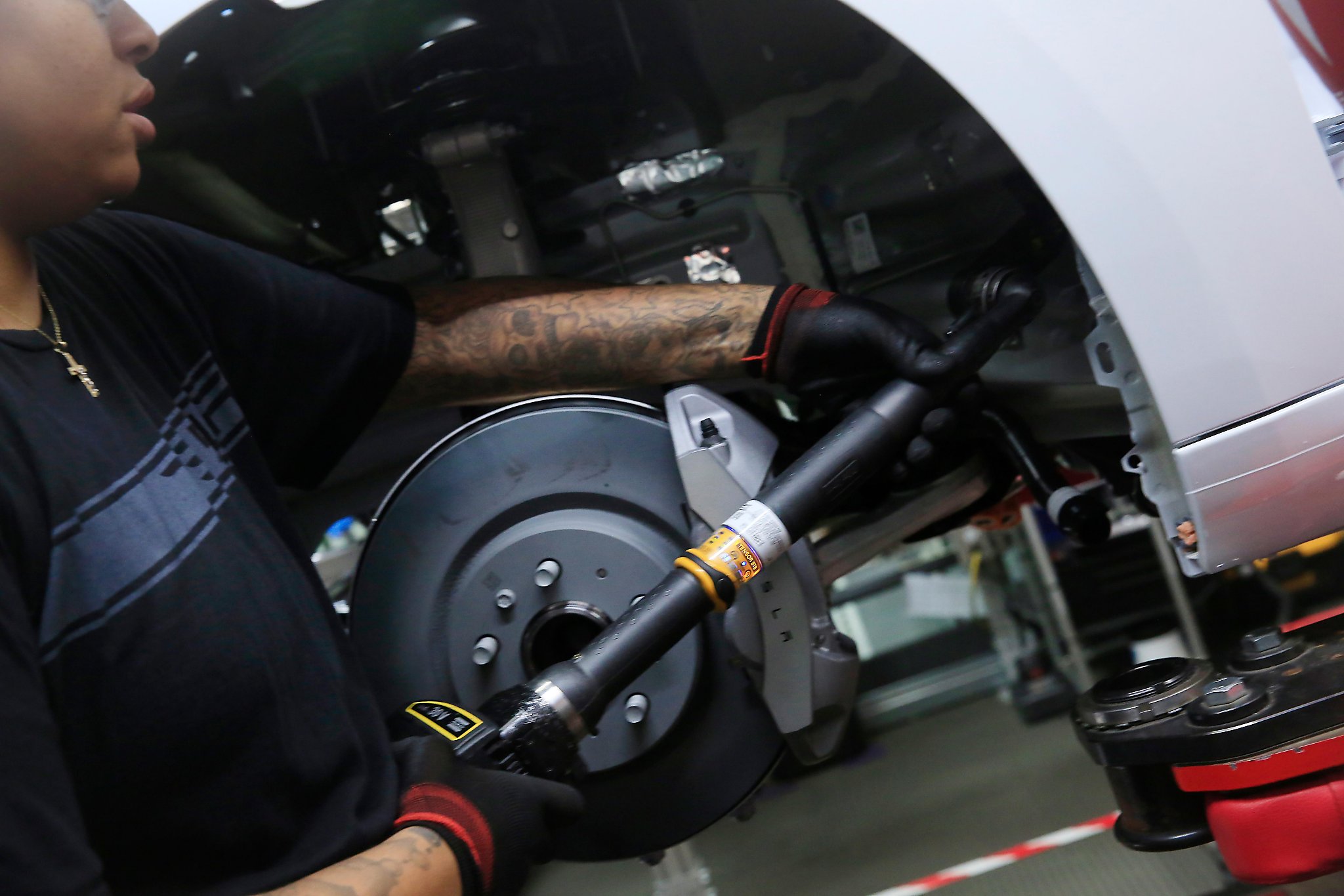
    A production associate demonstrates how to use a tool while working on a
Tesla Model 3.

https://s.hdnux.com/photos/74/47/56/15891370/5/rawImage.jpg
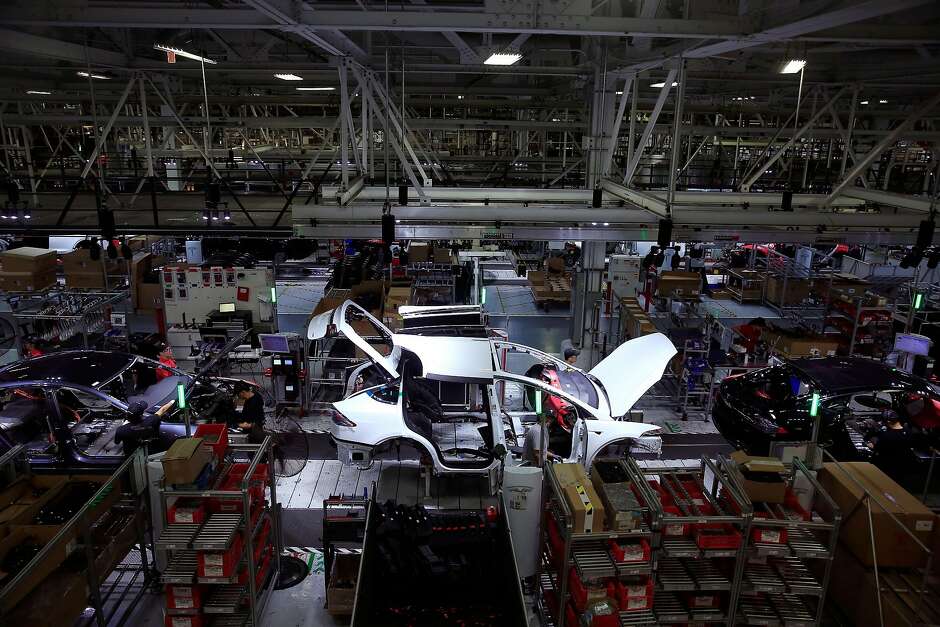
    Some tasks require the human touch, but Model 3 production remains
heavily, strikingly automated, with robots handling body assembly.

https://s.hdnux.com/photos/74/47/56/15891370/5/rawImage.jpg
    Workers perform tasks that require more dexterity than the robots
possess. Tesla says it is now turning out 5,000 Model 3s each week.

https://s.hdnux.com/photos/74/47/56/15891370/5/rawImage.jpg
    A production associate works in the body line for the Tesla Model 3.

https://s.hdnux.com/photos/74/47/56/15891370/5/rawImage.jpg
    Although the automation is intended to speed up car production, and help
Tesla become a true mass-market automaker, it also may reduce the risk of
injury to workers.

(image) 6 of 10
    Andre Rivera is one of 10,000 human workers at the Tesla plant who work
alongside thousands of robots.

https://s.hdnux.com/photos/74/47/56/15891370/5/rawImage.jpg
    Officials say injuries are down this year.

https://s.hdnux.com/photos/74/47/56/15891370/5/rawImage.jpg
    Increasing Model 3 production is critical for Tesla.

 https://s.hdnux.com/photos/74/47/56/15891370/5/rawImage.jpg
    As it ironed out problems in the process, Tesla has repeatedly shut down
Model 3 production this year to make tweaks before cranking up again.

https://s.hdnux.com/photos/74/47/56/15891370/5/rawImage.jpg
    A production associate fills a bin with parts while working on a Tesla
Model 3 at the Tesla factory on Wednesday, July 18, 2018 in Fremont, Calif.

https://s.hdnux.com/photos/74/47/56/15891365/5/940x940.jpg
Tesla is also producing Model S and Model X vehicles at the plant. That
production is less automated.

https://s.hdnux.com/photos/74/47/47/15890925/7/940x940.jpg
A Tesla Model 3 is seen on the assmebly line at the Tesla factory on
Wednesday, July 18, 2018 in Fremont, Calif.

https://s.hdnux.com/photos/74/47/56/15891343/5/940x940.jpg
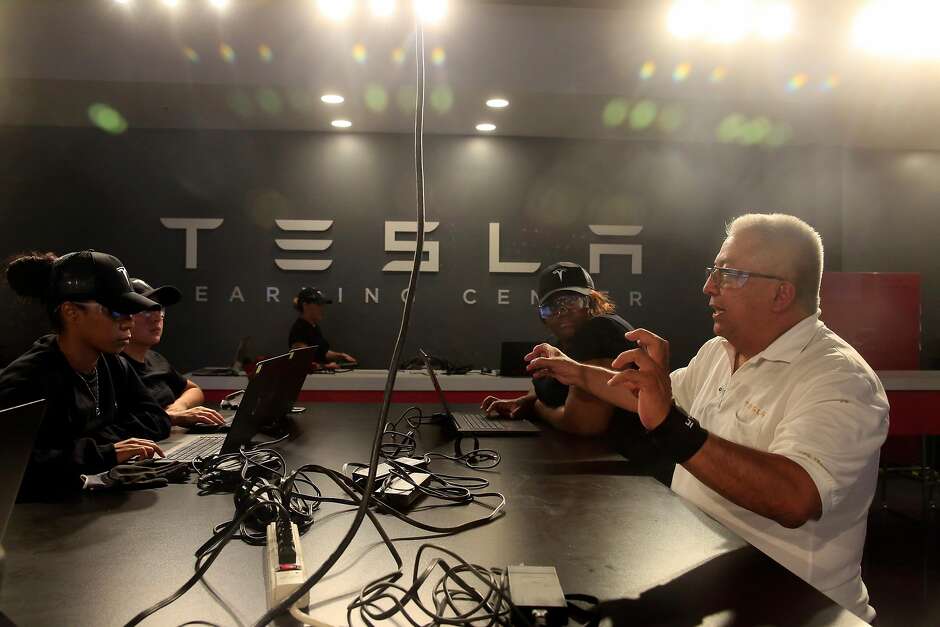
Al Marcos, training coordinator, works with new hires in the Tesla Learning
Center in Fremont in July.
]

Inside Tesla’s Fremont factory, six red robot arms bob and weave over a
small piece of silver metal that will soon become part of a Model 3 sedan.

A clear plexiglass wall separates them from any humans who might be nearby.
Most of the time, however, no one is. Even in a factory that employs 10,000
people.

The arms perform their tightly choreographed work, then pass the part on to
another station, where another set of robots takes over. Meanwhile, an
elevated conveyor line slowly moves partially assembled car bodies overhead.

Since CEO Elon Musk delivered the first electric Model 3 sedans at a party
behind the factory last July, the company has struggled to rev up production
of the car, considered the key to Tesla’s financial success. Musk has blamed
the delays, at least in part, on over-automation, saying Tesla at first
tried to use robots for many tasks that are better handled by humans.

Now Tesla has finally reached its goal of building 5,000 Model 3s per week,
and the production line — opened up for a tour to The Chronicle this week —
is humming. And while Musk has talked about re-introducing humans into the
Model 3 process, it remains heavily, strikingly automated.

It is, in fact, quite different from the separate production line that
builds Tesla’s Model S sedan and Model X SUV elsewhere in the factory, where
employees in black shirts and baseball caps swarm over car bodies carried on
robotic carts. So pronounced is the contrast, it feels as if Tesla has
crammed together two factories under one roof.

“One of the challenges we had was to reduce human intervention as much as
possible,” said Charles Mwangi, Tesla’s director of body engineering, his
voice nearly drowned out by the Model 3 body line’s constant whirrs and
piercing beeps.

Musk has for years described his vision for the future of auto production as
“the machine that builds the machine,” an expression memorialized on
T-shirts worn by some of the factory workers. And to tour the Model 3 body
line does indeed feel like walking through an immense machine that may be
supervised by humans but doesn’t need their constant input.

Robots from suppliers Kuka and Fanuc — 1,028 machines in all — spin parts,
screw in bolts and weld, sparks flying behind the plexiglass. Flashing red
and yellow lights at each work station will signal when a particular robot
requires maintenance, while a green light indicates smooth operation.
Meanwhile, there’s almost as much activity — again, automated — happening
overhead as there is on the floor.

“You pay for space in cubic feet — you might as well use it,” Mwangi said.

He joined Tesla in 2012, when the company released the Model S. At the time,
Tesla occupied just a corner of an otherwise empty factory, formerly the
home of New United Motor Manufacturing Inc., or NUMMI.

By the time Tesla was gearing up for the Model 3, the factory was no longer
empty. Designing the machine to build the machine, and fitting it into the
limited space available, required extensive planning.

“We used a lot of simulation, 3-D simulation, but we had to get it right
before we built it,” Mwangi said.

In its drive to hit the 5,000-car-per-week target, originally forecast to
happen last year, Tesla also had to improvise. In June, it erected an
immense tent next to the factory to handle some of the Model 3 assembly
tasks. The Chronicle’s tour of Model 3 production this week did not include
the tent.

The Model 3 production process is not fully automated.

Even sophisticated industrial robots, for example, can have trouble
manipulating flexible parts, like wires. Musk talked this spring about how
Tesla had tried to use a “flufferbot” to place a fluffy fiberglass mat on
top of car battery packs. It didn’t work — not reliably, anyway — and gummed
up what should have been a quick, simple step.

“Machines are not good at picking up pieces of fluff,” Musk said. “Hands are
way better at doing that.”

So the robots in the Model 3 production process do leave some tasks to
humans. On a mezzanine near the heart of the plant, robots lift and “marry”
the underside of the car — which contains the electric vehicle’s long, flat
battery pack — to the body, a step that can be risky for people, considering
the weight of the pack. Once the parts are married, however, humans attach
the brake cables, a job that requires dextrous fingers.

Although the automation is intended to speed up production, and help Tesla
become a true mass-market automaker, it also may reduce the risk of injury
to workers.

Employees trying to unionize the factory have complained for years about
injuries at the plant, and a workplace safety group issued a report last
year saying that the plant had far higher injury rates than the auto
industry’s average.

Laurie Shelby, Tesla’s vice president of environmental health and safety,
said the company’s accident rate this year is about 10 percent lower than
last year’s, and the rate of severe injuries has fallen 20 percent. Injuries
related to repetitive motions and stress, which automation can help avoid,
account for about 75 percent of injuries at the plant, she said.

“It’ll definitely help ergonomically, for sure,” Shelby said. “But you still
have people working with the automation.”

As it ironed out problems in the process, Tesla has repeatedly shut down
Model 3 production this year to make tweaks before cranking up again. Chris
Moral, a quality engineering technician on the Model 3, said the quality of
the cars has increased over time.

“It’s definitely improved since we started,” he said, at a safety fair for
workers outside the factory. “All around, really — paint quality, the way
the body fits. So we’re definitely on an upswing.”

Moral, 34, used to work at the plant in its NUMMI days, and he said the
changes, including the automation, are remarkable.

“It’s definitely different — it’s an eye-opener,” Moral said. “But this is
2018, and it’s Silicon Valley.”
[© sfchronicle.com]


+
https://motherboard.vice.com/en_us/article/xwkyj3/tesla-ev-rebates-cancelled-elon-musk-cult
A Tesla Is Not Just a Car for Elon Musk's Superfans
Jul 20, 2018  Respondents said they dislike other electric-car companies
because they believe ... that he likely wouldn't have bought another EV,
with or without an incentive ...
...
https://www.wired.com/story/tesla-range-record-munro-profitability-model-3/
Beyond Elon Musk's Drama, Tesla's Cars Are Thrilling Drivers
7.20.18
https://media.wired.com/photos/5b50fa81c4622c0b58ac8be7/master/w_582,c_limit/TeslaAgain_RTS1UB3N.jpg


For EVLN EV-newswire posts use:
 http://evdl.org/archive/


{brucedp.neocities.org}

--
Sent from: http://electric-vehicle-discussion-list.413529.n4.nabble.com/
_______________________________________________
UNSUBSCRIBE: http://www.evdl.org/help/index.html#usub
http://lists.evdl.org/listinfo.cgi/ev-evdl.org
Please discuss EV drag racing at NEDRA (http://groups.yahoo.com/group/NEDRA)