To All,
I am reposting from last year asking for any available advice as me and my
cousin continue to try to help get my uncle's EV project started in 1984 to
a successful conclusion.


I am still trying to help my uncle realize his main bucket list item while
there is still time. He has been working off and on for over 30 years to
slowly build an electric car. When he attempted to power it for the first
time last year the controller failed to trigger the contactors to send power
to the motor. He said all he wants to do is to drive this car at least once
before he dies. He gets up every day and puts on his union machinist suit
and goes to work in a construction company warehouse in Ludlow Massachusetts
doing maintenance and machinery repair. He has started talking about
retiring and would then need to find another location for the EV project car
if it is not yet finished. So I was asked to come take a look.  In my
distant past I have a degree in electrical engineering and have experience
with SCR controlled injection molding machines so theoretically I should
technically understand all documentation and pretty much understand how
things should work.


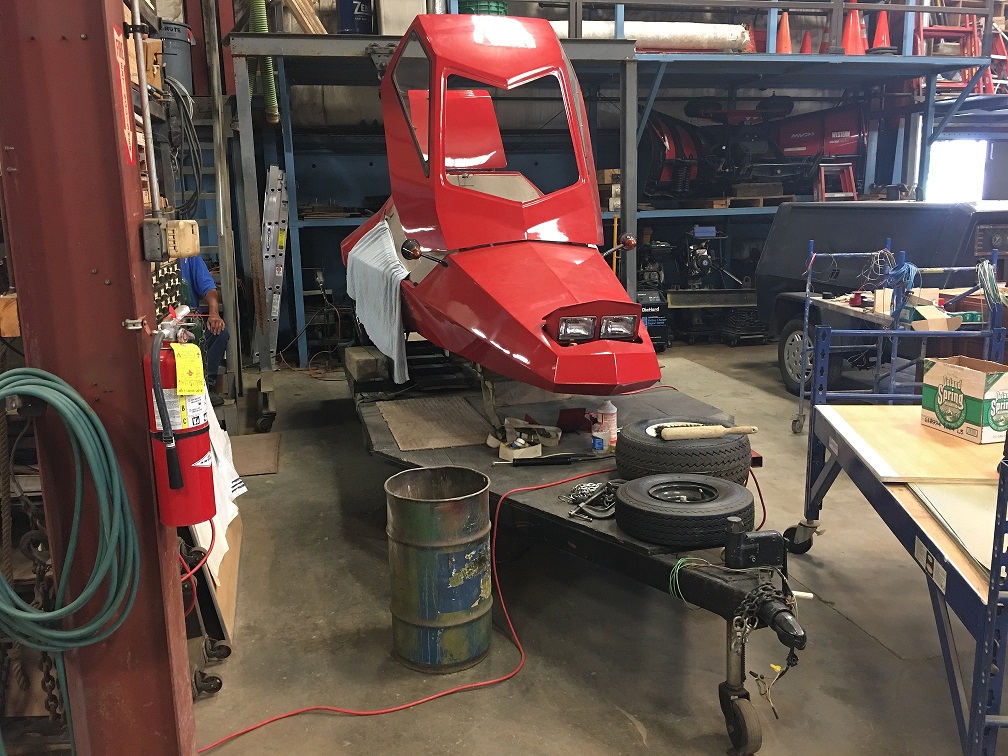
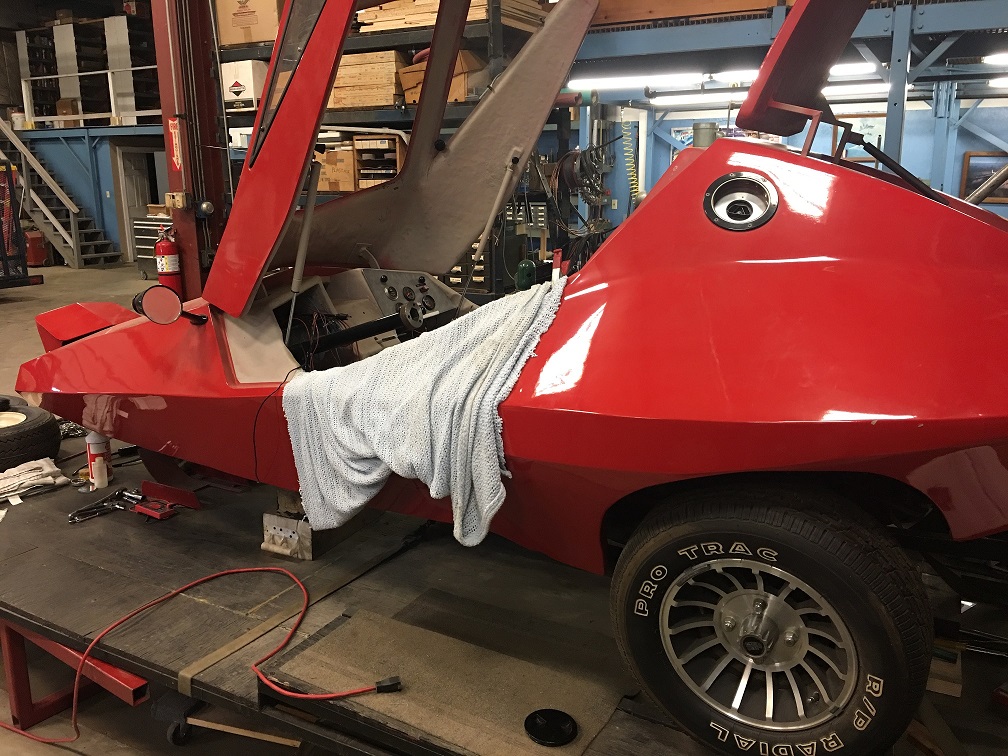
The car chassis was hand built:


http://ptandjb.com/eddiesEV1/carfront0491.JPG


http://ptandjb.com/eddiesEV1/carside0490.JPG


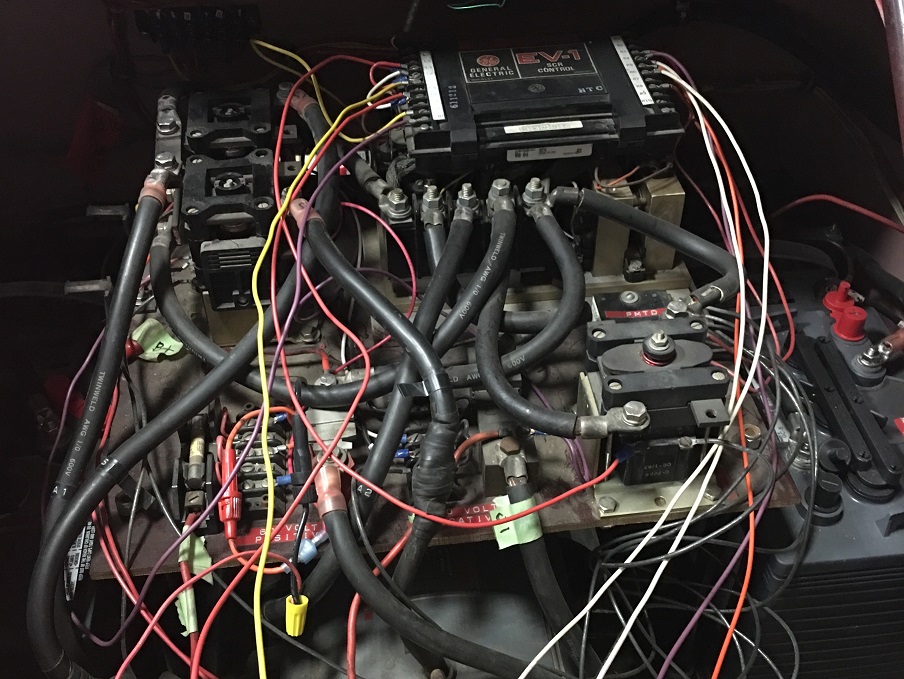
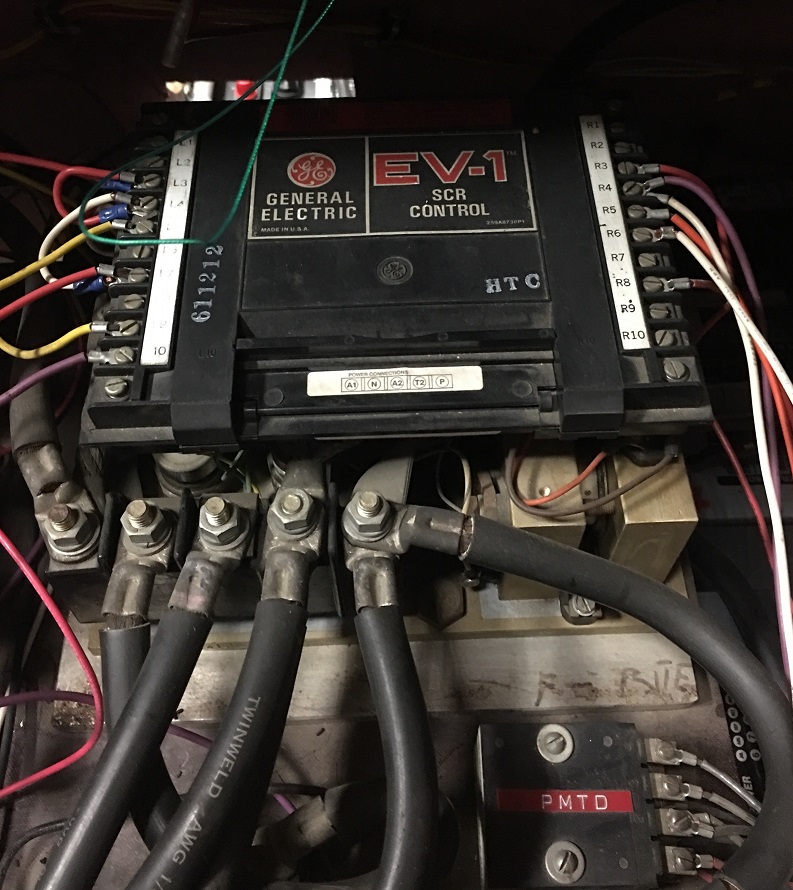
Overview of controller assembly:


http://ptandjb.com/eddiesEV1/EV1fullview0483.JPG


http://ptandjb.com/eddiesEV1/EV1closeup0485.JPG


I had thought last year we had proven that the EV1-B controller was
defective and went back last month to try to disassemble and test the
controller. We repeated our original investigation, with SEAT and BRAKE
switches bypassed and KEY, FWD, and ACCEL switches appropriately set there
was no contactor activation. Looking more carefully at the documentation, I
realized that I had not considered STATIC RETURN TO OFF and PULSE MONITOR
TRIP requirements, and could no longer conclude I had proven the controller
defective. I was confused as the exact process (see confusing manual
excerpts below). Because I was not up to speed on these requirements, we
called it a day and I came home to study documentation and try to figure out
a way forward. An initial successful outcome would be sending power to the
motors in forward or reverse in START ACCELERATION mode.


>From the manuals:


The control circuit is energized by closing the Key switch, Seat switch, and
moving the Forward or Reverse lever to either position and then depressing
the accelerator, thus closing the Start switch. This applies power to the
control card and, if the "static return to OFF" requirement and the pulse
monitor trip requirement are satisfied, turns on the PMT driver, which will
close the selected directional contactor, completing the circuit to the
traction motor. The directional contactor is controlled by the directional
switch.

*      STATIC RETURN TO OFF - this built-in feature of the control requires
the operator to return the directional lever to NEUTRAL anytime he leaves
the vehicle and returns. If the Seat switch or Key switch is opened, the
control will shut off and cannot be restarted until the Directional switch
is returned to NEUTRAL. A time delay (0.5 seconds) is built into the Seat
switch input to allow momentary opening of the Seat switch. This same delay
requires the Directional switch not be closed until both the Key switch and
the Seat switch have been closed for 0.5 seconds.

*      PULSE MONITOR TRIP - this function contains three features: The look
ahead, the look again, and the automatic look again reset.

If 1 REC (the main SCR) is shorted or lA is welded. PMT will look ahead and
prevent F or R from closing if either condition exists.

If 1 REC fails to commutate, or if lA power tips remain closed when they
should be open, the control will open F or R contactor. PMT will then look
again by testing for a fault and, if none, reclose F or R. If the fault
still exists, the F or R will reopen and remain open.

If lA closes before a second commutation failure, the look again counter
will automatically reset. This eliminates the inconvenience of resetting the
PMT with the key switch if the tripping is due to random noise.

When the PMT circuit prevents F or R from closing, the PMT circuit can be
reset only by opening the Key switch.


I have uploaded various relevant files from various sources to my web domain
in directory where they can be viewed or downloaded:


http://ptandjb.com/eddiesEV1


                EV-1 Spec1.jpeg                               1st page
original EV-1 controller spec sheet

               EV-1 Spec2.jpeg                                2nd page
original EV-1 controller spec sheet

               EV1.pdf                                                EV-1B
Troubleshooting Manual & Parts Lists (59 pages)

               EV1WireDiagram2.docx                 EV-1B Wiring Diagram as
Word Document

               EV1WireDiagram2pdf.pdf            EV-1B Wiring Diagram as PDF
Document

               EV1closeup0485.JPG                      EV-1B close-up view

               EV1fullview0483.JPG                      EV-1B full view

               carfront0491.JPG                             front view car
chassis

               carside0490.JPG                               side view car
chassis

               ev1maint1.pdf                                  GE EV-1
Troubleshooting and Repair Manual part 1 (22 pages)

                ev1maint2.pdf                                  GE EV-1
Troubleshooting and Repair Manual part 2 (19 pages)

                ge_ev1_rs_notes.pdf                    Roger Stockton's EV-1
SCR DC Motor Controller Notes

ge_ev1_rs_notes.docx                 Roger Stockton's EV-1 SCR DC Motor
Controller Notes (edited)


Before our next trip to Ludlow to further evaluate the EV1-B, I have some
questions:


Is there anyone familiar with the GE EV1-B controller willing to talk to me
on the phone and/or correspond by email and/or make a visit to see the car
to render technical assistance? All reasonable expenses would be covered.
Also Facetime video call assistance is an option.


Is there a way satisfy/bypass/eliminate the PMT requirement to rule that out
as a problem? I have trouble figuring how to understand its function.


If we prove a failure of the EV1-B controller does anyone have experience
working on this unit?


If demonstrated defective, are there repair options available sufficiently
local to Ludlow Massachusetts that can visit the site or are there sites we
can bring or ship the EV1-B controller? A typical forklift repair technician
may simply want to replace the EV1-B unit and not troubleshoot faults inside
the unit.


Is there a source for spare parts/technical support for the EV1-B controller
if we get inside the box?


Thanks in advance for help, if fortunate to succeed there will be a YouTube
video of a successful outcome. This email will be cross posted at
diyelectriccar.com and evdl.org.


Paul Traceski


-------------- next part --------------
An HTML attachment was scrubbed...
URL:
<http://lists.evdl.org/private.cgi/ev-evdl.org/attachments/20180724/5eec270b/attachment.html>
_______________________________________________
UNSUBSCRIBE: http://www.evdl.org/help/index.html#usub
http://lists.evdl.org/listinfo.cgi/ev-evdl.org
Please discuss EV drag racing at NEDRA (http://groups.yahoo.com/group/NEDRA)