http://www.caradvice.com.au/597293/2018-nissan-leaf-review/
2018 Nissan Leaf review
2017/10/31  Mike Costello
[images
http://s3.caradvice.com.au/thumb/960/500/wp-content/uploads/2017/10/2018-nissan-leaf-first-drive-review-35.jpg

http://res.cloudinary.com/caradvice/image/upload/c_fill,q_auto,f_auto,w_700,ar_16:9/v1509414178/j89wre2bredrneqd8aw1.jpg

http://res.cloudinary.com/caradvice/image/upload/c_fill,q_auto,f_auto,w_700,ar_16:9/v1509412762/or6ehacdkhivoe0jbzl6.jpg

http://res.cloudinary.com/caradvice/image/upload//v1509411993/f7sm4b2qiqxuf4a1alax.jpg

http://res.cloudinary.com/caradvice/image/upload/c_fill,q_auto,f_auto,w_700,ar_16:9/v1509411582/ahby6qlr0b6ngto6oson.jpg

http://res.cloudinary.com/caradvice/image/upload/c_fill,q_auto,f_auto,w_700,ar_16:9/v1509414183/bkvmprbnq3bthij8oxes.jpg

http://res.cloudinary.com/caradvice/image/upload/c_fill,q_auto,f_auto,w_700,ar_16:9/v1509414183/wdyyrhrpoyrgcjtvrdao.jpg

http://res.cloudinary.com/caradvice/image/upload/c_fill,q_auto,f_auto,w_700,ar_16:9/v1509414183/kkefnlx4xmp6ea5n2vod.jpg

http://www.caradvice.com.au/597293/2018-nissan-leaf-review/photos


video
https://www.youtube.com/v/iii2rJcJYBQ
]

The 2018 Nissan Leaf must remind people that its maker was the world's real
mainstream EV pioneer, even if Silicon Valley gets the plaudits. It's not
the game-changer its predecessor was, but credit where it's due.

Pros and Cons

Pros
    Claimed range opens more doors
    Revised cabin displays a step up
    Smooth and punchy electric drivetrain
    Solid array of driver aids meet class standards

Cons
    Could use more sex appeal
    Lack of steering column reach adjustment
    Indicated $50k price will be a hurdle if true
    Australian deliveries likely 12 months away

Nissan’s decision to launch the first Leaf electric car way back in 2009 was
akin to a military leader from ancient history dashing into the fray of
battle without ensuring his soldiers were following close behind.

Here the company was, rolling out a mainstream EV across the world before
most rival carmakers had so much as figuratively rallied their engineers. It
was a major gamble, but one that Nissan boss Carlos Ghosn saw as an
essential differentiator for the years ahead.

Anyone who’s into the tech game knows that being an early adopter makes you
a crash-test dummy for any problems that arise. But at the same time, you
can stake a claim to leadership if the field matures. And Nissan always
thought this was a certainty.

Now it’s time to capitalise, and the new Leaf is tasked with doing exactly
this – cashing in on Nissan’s deserved status as the maker of what has long
been the world’s most popular EV, often by something approximating default,
in a now rapidly maturing market.

Sure, the segment is still relatively small, but major players such as
Volkswagen will launch its own populist EVs by 2020, and industry analysts
predict the pricing of electric and combustion-engine cars will converge
around 2025. Earlier if subsidies apply.

The other reason why the new Leaf is so vital is that Nissan must remind the
public that it is the true EV innovator for the masses, alongside alliance
partner Renault and perhaps BMW, and reclaim the limelight from Tesla, which
has used its charismatic founder to steal everyone’s thunder without yet
offering product the average person can hope to afford.

So what has Nissan done over the past eight years? The answer is tantamount
to ‘enough – for now’. The new Leaf for 2018 comes with a redesigned skin
sitting on a reworked platform that houses a ‘denser’ lithium-ion battery
pack that offers a much longer driving range between recharges, the headline
figure for any prospective EV buyer.

It also gets Nissan’s latest active safety driving aids that allow partial
‘one-lane’ hands- and feet-free driving, a ramped-up regenerative braking
system like the BMW i3’s that allows one-pedal urban commuting, and the
company’s revamped infotainment displays/UI that finally match slicker rival
units.

Where to begin…

Nissan has developed the Leaf’s now 40kWh Li battery pack to house cells
with 67 per cent greater density compared to the 24kWh 2010 launch model,
and has worked on improving durability by playing with the internal
chemistry.

The resultant 400km driving range ceiling is about triple the original
Leaf’s, and more than double the iterations uprated with 30kWh packs, even
though the actual battery array is the same size as before.

Buyers will arrive at a full charge in 16 hours if using a 3kW connection,
or eight hours if using a more powerful 6kW point. Quick-charging capability
will get your energy reserves to 80 per cent in 40 minutes, if you’ve access
to public charge points.

The new drivetrain makes power of 110kW and instant torque rated as 320Nm,
up 38 per cent and 26 per cent respectively, cutting the claimed 0-100km/h
time to 8.0 seconds. The kerb weight is about 1500kg, around 200kg heavier
than an equivalent-size IC car like a Mazda 3.

For context, how does this compare to Australia’s favourite EV, the BMW i3
94Ah? The carbon-fibre Bimmer is about 200kg lighter, its 125kW/250Nm motor
helps it dash to 100km/h about 0.7sec faster, and it tops up to 80 per cent
on a fast-charger in 39 minutes. Its 33kWh battery gives an inferior range
of about 300km on the European cycle though.

So this Nissan edges the BMW, which it should given the pace at which the
market develops. And its lead will be eroded fast if it isn’t proactive,
which is why Nissan says it will also offer a Leaf with more power and
longer range, at a higher price, during 2018.

This is to ward off imminent competitors such as the 2020/21 Volkswagen I.D
and its expected 600km range, plus high-end Golf diesel-matching price, and
the Tesla Model 3 when and/if that company gets production ramped-up to
satisfy the orders it has taken deposits on.

Looking ahead further still, the company is working on solid-state batteries
that theoretically offer even greater ranges. Battery makers are also making
huge progress on rapid charging to improve convenience, while Nissan and
others are also preparing to trial wireless/contactless inductive-charging
conducted via pads and coils, rather than plugs.

But that’s all for the future. Here in the now we can report the MY18 Leaf’s
driving characteristics reminded us why EVs have such an obviously strong
future for a sizeable part of the population – especially the majority of
car-using humans: city-dwellers.

Acceleration is frisky, especially off the line where the motor’s
instantaneous torque delivery gets you up and running fast, equivalent to a
proper sports car out to about 60km/h before it starts to taper. The
single-speed gearing is also a novel feeling, bringing momentum on with a
surge rather than gradation.

The there’s the feted ‘e-Pedal’ with energy recuperation that gives a
deceleration rate of up to 0.2 g when you lift off the throttle, effectively
bringing the car to a stop without braking.

Once you become familiar, the car’s actual brake pedal will collect dust
until you leave the urban sprawl – as our time spent in the similarly
equipped BMW i3 showed us – or unless some numpty cuts you off. The only
downside is the wooden pedal feel if you actually do need to apply said
middle pedal. This could use a tweak.

Nissan’s fan-dangled ProPilot suite offers claimed single-lane autonomy. But
forget the nice marketing, it’s just a package of lane-departure prevention
that can control the steering if lane markings are clear, and adaptive
cruise control that brings the car to a halt, and keeps it there until you
hit a button on the steering wheel.

Still, this Level 2 autonomous tech package felt as deft as those in much
pricier BMWs and Mercedes-Benzes on our brief Tokyo test drive, and we would
point out that Nissan has been at the pointy end of driverless car research
for a long time now – even if it's mostly only emerged in concept form
compared to the Germans. We'll wait to drive it locally...

Finally there’s a ProPilot parking system that controls throttle, braking
and steering to put the car into parallel or perpendicular bays all by
itself. All you have to do is hold a button and thanks to the car’s four
high-res cameras and 12 ultrasonic sensors, it parked us just fine, albeit
slowly.

Along with all this, the Leaf gets AEB, blind-spot monitoring, a 360-degree
overhead camera, a system designed to prevent accidental pedal
misapplication from actually causing harm in most cases (Nissan actually
cited Japan's ageing population as its motivator), cross-traffic alert and
traffic sign recognition cameras and data processors.

From a ride and handling perspective, the Leaf’s revised legacy platform
limits any hope of hot hatch dynamism, though for urban driving the light
steering (feel-free despite new software and stiffer steering torsion bar)
and silent drivetrain are ideal, even if the latter merely maximises road
roar from tyres and wind.

Heavy components including the battery are placed in the centre of the body
and low, to improve stability. The rear bump stops are now rubber not
urethane, though honestly on our test loop we only encountered marble-smooth
roads. Though we can’t imagine it’s less at home on patchy extra-urban
surfaces than the skinny-tyred and sometimes-graceless BMW i3…

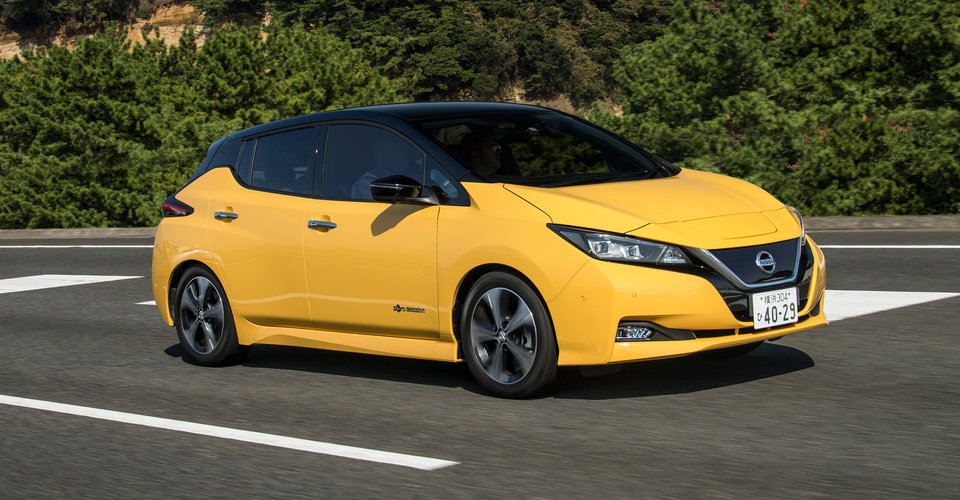
What do you think of the design? It’s certainly more conventional than
before, likely more capable of appealing to a mainstream audience, less
polarising than the i3, probably not as classically chic as a Renault Zoe.
Though the plethora of bright colours are hit/miss. Dark red, yes. Bright
yellow, eurgh.

It is inspired by the IDS Concept car from the 2015 Tokyo Motor Show, albeit
very toned-down, which is a shame. There’s a similar brand-signature
V-Motion grille, boomerang light array and ‘floating’ (contrast-painted)
roof.

The body also has a slippery 0.28 coefficient-of-drag rating thanks to a
roof and floor that direct air flow to converge behind and away from the
car’s tail, while the angle of the charging port at the front has been
reconfigured for greater convenience, letting the customer connect the
charging cable without bending down.

“The philosophy behind the exterior design was to express clean and simple
lines and a robust and sleek silhouette, creating the feeling of a high-tech
device,” Nissan claims. In case you were interested.

The Leaf’s cabin belies the car’s Mazda 3-rivalling dimensions thanks to the
floor design and high roof, comfortably seating four adults. The battery
mounting point also allows a deep boot with a huge 435-litre capacity,
albeit at the expense of any type of spare wheel – though Australia will
likely pick up a space-saver spare as an option, as it should.

There’s a new infotainment screen with simple menus and belated Apple
CarPlay integration is Nissan’s finest to date, while its NissanConnect
integration system lets you look for continuously updated information such
as the location and operating hours of free charging stations and charging
station availability.

Owners can also use their smartphone to check the car’s battery status and
switch on the air conditioning, heating and charging process remotely.

On a side note, we played with a working trial version of a new Nissan app
on a kind Japanese engineer’s phone, that lets you keep an eye on all of
your car’s data by pulling it from an Alliance cloud server, and found it
way more intuitive than BMW’s i app.

The instruments ahead of you also come complemented by a TFT digital display
with a range of sub-menus, including ones that show what the battery pack
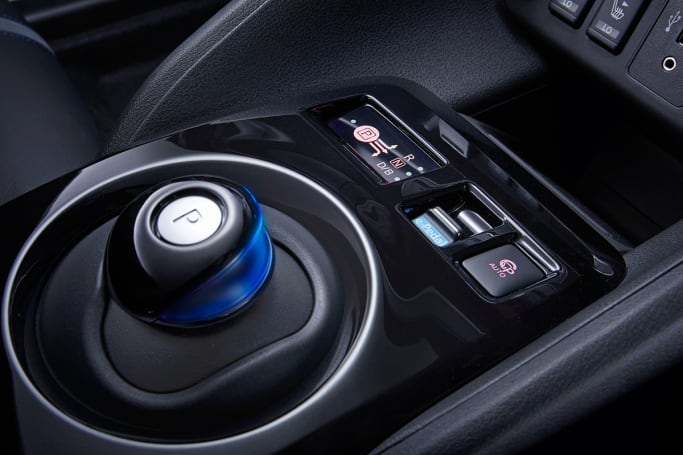
and motor are doing in real-time. We also dig the button placement and the
little gear shifter/knob.

Less ideal are the hard plastics everywhere that feel far from premium,
though in fairness this is a common Japanese design ethos, and the lack of
telescopic steering column adjustment that really waters down what are
otherwise excellent ergonomics.

Our tester was fitted with one notably cool option: a camera display in the
rear-view mirror housing that shows you what’s behind no matter what’s in
the cabin. We loved it, though some people we spoke with didn’t. Try before
you buy.

On the topic of buying, here’s one major sticking point. The Leaf is now in
sale in Japan, and will roll out across 60 countries worldwide in the short
term.

Yet because Australia is miles behind Europe, the US and even China in EV
market penetration – thanks in part to a government that looks at
subsidising green energy in amateurish fashion, according to one former
Nissan Australia exec we know — we’re way down the pecking order.

When can we have the Leaf locally? Potentially as a Christmas present. In
2018. More than a year from now. When it will be priced at up to $50,000.
Sure, that’s $15k cheaper than the BMW i3, but it’s also not a projected
price point that will change the game.

All that said, provided Nissan offers good buyer support – dealer charging
stations, home wall-boxes, engaged dealers – it’s in pole position to remain
an EV leader both here and internationally for the time being.

The new Leaf is not the paradigm shift that the first one was, and it’ll
need to keep improving in terms of driving range, cabin layout and partial
autonomy if it’s to match the next crop of rivals launching around 2020. But
credit to Nissan where’s it’s due …
[© 2017 CarAdvice.com]


https://www.carsguide.com.au/car-reviews/nissan-leaf-59919
Nissan Leaf 2018 review
October 31, 2017

[images
https://res.cloudinary.com/carsguide/image/upload/f_auto,fl_lossy,q_auto,t_cg_hero_large/v1/editorial/2017-Nissan-Leaf-Hatch-White-Press-Images-1200x800p-1.jpg
The new Nissan Leaf launched just over a month ago in a blaze of light and
sound in Tokyo

https://res.cloudinary.com/carsguide/image/upload/f_auto,fl_lossy,q_auto,t_cg_hero_large/v1/editorial/2017-Nissan-Leaf-Hatch-White-Press-Images-1200x800p-2.jpg
It's mercifully less blobby than the older car which reminded me of a
humpback whale, and more conventional-looking all-round.It's mercifully less
blobby than the older car which reminded me of a humpback whale, and more
conventional-looking all-round

https://res.cloudinary.com/carsguide/image/upload/f_auto,fl_lossy,q_auto,t_cg__marking_background__sm_/v1/editorial/2017-Nissan-Leaf-Hatch-White-Press-Images-1200x800p-9.jpg
It's got the usual lofty roof, a back seat you could put three kids across
and cupholders front and rear for a total of four. It's got the usual lofty
roof, a back seat you could put three kids across and cupholders front and
rear for a total of four

https://res.cloudinary.com/carsguide/image/upload/f_auto,fl_lossy,q_auto,t_cg__marking_background__sm_/v1/editorial/2017-Nissan-Leaf-Hatch-Yellow-Press-Images-1200x800p-%20%2818%29.jpg
While we didn't point it down a bendy road, the very light steering is
unlikely to win it any fans

https://res.cloudinary.com/carsguide/image/upload/f_auto,fl_lossy,q_auto,t_cg__marking_background__sm_/v1/editorial/2017-Nissan-Leaf-Hatch-White-Press-Images-1200x800p-10.jpg
ProPilot Park is also nothing we haven't seen before but, my goodness, it's
slow. ProPilot Park is also nothing we haven't seen before but, my goodness,
it's slow

]

Expert Rating
6.8/10

What we like
    Better looking
    Improved interior technology
    Better range

What we don't
    Lack of reach-adjustable steering
    Price might not be right
    Steering a bit light

Price Guide  $51,500 - $51,500

Based on new car retail price [
https://www.carsguide.com.au/nissan/leaf/price/2017
]

Nissan should rightly feel aggrieved that Tesla makes all the the headlines
when it comes to electric cars. Since 2010, the Leaf has been wafting down
the world's (mostly urban) roads under electric power. The company has sold
300,000 of them, making Nissan the global leader in electric vehicle sales.

Nobody else has done this. Something else nobody has done is release a
second-generation mass market electric car. The new Nissan Leaf launched
just over a month ago in a blaze of light and sound in Tokyo and we're back,
fresh from poking around the new IMx electric concept, to see how the new
model drives.

Is there anything interesting about its design?

Let's be honest, the first Leaf wasn't a gorgeous car and neither is the
second. It's mercifully less blobby than the older car which reminded me of
a humpback whale, and more conventional-looking all-round. It could pass as
a kind of Pulsar facelift.

Or it would if it wasn't bristling with details that mark it out as an EV.
Blue flashes abound being the colour of choice for carmakers across the
world to denote...er...green cars. The optional two-tone paint is quite
effective. It's got a clear "shaped by aero" look about it, which is
sensible as every little bit helps.

Inside could be mistaken, again, for one of the marque's less advanced
machines. That's bound to be deliberate to both keep costs down and to make
the car more appealing to a wider range of buyers.

What is impressive is the new media system and the way it integrates
properly into the dash. Materials are variable, with some hard plastics here
and there, but the stuff you touch the most is pretty good.

How practical is the space inside?

Like any conventional hatchback, you'll be perfectly happy in the Leaf as
long as you're up front or not too tall. The driving position is probably
the only sticking point in the new Leaf. As with its predecessor, it's
missing reach adjustable steering. As you sit a little high due to the
thicker-than-usual floor (the batteries are under there), that's going to be
an issue for taller drivers.

Apart from that, it's got the usual lofty roof, a back seat you could put
three kids across and cupholders front and rear for a total of four. The
boot will swallow 435 litres of stuff, although if we have a space-saver
spare, it might take a dive. As it is, the boot is deep and could probably
do with a false floor to stop you from having to bend down to place or
retrieve things.
Does it represent good value for the price? What features does it come with?

Australia is a small market, so we're some way off from actual pricing.
Nissan execs have been promising other markets pricing that is basically
flat - that would mean, hopefully, a price below $50,000.

Basic spec looks like being 16-inch alloys, cloth trim with blue stitching,
six speaker stereo with Apple CarPlay and Android Auto, sat nav, reversing
camera, front and rear parking sensors, auto LED headlights and a space
saver spare (the Japanese spec cars didn't have a spare).

    The Nissan stereo head unit is only a small unit, at 5.0 inches.

ProPilot semi-autonomous highway and parking functionality and the nifty
rear vision mirror which is actually a screen fed by a rear-facing camera
are both likely to be an option.

The Nissan stereo head unit is thankfully better, but more importantly, it
has those aforementioned smartphone mirroring plug-ins. Expect more of this
in other Nissans, too - a well-placed executive I spoke with was mystified
as to why it wasn't already in everything Nissan could fit it to, and
promised more to come. Sadly the screen is only a small unit, at 5.0 inches.

What are the key stats for the engine and transmission?

The new Leaf's battery and motor are big step forward. The battery capacity
has jumped to 40kWh, with range up to a claimed 400km on Japanese cycle
figures. Power is up from 80kW to 110kW and torque is also up to a healthy
320Nm, a rise of 24 per cent.

Power goes to the front wheels via a single-speed transmission.
How much fuel does it consume?

Obviously fuel consumption is a big fat zero, but the range is what you want
to know about. We covered a range of road types and speeds and the range
looked to be a fairly reasonable 280-350km depending on how much stick you
apply.

Charging on a domestic plug will take around 16 hours at 3kW and 8 hours at
6kW.Charging on a domestic plug will take around 16 hours at 3kW and 8 hours
at 6kW.

On the day before our drive, Nissan showed us a working concept of a
drive-over mat for inductive charging. It's a few years away,
however.On the day before our drive, Nissan showed us a working concept of a
drive-over mat for inductive charging. It's a few years away, however.

Charging on a domestic plug will take around 16 hours at 3kW and 8 hours at
6kW. On the day before our drive, Nissan showed us a working concept of a
drive-over mat for inductive charging, which means no plugs or wires and an
easy drive up, switch off and charge experience. It's a few years away,
however.

What's it like to drive?

Like all electric cars, the Leaf is fun even if it isn't meant to be.
Nissan's global PR machine have spent the best part of the last month or so
talking up the Leaf's driving appeal so expectations were high. They were
further jacked up by the NISMO Leaf Concept on the Tokyo Motor Show stand a
couple of days before we drove the standard car.

As always, the way an EV drives is quite striking. The step off from
standstill is addictive - the Leaf is the strong and silent type, the the
dash to city speeds dispatched with vigour. The run to 100km/h is well under
ten seconds, too, so while it's not a rocket, it's not a slouch either.

New to the Nissan is one pedal operation or what the Japanese company calls
ePedal. It's switchable (and best used in town) and differs from a similar
system on the BMW i3 by not just using the drag of the electric motor when
you lift off the throttle, but also lightly applies the brakes. The idea you
would rarely need the brake pedal was easy to swallow and proved to be
absolutely true. It does make the car fun to dart around in but also
relaxing, which isn't a bad trick.

But fun in the traditional sense? Not really. While we didn't point it down
a bendy road, the very light steering is unlikely to win it any fans. Grip
seemed good, though and it doesn't feel heavy like some electric cars do
(yes, Tesla).

Key to an electric car is the range. Nissan claims 400km which is as
believable as a fuel figure sticker, but subject to the same rational
thinking as those stickers. Our limited run from Nissan's HQ in Yokohama on
a short-ish loop (which did involved some less than sympathetic use of the
ePedal) and a sprint along a freeway saw us return with still 228km range
left. While that sounds a bit weak, it does mean that normal driving should
yield around 350km in the real world, which isn't terrible.

Another of Nissan's favourite features is ProPilot. Billed as
semi-autonomous driving, that's probably a bit of a stretch. It worked well
enough, keeping to a speed, keeping to a lane, and braking for slow cars in
front - but it's really just a cleverer active cruise control.

ProPilot Park is also nothing we haven't seen before but, my goodness, it's
slow. If you park as slowly as the Leaf parks itself, someone will probably
get out of the car behind and clock you one. Thankfully, Nissan's European
team is going to speed things up to what we expect from, say, a Golf.
What safety equipment is fitted? What safety rating?
ANCAP safety rating

The Leaf will leave the Oppama and Sunderland plants with at least six
airbags, ABS, stability and traction controls. Also available is AEB and
rear cross-traffic alert as well as the ProPilot semi-autonomous driving
that adds lane-keeping and blind spot monitoring. Two ISOFIX attachment
points are expected.
What does it cost to own? What warranty is offered?
Warranty

Basic warranty  3 years / 100,000 km warranty

It's likely the Leaf will be covered by the usual Nissan warranty but
further to that, Nissan has nothing yet to offer, which is understandable
given how long it will be before the car arrives. It is expected Nissan will
carry over its existing eight-year/160,000km battery warranty.
2min Insurance Quote
Finance your car
Verdict

The Leaf is a long way from reaching our shores, probably late 2018.
Australia just isn't a big market for the Leaf and in Japan alone the first
month of sales has yielded 9000 orders, which is a cracking start by any
measure.

The new Leaf is way better than the old car - it's stiffer, even quieter and
has a far better range. Only problem is, we're a long way from seeing it and
its likely $50,000 (or thereabouts) price tag is possibly a bridge too far
for Australians.

This is the first second-generation mass-produced electric car, putting
Nissan ahead of the game. With 3.5 billion kilometres covered by the first
generation, that's a lot of data for Nissan to have consumed and learnt
from. And they have.
Will the Leaf's better range and more accessible looks tempt you away from
buying another petrol or diesel...or hybrid...hatch

Click here for more 2017 Nissan Leaf pricing and specs info
Expert Rating 6.8/10 Reviewed & driven by Peter Anderson

    Design    7
    Practicality    7
    Price and features    6
    Engine & trans    7
    Fuel consumption    7
    Driving    7
    Safety    7
    Ownership    6
[© 2017 Carsguide.com.au]


https://electrek.co/2017/11/01/nissans-us-leaf-sales-tumble-next-generation/
Nissan’s U.S. Leaf sales tumble to a crawl as buyers wait for the next
generation
Nov. 1st 2017  Nissan’s all-electric Leaf sales have been difficult for a
while now, but it unsurprisingly tumbled to a crawl last month after the
Japanese automaker unveiled its next-generation Leaf and delayed deliveries
until next year for the American market ... Nissan was expected to come out
with an EV capable of over 200 miles of range in ...
https://electrek.files.wordpress.com/2017/09/2018_nissan_leaf_us_09-e1504896877315.jpg?quality=82&w=1024#038;strip=all&w=1600


https://cleantechnica.com/2017/11/01/nissan-received-9000-orders-new-leaf-japan-far/
Nissan Has Received >9000 Orders For New LEAF In Japan So Far
November 1st, 2017  While there’s no official information released yet about
demand for the refreshed Nissan LEAF in the US market ... increased maximum
range of the new LEAF is likely to be the primary selling point for many,
the “improved” (made to look like a “normal” car) appearance ...
https://c1cleantechnicacom-wpengine.netdna-ssl.com/files/2017/10/2018-Nissan-LEAF.png


For EVLN EV-newswire posts use:
 http://evdl.org/archive/


{brucedp.neocities.org}

--
Sent from: http://electric-vehicle-discussion-list.413529.n4.nabble.com/
_______________________________________________
UNSUBSCRIBE: http://www.evdl.org/help/index.html#usub
http://lists.evdl.org/listinfo.cgi/ev-evdl.org
Please discuss EV drag racing at NEDRA (http://groups.yahoo.com/group/NEDRA)