nowhere in these articles did i see anything about frequency regulation and VPP
(Virtual power plants) where massively distributed and aggregated battery banks
reduce or r emove the need for spinning reserves. If you dont have a power
plant on standby to immediately spin up (or down) but can take from a VPP of
10-100 gigawatts (or more) a blip at a time instead. All the Teslas talk to the
mothership(s) this could be as simple as just charge rate adjustments
      From: brucedp5 via EV <[email protected]>
 To: [email protected]
 Sent: Thursday, April 21, 2016 7:01 AM
 Subject: [EVDL] EVLN: Inside Tesla’s Desert Battery Gigfactory


http://ww2.kqed.org/science/2016/04/15/inside-teslas-mysterious-desert-battery-factory/
Inside Tesla’s Mysterious Desert Battery Factory
APRIL 15, 2016  Lauren Sommer

[images
http://ww2.kqed.org/science/wp-content/uploads/sites/35/2016/04/Tesla-factory-aerial-1920x1028.jpg
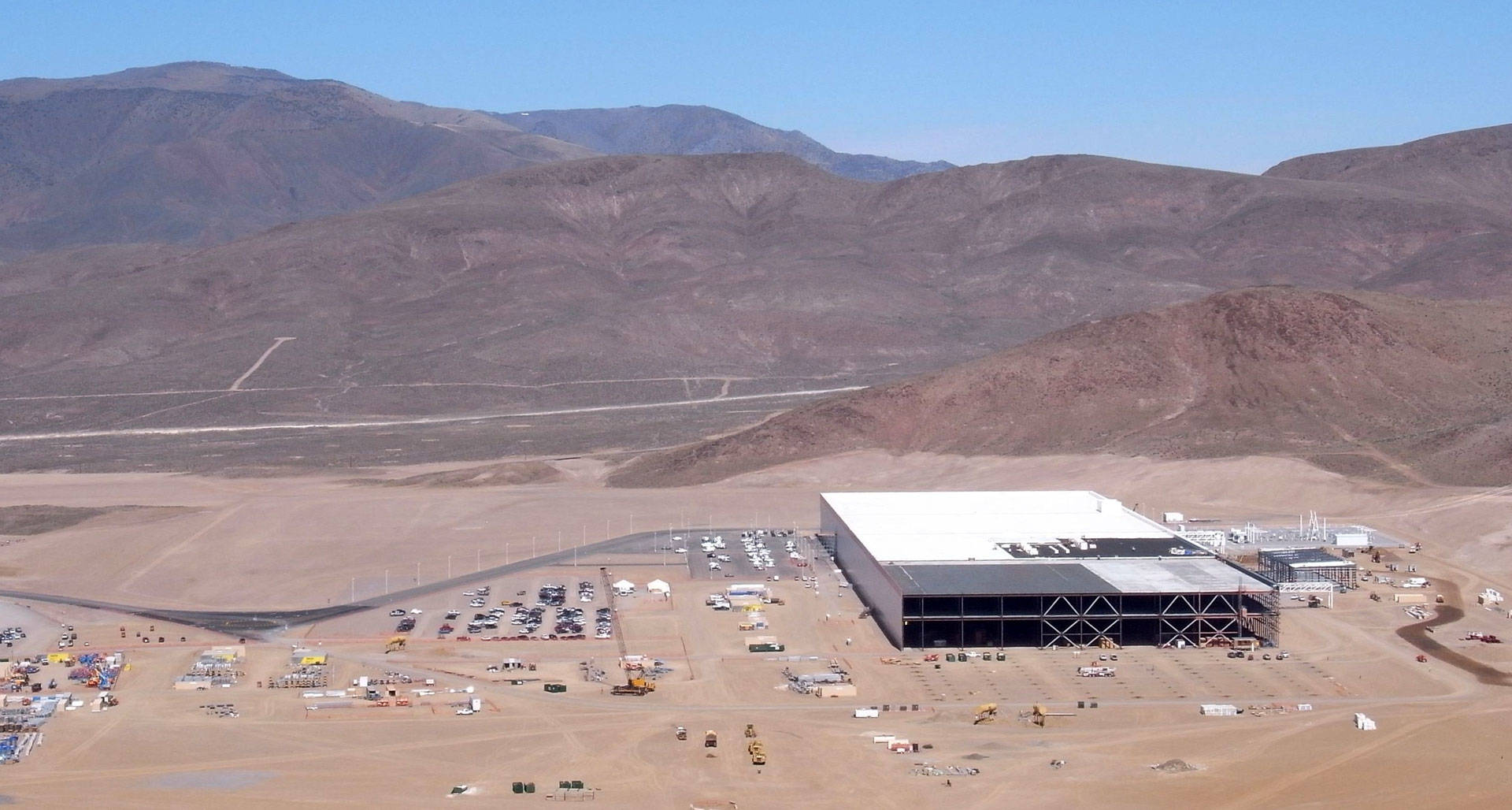
About 14 percent of the Gigfactory has been built so far. It’s expected to
be one of the largest buildings on the planet. (Tesla)

http://ww2.kqed.org/science/wp-content/uploads/sites/35/2016/04/Outside2-1180x614.jpg
Tesla is beginning battery production while neighboring sections of the
factory are still under construction. (Lauren Sommer/KQED)

http://ww2.kqed.org/science/wp-content/uploads/sites/35/2016/04/Inside1-1180x644.jpg
Production is underway for Tesla’s home battery, the Powerwall. (Lauren
Sommer/KQED)

http://ww2.kqed.org/science/wp-content/uploads/sites/35/2016/04/Tesla_V06_160415-400x711.png
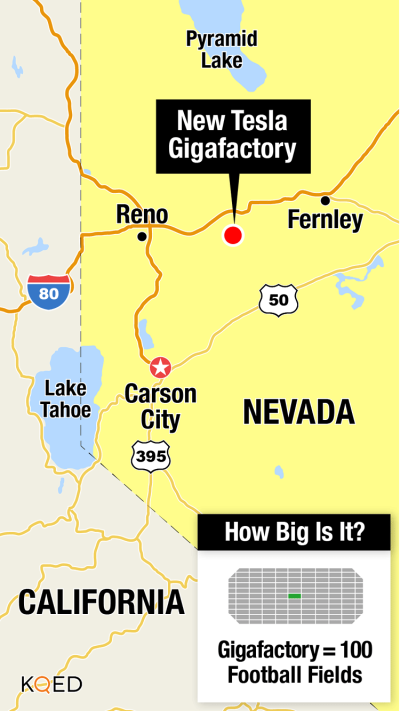
(map)  Tesla. Graphics by Teodros Hailye/KQED

http://ww2.kqed.org/science/wp-content/uploads/sites/35/2016/04/Tesla-Aerial-Perspective-768x374.jpg
An artist rendering of the Gigafactory, covered in solar panels that will
power the facility. (Tesla)

http://ww2.kqed.org/science/wp-content/uploads/sites/35/2016/04/Inside2-768x387.jpg
Tesla’s Powerwall production line. (Lauren Sommer/KQED)


audio
http://www.kqed.org/.stream/anon/radio/science/2016/04/WEBTeslaGigafactorySommer160418.mp3?_=1
]

Telsa’s Gigafactory is a lot like Willy Wonka’s Chocolate Factory: it’s
mysterious, it’s big and few people have been inside.

For almost two years now, the company has been building the largest battery
factory on the planet high in the Nevada desert—a factory that it says could
revolutionize the way consumers use energy at home.

It’s tucked away in a dusty valley, half an hour east of Reno. Driving up
Electric Avenue, the factory is a stark contrast on the horizon. It’s a
sleek white building with a red stripe, almost like one of the company’s
cars.

“It’s really hard to get a sense of scale,” says Tesla co-founder and Chief
Technical Officer JB Straubel. “I mean, it’s huge.”

We’re up on the roof of the Gigafactory, the small piece that has been built
already, trying to get a glimpse of that scale.

“So you can see the building footprint that would be in front of us to the
west and north,” he says, pointing to the flat expanse of land where the
rest of the factory will go—all 5.8 million square feet of it.

“I’m not a huge football fan but I think it’s on the order of around a
hundred football fields,” Straubel says.

Like Willy Wonka’s factory, there’s a lot of hype about this place, both for
the records it’s breaking and the company’s mystique. People have been
caught sneaking onto the property to see it under construction.

With its multiple floors, it’ll be one of the largest factories in the U.S.,
period. Its main rival is Boeing’s factory in Everett, Washington where 747s
are assembled.

Nevada beat out several states by luring Tesla with an incentive package
worth more than a billion dollars. Lawmakers here are watching like hawks
for the economic benefits, like making sure Nevadans make up a big part of
the factory’s construction crew and 6,000 permanent workers.

Baking Batteries
Inside the factory, that workforce is going full steam ahead. Workers are
welding steel, pouring concrete and installing highly specialized machines,
shrouded in plastic. It goes on for room after room after room.

“So this is a pretty exciting room,” Straubel says. It’s filled with huge
metal tanks, almost like an insanely-large industrial kitchen. “This is
where we will actually mix the materials, the raw materials, we mix them
into what’s called a slurry.”

The main pieces of the lithium-ion batteries, the anode and cathode, are
baked by huge machines in yet another room.

“It’s a little bit like a giant baking oven except it’s a few hundred feet
long,” he says.

As each section of the Gigafactory is completed, Tesla moves in and starts
battery production immediately. It will eventually be connected by rail to
Tesla’s car-assembly plant in Fremont, California.

Straubel says the Gigafactory will even run on renewable energy from solar
panels covering the roof, as well as off-site renewable projects and
batteries, of course.

[image]  Tesla CTO JB Straubel in front of Powerpacks, refrigerator-size
batteries for factories or electric utilities. (Lauren Sommer/KQED)
All About Scale

Tesla expects the factory, created in partnership with Panasonic, to double
the world’s capacity for lithium-ion battery production, eventually making
35 gigawatt-hours of energy storage annually. That would supply 500,000 of
its electric cars, a significant leap over what the company is producing
now.

“It’s not just about building a lot more batteries but it’s about reducing
the cost,” Straubel says.

Telsa is known for its pricey cars. Its sedan, the Model S, starts at
$76,500 before tax credits, and batteries are a big part of the sticker
price. Analysts estimate that most battery packs cost well over $10,000.

Which is why, Straubel says, the Gigafactory is about scale. He believes
scaling up could drive down the cost of batteries 30 percent or more.

“We think we’ll probably be able to exceed that,” Straubel says. “Our
vehicles can be more affordable. More people can have access to them.”

That’s what the company is going for with the new Model 3, its first mass
market car, announced last month. It’ll run around $28,000 dollars after the
federal tax credit.

It won’t come out until late next year, but customers lined up in droves to
put down $1,000 deposits.

“We have today over 325,000 reservations for Model 3, representing this
enormous backlog of orders,” he says.

The catch is that Telsa can’t fill those orders without this factory up and
running.

“That’s part of why we’re trying to go so fast and accelerate the
construction here, so we are ready ahead of time,” Straubel says.

[image]  Under Nevada’s tax incentive package, half of the workers hired
must be Nevada residents. (Lauren Sommer/KQED)

A Home Battery
Just one room over, the part of the Gigafactory that is running is making
something else: the Powerwall.

It’s a flat battery, about 4 feet long, 3 feet wide, and it’s Telsa’s first
battery for your house. There are stacks of them on the factory floor, ready
to ship to customers.

“If someone has solar on their house and they install a Powerwall, what this
lets you do is store your surplus solar energy,” Straubel says. Homeowners
could then use around 7 kilowatt-hours of that stored energy at night, which
is several hours’ worth, depending on energy demand.

[image]  Tesla’s home battery, designed to store solar energy for use at
night. (Lauren Sommer/KQED)
The production floor is also stacked with Powerpacks, a larger version of
the battery about the size of a refrigerator. They’re designed to store
electricity at factories, industrial sites, or on the grid itself by
electric utilities.

The machines humming in this part of the plant are part of Tesla’s ultimate
vision for their customers: an electric car in the garage and batteries that
store all the solar power they need. It’s a future free of fossil fuels,
Straubel says.

“Batteries are the missing piece in allowing sustainable energy to scale up
to 100 percent of our energy needs,” he says. “We’re confident that
eventually just about every vehicle on the road will move to being
electric.”

“That’s changing the transportation landscape. That’s changing the energy
landscape. It is changing the world,” he says.

It probably doesn’t need to be said: trying to change the world is a major
gamble.

Gamble in the Desert
“Is (Tesla CEO) Elon Musk far-seeing and investing in the future? Or is he
making big bets that could all collapse at once?” says Severin Borenstein,
an energy economist at UC Berkeley.

When it comes to fighting climate change, Borenstien says the world could
use lots of electric cars and low-cost, solar batteries.

“If we could figure out a way to produce batteries at large-scale and
low-cost, it would really be a game changer for reducing greenhouse gas
emissions,” he says.

The question, he says, is whether consumers are ready to buy into Tesla’s
vision.

Gas prices have been extremely low, which hurts demand for efficient cars.
And then there’s the $3,000 Powerwall battery. Electric rates in many states
make it hard to actually save money storing your own electricity.

In California and some other states, solar customers are paid by their
electric utilities for the extra solar power they put onto the grid, a
policy known as “net-energy metering.” That creates little financial
incentive to store solar energy at home.

A battery could save someone money if electricity costs a lot more at night
than it does during the day. Borenstein says few states have those kind of
electricity prices.

“Average households are not going to get much or any value from these
batteries,” Borenstein says.

Early adopters may not care, though.
“They’re people who like that and feel good about it and they’re mostly
pretty darn rich,” he says.

Tesla is betting that cheaper batteries will make everyone else want a home
battery and electric car, too, something that could finally lead the company
to profitability.

The $5 billion Gigafactory is exactly that gamble. If Tesla stays on
schedule, the factory will be fully open in four years.
[© kqed.org]


For EVLN EV-newswire posts use:
http://evdl.org/evln/


{brucedp.150m.com}

--
View this message in context:
http://electric-vehicle-discussion-list.413529.n4.nabble.com/EVLN-Inside-Tesla-s-Desert-Battery-Gigfactory-tp4681631.html
Sent from the Electric Vehicle Discussion List mailing list archive at
Nabble.com.
_______________________________________________
UNSUBSCRIBE: http://www.evdl.org/help/index.html#usub
http://lists.evdl.org/listinfo.cgi/ev-evdl.org
Read EVAngel's EV News at http://evdl.org/evln/
Please discuss EV drag racing at NEDRA (http://groups.yahoo.com/group/NEDRA)


-------------- next part --------------
An HTML attachment was scrubbed...
URL:
<http://lists.evdl.org/private.cgi/ev-evdl.org/attachments/20160421/afae27c5/attachment.htm>
_______________________________________________
UNSUBSCRIBE: http://www.evdl.org/help/index.html#usub
http://lists.evdl.org/listinfo.cgi/ev-evdl.org
Read EVAngel's EV News at http://evdl.org/evln/
Please discuss EV drag racing at NEDRA (http://groups.yahoo.com/group/NEDRA)