http://www.autoevolution.com/news/electric-car-charging-plugs-the-beta-vs-vhs-battle-of-the-21st-century-105447.html
Electric Car Charging Plugs, The Beta Vs. VHS Battle Of The 21st Century
10TH MARCH 2016  SEBASTIAN TOMA
[images
http://s1.cdn.autoevolution.com/images/news/gallery/electric-car-charging-plugs-the-beta-vs-vhs-battle-of-the-21st-century_5.jpg
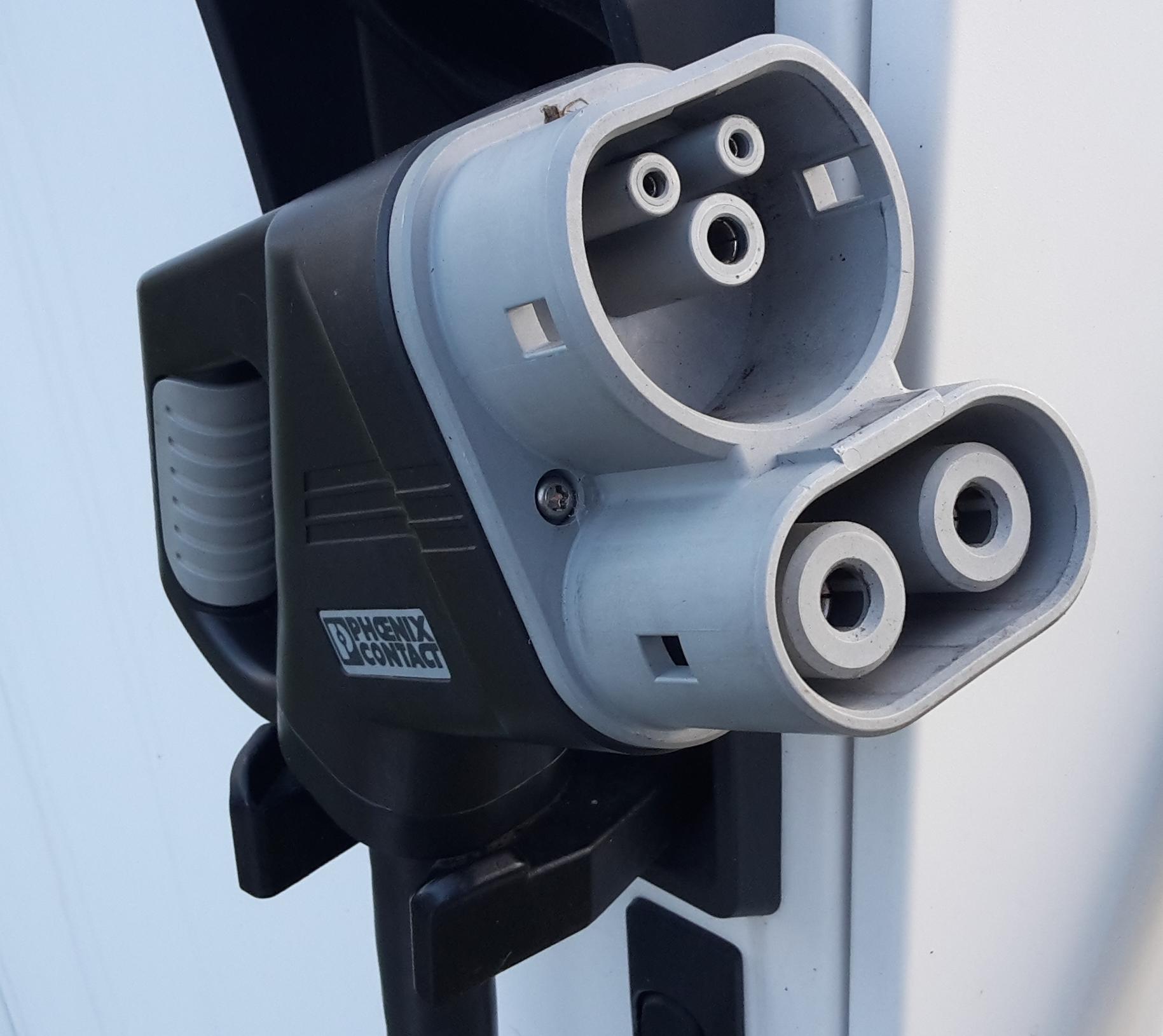
combo

http://s1.cdn.autoevolution.com/images/news/gallery/electric-car-charging-plugs-the-beta-vs-vhs-battle-of-the-21st-century_3.jpg
type2

http://s1.cdn.autoevolution.com/images/news/gallery/electric-car-charging-plugs-the-beta-vs-vhs-battle-of-the-21st-century_4.jpg
CHAdeMO (left) j1772/type1 (right)
]

Industry standards once meant that everyone had to adhere to a particular
set of parameters. The same should have happened with electric cars, but
history has demonstrated that it is not as easy as one might think to set a
standard and have everyone use it.

We cannot help but reflect on the old Betamax-VHS war, and the HD DVD/BluRay
war that followed. Eventually, one technology won, but the tech world still
has a major format battle in the form of the charging ports used by the
leading smartphone and tablet manufacturers.

We started this story after we wrote about Volvo’s latest request aimed at
competing carmakers. The Swedish brand wants all carmakers to agree upon a
standard for charging battery-powered vehicles that would be used on the
Globe in the same form.

While researching for that story, we found out that there were four types of
chargers as “standard” for battery-powered vehicles.

This reminded us of the late 1990s and early 2000s, when each cell phone
manufacturer had their charging ports, and almost each major manufacturer
often changed the charger, voltage, and port standard.

Thankfully, in the case of phones, USB became the norm as the “output” of
the charger adaptor, while the cable that links the charger to the
smartphone is still a cold war between Apple and the companies that sell
smartphones with MicroUSB adapters.

Returning to the matter at hand, the success or failure of battery-powered
vehicles relies on the charging solutions developed and employed worldwide.
However, how can someone operate a standard in a world that’s so divided?

As we wrote in the article concerning Volvo’s request on a standard for
plug-in vehicles, we asked ourselves how could this be possible in our
“everybody has to be right, or he or she will be offended” world.

What happened in the VHS/Beta war?
The two competing video recording and playback systems were not the first to
market, but U-matic was. It rapidly died off because the U-matic was not
user-friendly and wasn’t affordable either. Sony invented this format, but
the first consumer-grade video cassette recorder was a Philips VCR.
Unfortunately, the VCR format also died because of reliability issues and
the introduction of the VHS standard.

Back in the mid-1970s, Sony presented the Beta format as its new proposition
in the world of video cassette recorders. In spite of a later meeting in
which they were introduced to the VHS format formed by JVC, they insisted on
the Beta format, eventually marketed as Betamax, because of serious
investments the Sony corporation made to develop it.

Furthermore, Sony executives were advised to “embrace VHS for the good of
the industry,” reports say, but the company decided against this. Sound
familiar? Well, this is happening today in the world of charging plugs for
electric vehicles.

Was Beta better than VHS?
In short, Betamax was not better than VHS, but Sony’s excellent marketing
made people think it provided superior quality. In the technology’s defense,
it did have lower video noise, a slightly higher horizontal resolution, and
less luma/chroma crosstalk than VHS.

Unfortunately for Sony and its Betamax, quality was not the only problem, as
its cassette technology did not feature a recording time as long as the one
VHS technology provided. The difference was enormous, as the first Betamax
offered 60 minutes of recording time, while VHS could manage 120 minutes of
recording.

Eventually, Sony had to introduce a two-hour mode on its Beta tapes to
compete with the VHS technology, and ended up reducing the horizontal
resolution by ten lines to 240 (horizontal NTSC). At about the same time,
VHS managed to raise the apparent resolution to 250 horizontal lines.
Eventually, the user experience was virtually identical, and the difference
was imperceptible on the common televisions of the time.

Why are we mentioning this? Because user experience is often a more
important factor in the success of a product, standard, or technology than
performance, quality, or even price.

How the VHS won?
VHS players were more affordable than their equivalent Betamax units, and
users did not see the price difference between them as justified by the
claimed superior quality. Betamax’s shorter recording time did factor in, so
the video tape equivalent of range and charge time (to bring an analogy with
electric vehicles) mattered more than their performance.

So, the great VHS versus Betamax battle of the mid-1970s and late 1980s was
eventually won by price, as customers chose the more affordable units and
this forced Sony to build VHS devices. Sony finally won the video recording
and playback war in the 1990s, when the Blu-Ray DVD was chosen over the HD
DVD solution of their rivals.

What carmakers can do to stop a silly VHS/Betamax war of charging ports?

First of all, they could finally agree on a standard plug. It should feature
both DC and AC, as well as a heavy-duty cable and ports to allow
quick-charge capabilities. So, instead of developing advanced chargers that
only work on their products, like Tesla and CHAdeMO currently do, it is in
the automotive industry’s best interest to agree on a single connector for
electric vehicles that will be used on the entire Globe.

Sure, a few egos will be hurt, but it is in the best interest of the
customers, the electric car in general, and for the OEM eventually, as they
will be spared of the costs of developing and manufacturing dedicated
charging ports for electric and plug-in vehicles.

We can only hope that a solution to this problem will come shortly, and that
it will be retrofittable to current charging networks. We are speaking of a
universal charging plug that will be suitable for various quick-charge
stations, and compatible with the existing and future plug-in cars.

Is there a standard for this in the automotive industry? Yes, there is, and
you use it every time you refuel your vehicle. So it is possible for
automakers to settle on an issue like this, but they need help from the
people in charge of infrastructure development.

What are the current plugs used for charging for plug-in vehicles?

As we explained at the beginning of this story, four types of plugs for
charging electric vehicles are currently on the mass-market today. There
have been attempts to standardize this field from the beginning, but the
Society of Automotive Engineers has managed to provide two separate standard
plugs.

We will start with the SAE J1772 connector, also called a Type 1 connector.
This connector is standard for electric vehicles in the United States of
America. It can be used with both 120V AC power and 240V AC power. The
connector only goes into the car in one way, and has several safeguards to
avoid electric shock in wet conditions. Most electric vehicle manufacturers
initially adopted this connector, and it is still in use.

However, the Society of Automotive Engineers has developed an alternative
connector, called an "SAE Combo." The new charger is supported by Volvo and
seven other carmakers, including Audi, BMW, Mercedes-Benz, Chrysler, GM, and
Volkswagen. Unlike the Type 1 connector, the SAE Combo has extra pins inside
to support quick-charge functions. It can work with up to 450 volts,
200Amps, and up to 90 kW. That would be enough even for a Tesla.

Meanwhile, Tesla Motors has its proprietary connectors. The plug on the
vehicle has a design that supports an adaptor, so the cars made by Tesla can
be charged by a regular charging station for electric vehicles, but Tesla’s
proprietary plug only works with the Tesla Supercharger.

Tesla did not develop their Supercharger system from scratch, as they
modified a Type 2 plug to have longer conductor pins and to support a deeper
insertion, which allows greater current to enable quick-charging. Tesla’s
charger works with AC and DC, but its plug does not have extra DC pins,
because the direct current can flow through the alternative current pins.

Tesla does sell an adaptor that works with Type 1 systems in the US, but
most customers tend to use the Supercharger network instead. Other adaptors
for Tesla models are in discussion, so that the clients can charge their
vehicles from different systems, depending on the market.

The Type 2 plug for electric cars was developed by Mennekes with Germany’s
VDE, and became the standard for the latter. The ACEA (European Association
of Automobile Manufacturers) decided to use the Type 2 connector in the
European Union.

However, this specification will not be the norm for long, as carmakers and
various industry bodies want to develop a charging network based on an
evolution of the Type 2 socket, which will support a joint output of
three-phase 400V at 16 Amps.

Another solution, called the Type 3 was proposed by electrical companies in
France and Italy. The proposed system is a three-phase setup that works at
32 Amps and has its own connector. Authorities in Europe want to phase out
the Type 1 connector because it does not support three-phase charging, but
they still are under consideration between the Type 2 and the Type 3
connector.

The fourth connector is the CHAdeMO solution, developed for quick charging
stations, and made by the association with the same name. It includes
several Japanese carmakers, like Nissan, Mitsubishi, Fuji Heavy Industries
(Subaru), and Toyota.

The CHAdeMO chargers have been installed in Japan, Europe, and the USA, but
not all plug-in vehicles have adapters that work with this solution. Cars
fitted with this plug are sold with adapters to match other systems.

Which solution will triumph?
Well, while the Type 1 connector is widespread, and the Type 2 is popular in
Europe right now, the SAE Combo seems to bring the best compromise, at it
features AC and DC pins inside. The latter is a request of the Chinese
automotive industry, whose electric vehicles get quick-charge capabilities
using DC power.

In the end, the auto business will find a way to make adaptors which will
give electric car users more charging options, but not all systems are
compatible. However, it will not be practical for a user to have several
adaptors in their vehicle, so a common standard will be required shortly to
enable more charging options and a shared infrastructure for battery-powered
cars.
[© autoevolution.com]


For EVLN EV-newswire posts use:
http://evdl.org/evln/


{brucedp.150m.com}

--
View this message in context:
http://electric-vehicle-discussion-list.413529.n4.nabble.com/EVLN-War-of-EVSE-standards-Volvo-s-push-for-ccs-combo-tp4681005.html
Sent from the Electric Vehicle Discussion List mailing list archive at
Nabble.com.
_______________________________________________
UNSUBSCRIBE: http://www.evdl.org/help/index.html#usub
http://lists.evdl.org/listinfo.cgi/ev-evdl.org
Read EVAngel's EV News at http://evdl.org/evln/
Please discuss EV drag racing at NEDRA (http://groups.yahoo.com/group/NEDRA)