http://www.roadandtrack.com/motorsports/news/a28004/bill-nye-the-science-guy-thinks-nascar-should-switch-to-electric-cars/
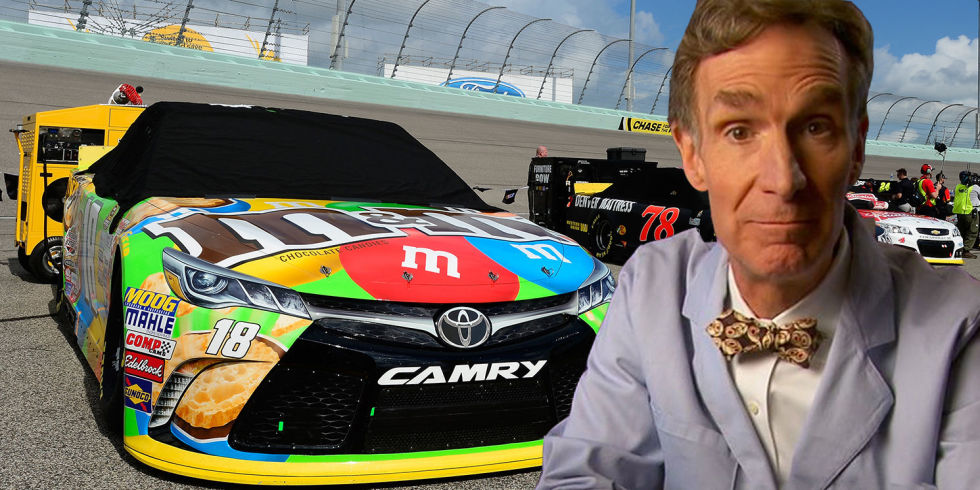
Bill Nye the Science Guy Thinks NASCAR Should Switch to Electric Cars
JAN 26, 2016  BOB SOROKANICH
[image
http://roa.h-cdn.co/assets/16/04/980x490/landscape-1453844885-billnye.jpg
Modified from Robert Laberge/Getty Images
]

Your favorite PBS scientist weighs in on the most popular motorsport in
America.

Ready for a combination of American pop culture you never thought you'd see
together? Bill Nye, the Science Guy just published a blog post where he
argues that NASCAR should switch to electric cars. And you know what? He
brings up some pretty good points.

If you read Nye's entire post over at Aeon (and you definitely should),
you'll get the sense that the guy knows at least a little bit about
motorsports. He explains that he has family in North Carolina and Virginia,
and that he's even visited Martinsville Speedway in Ridgeway, Virginia. But,
he says, while he can appreciate the exhilaration of speed and noise, deep
down the spectacle saddens him:

(B)eyond the heart-pounding,
Are-these-cars-going-to-jump-the-barrier-and-kill-me? exciting quality of
it, it's depressing – leastways depressing for me as an engineer. Because
here I am trying to envision the smart, efficient transportation technology
of tomorrow, and there is NASCAR doing the opposite – celebrating a very old
transportation technology of yesterday.

This being Bill Nye, there's got to be some numerical evidence, right? Oh
yeah, The Science Guy has that covered:

Consider the following: a typical NASCAR racecar produces up to 540 ft-lbs
(730 Newton-metres) of torque. The Tesla Model-S (sedan), right out of the
showroom, produces 713 ft-lbs (970 N-m). A NASCAR vehicle can get up to 850
horsepower (hp) with the car and driver weighing about 3,600 lbs (that's 630
kilowatts and 1,650 kg). The Tesla produces 'only' 532 hp (400 kW), and with
a car weighing an extra 1,000 lbs (450 kg). Looking at those last couple of
numbers might make you think that the NASCAR vehicle is way more powerful
than a high-end electric one. But note well, we are comparing a NASCAR car
made to race with a true stock car (one a consumer can buy), albeit an
electric one, that has not been refined to compete on racetracks. The
gasoline-powered car is a product of a century of development. Just think
what an electric carmaker, such as Tesla, could produce given, say, three
years.

Side note: Check out how Nye throws shade at how un-stock today's "stock
cars" really are (emphasis added above). Nice one, Bill.

Nye then goes on to explain his dream for NASCAR, where a fleet of electric
racers use pit stops to swap batteries, rather than refuel, in a setup that
sounds pretty similar to Tesla's long-abandoned battery swapping station
plan. Nye says the series could change its name to NESCAR—National Electric
Stock Car Racing.

Yes, we all appreciate how crazy this sounds. NASCAR is definitely not
switching to battery-electric vehicles in any foreseeable future. The
nearest thing, the all-electric Formula E racing series, has audiences and
budgets that are probably a fraction of a fraction of those in NASCAR.

But even though Nye's proposal for a zero-emissions NASCAR is a complete and
total non-starter, The Science Guy makes some very valid criticisms of what
stock car racing has become. "It's a celebration of old tech," Nye says of
NASCAR. He talks about how he wishes NASCAR was more like NASA, or use
Google XPrize-style competitions to encourage creative engineering in new
and exciting directions. "There's no reason why NASCAR couldn't be like
that: a race with rules designed to reward the coolest, most advanced
vehicle technologies."

Meanwhile, the NASCAR we've got just introduced another mind-bogglingly
ridiculous set of mandatory caution periods, this time using a countdown
clock.

Nye offers an example from racing history that highlights exactly what's
wrong with anti-innovation motorsports rules, the kind found in NASCAR and
so many other forms of racing:

When I was a kid, auto-racing was where new technology was developed rather
than where old technology was preserved or even celebrated. We admired cars
that went faster and could be manoeuvered well. Next time you're in the
Indianapolis Motor Speedway Hall of Fame Museum, check out the STP-Paxton
Turbocar. It almost won the 1967 Indianapolis 500 race with a helicopter
turbine engine adapted for car racing. The car led for 170 of the 200 laps,
almost the entire race. A ball-bearing cracked on the third-to-last lap.
Race officials could tell that, if they allowed this type of innovative car
to come back year after year, racing teams would have a chance to test it
further, and make additional improvements to this sure-win innovation. Soon,
all the other racecars would be obsolete. Instead of embracing this
innovation, they changed the permitted size of the intake duct so that it
was too small to enable a turbine car to keep up.

"I'm not saying we should all be driving turbine engine-powered cars," Nye
concludes. "I'm saying racing should be about the future rather than the
past." On that, undoubtedly nearly every racing fan can agree.

Just don't hold your breath waiting for an electric NASCAR series, Bill.
[© 2016 Hearst Communications]
...
http://nascar.nbcsports.com/2016/01/26/bill-nye-the-science-guy-wants-nascar-to-trade-gas-for-electric-power/
Bill Nye, the Science Guy wants NASCAR to trade gas for electric power
Jan 26, 2016
...
http://www.yardbarker.com/nascar/articles/bill_nye_wants_nascar_to_use_electric_cars_and_become_nescar/s1_13156_20257762
Bill Nye wants NASCAR to use electric cars and become NESCAR
1/29/16  Nye points out the all-electric Tesla Model S and its performance
as a car out for general consumption versus what NASCAR stock cars produce.
Nye also envisions a world where gas cans are eschewed for pit crews …


https://aeon.co/opinions/if-nascar-embraced-electric-cars-it-could-change-the-world
If NASCAR embraced electric cars it could change the world
[JAN 26, 2016]  Corey S Powell

Bill Nye ‘The Science Guy’ is a science educator, television presenter,
writer and former mechanical engineer. His latest book is Unstoppable:
Harnessing Science to Change the World (2015). He lives in New York City.

I have roots in the southern United States. My mom was from Durham, North
Carolina, and my sister, nephew, nieces, spouses, their exes, kids and more
kids live in and around Danville, Virginia. Around there, it’s a big deal to
go to the races. The boys of various ages, and occasionally some of the
girls and women, will pile into vehicles to go see races in South Boston or
other tracks nearby. I’ve been to the track in Martinsville – the ‘paper
clip’ – which is still the shortest track on the NASCAR (National
Association for Stock Car Auto Racing) circuit. It’s less than a kilometre
long, only half a mile. But it is exciting. The cars go just crazy fast, and
they are amazingly loud … or LOUD!! But beyond the heart-pounding,
Are-these-cars-going-to-jump-the-barrier-and-kill-me? exciting quality of
it, it’s depressing – leastways depressing for me as an engineer. Because
here I am trying to envision the smart, efficient transportation technology
of tomorrow, and there is NASCAR doing the opposite – celebrating a very old
transportation technology of yesterday.

Despite the excitement, NASCAR kinda breaks my heart. It’s a celebration of
old tech. It uses gasoline-burning instead of electron-flowing. I wish
NASCAR were more like NASA. I wish NASCAR were more about the future instead
of the past. I wish NASCAR set up Grand Challenges to inspire companies and
individuals to create novel automotive technologies in the way NASA does to
create novel space technologies. At NASA currently, there are challenges to
come up with techniques to mine an asteroid, build a better space suit, and
survive the radiation environment in deep space. Those competitions are like
races, with winners getting significant grant money. Or look at Google,
which created the Lunar XPrize, a genuine competition to see which private
group can land a robot on the Moon and send pictures back. There’s no reason
why NASCAR couldn’t be like that: a race with rules designed to reward the
coolest, most advanced vehicle technologies.

To address climate change in the medium and long term, we have to stop,
completely stop, burning fossil fuels. The obvious, straightforward,
We’re-already-just-about-there answer is to convert our entire
ground-transportation fleet – trains, trucks, buses and cars – to electric
motors with batteries to store energy the way that gasoline tanks store
energy in our fuel-burning vehicles. In the short term, NASCAR could help
get us there. We could convert all of our racecars to electricity – right
now – and show the public exactly what electrons can do.

Consider the following: a typical NASCAR racecar produces up to 540 ft-lbs
(730 Newton-metres) of torque. The Tesla Model-S (sedan), right out of the
showroom, produces 713 ft-lbs (970 N-m). A NASCAR vehicle can get up to 850
horsepower (hp) with the car and driver weighing about 3,600 lbs (that’s 630
kilowatts and 1,650 kg). The Tesla produces ‘only’ 532 hp (400 kW), and with
a car weighing an extra 1,000 lbs (450 kg). Looking at those last couple of
numbers might make you think that the NASCAR vehicle is way more powerful
than a high-end electric one. But note well, we are comparing a NASCAR car
made to race with a true stock car (one a consumer can buy), albeit an
electric one, that has not been refined to compete on racetracks. The
gasoline-powered car is a product of a century of development. Just think
what an electric carmaker, such as Tesla, could produce given, say, three
years.

It’s easy for me to imagine an electric racecar that completely outperforms
a gas-powered competitor. Instead of refuelling a gas tank, the electric
racecar pit crew would change battery packs. The car would be designed to
roll up a ramp. The battery pack would be disconnected and dropped out.
Moments later, a fresh battery pack would be lifted into place, and off our
electric racer would go with time in the pit comparable to what it takes to
refuel and service a conventional gas-powered racecar.

I admit also to being a fan of James Bond movies. In the most recent one,
Spectre, our hero gets to drive (and destroy) an Aston Martin DB10. It goes
(or went) a claimed 0-to-60 in 3.1 seconds. Well, the stock Tesla Model S
goes 0-to-60 in 2.8 seconds. Nose to nose, you would not need a photo to see
who finished first. Sorry gas-fired slowpoke. Just think what an electric
race would be like. It would be faster, and quiet. You could talk to the
person next to you. The drivers could probably hear the roar of the crowd
rather than having to imagine it as they do now. And most significant from
my point of view, everyone in the crowd, every race fan, would want an
electric car! The market for electric cars would go crazy. Manufacturers
could not produce them fast enough. We could convert our transportation
system to all-electric in less time than it took to go from horse-drawn to
horseless carriage, 20 years maybe. I’m tellin’ ya, after you drive an
electric car, you don’t want to drive anything else. They’re faster, quieter
and cheaper to operate.

In spite of this optimism, when I get to thinking about it, NASCAR right now
just brings me down. They use ancient tech: carburetors, valve pushrods and
cast-iron engines. But the biggest depressor for me is the fuel consumption.
These cars get as little as 80 litres per 100 km, or 3 miles to the gallon
(mpg). Sometimes they get away with up to 4.5 mpg. That is, to my way of
thinking, astonishingly bad.

Let me offer a backward-looking yet forward-thinking story. When I was a
kid, auto-racing was where new technology was developed rather than where
old technology was preserved or even celebrated. We admired cars that went
faster and could be manoeuvered well. Next time you’re in the Indianapolis
Motor Speedway Hall of Fame Museum, check out the STP-Paxton Turbocar. It
almost won the 1967 Indianapolis 500 race with a helicopter turbine engine
adapted for car racing. The car led for 170 of the 200 laps, almost the
entire race. A ball-bearing cracked on the third-to-last lap. Race officials
could tell that, if they allowed this type of innovative car to come back
year after year, racing teams would have a chance to test it further, and
make additional improvements to this sure-win innovation. Soon, all the
other racecars would be obsolete. Instead of embracing this innovation, they
changed the permitted size of the intake duct so that it was too small to
enable a turbine car to keep up.

I’m not saying we should all be driving turbine engine-powered cars. I’m
saying racing should be about the future rather than the past. How about
NASCAR becoming NESCAR (National Electric Stock Car Racing)? The sooner
NASCAR (or NESCAR) embraces electric drive trains, the sooner the US can be
the world leader in automotive technology, and the sooner we can stop
pumping carbon dioxide into the air every time we want to go somewhere to
get groceries, pick up the soccer team, commute to work or watch a race.
[© aeon.co]


http://www.nationaldailypress.com/2016/01/28/4506/why-nascar-isnt-in-a-position-to-make-the-switch-to-electric-cars-here-is-the-answers/
Why NASCAR Isn't In A Position To Make The Switch To Electric ...
[2016/01/28]  On paper, it sounds like such a cool idea: “If NASCAR embraced
electric cars, it could ... Everyone in the crowd, every race fan, would
want an electric car!


For EVLN EV-newswire posts use:
http://evdl.org/evln/


{brucedp.150m.com}

--
View this message in context:
http://electric-vehicle-discussion-list.413529.n4.nabble.com/EVLN-Bill-Nye-the-Science-Guy-Thinks-Electric-NASCAR-NESCAR-tp4680142.html
Sent from the Electric Vehicle Discussion List mailing list archive at
Nabble.com.
_______________________________________________
UNSUBSCRIBE: http://www.evdl.org/help/index.html#usub
http://lists.evdl.org/listinfo.cgi/ev-evdl.org
Read EVAngel's EV News at http://evdl.org/evln/
Please discuss EV drag racing at NEDRA (http://groups.yahoo.com/group/NEDRA)