% Remember the 1990s Push for 42-Volt Electrical Systems? %
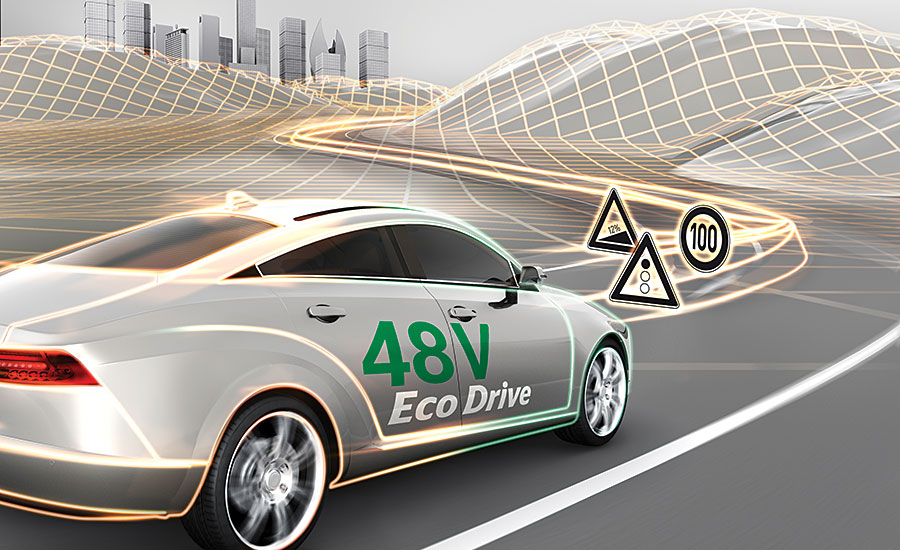
http://www.assemblymag.com/articles/93092--volt-systems-will-help-reduce-wiring-costs 48-volt systems will help reduce wiring costs November 3, 2015 Austin Weber [image http://www.assemblymag.com/ext/resources/Issues/2015/November/48-volt/asb1115auto.jpg?1446576850 48-volt systems will help reduce wiring costs ] For decades, automobiles have depended on 12-volt electrical systems. But, that’s about to go the way of chrome bumpers, hood ornaments and running boards. As power and performance demands accelerate, the electrical load needed in vehicles is increasing. That’s forcing engineers to explore cost-efficient options, such as 48-volt systems. The higher voltage is ideal for handling stop-start systems, compressors, electric power steering, regenerative brakes and other energy-efficient electrical systems. As a result, smaller cable cross-sections will be needed in the future, which means lighter wiring harnesses can be used. According to IHS Automotive, by 2025, 48-volt systems will be used in more than 95 percent of the world’s mild hybrid vehicles and about half of all hybrid vehicles. Tier 1 suppliers such as Bosch, Continental and Delphi are scrambling to capture a share of the lucrative business. “The growing interest in 48-volt (technology) has come from the tightening mandates on fuel economy and CO2 emissions, as well as nonhybrid applications that require more power, such as active suspension systems and electric turbo-superchargers,†says Kevin Mak, senior analyst at Strategy Analytics, a market research firm. “The 48-volt system is a way of reducing cost over high-voltage hybrid power train systems, because it doesn’t need costly protection devices,†adds Mak. “Also, by standardizing on one voltage, it should theoretically allow economies of scale among suppliers. And, it enables OEMs to cut wiring costs, reduce weight (and) enhance the fuel economy of their product offerings.†“Compared to higher-voltage mild hybrids, vehicles with 48-volt systems have demonstrated 70 percent of the benefit at 30 percent of the cost,†claims Jeff Owens, chief technology officer at Delphi Automotive LLC. “(The new technology) could reduce the percentage of CO2 emissions by double digits, capture energy typically lost while braking, and provide torque in the low rpm range for anemic start-stop hybrids. The beauty of a 48-volt solution is that drivers will not lose engine performance to gain fuel efficiency from downsized engines.†The idea of using 48-volt electrical systems is not new. “It was looked at very closely 15 years ago, but the incremental costs were too high, especially the DC-DC converter,†explains David Alexander, senior research analyst at Navigant Research. “More efficient 12-volt systems ended up being developed. Now, demand for higher power means higher voltage is the only way to go, and power electronics, such as DC-DC converters, are now cheaper than they were.†Alexander says the first 48-volt subsystems will be introduced on high-end vehicles during the next three years. “After that, they will migrate to higher volume models,†he predicts. “(However), it will be many years before a vehicle is launched without a legacy 12-volt subsystem, as well as a 48-volt power system. “In the short term, there will probably be two batteries, one of each voltage,†adds Alexander. “But, in time, the 12-volt may be downsized or eliminated. “LED lighting may also benefit from the higher voltage,†says Alexander. “(However), other electrical devices, such as infotainment systems, wipers and seat-mirror adjustments, will probably remain on 12-volt (batteries) for a long time.†Cost is still the big challenge that engineers must address, says Christian Mueller, manager of component forecasts and analysis at IHS Global GmbH. “Because it is new, (48-volt) components will be relatively expensive for a few years,†he points out. “Once everyone is convinced it is the right solution for the future, investments will be made to ramp up volumes and reduce prices.†“Moving loads to 48-volts that are currently driven from the 12-volt supply will mean lower currents and thus provide the potential for smaller cables and lighter harnesses,†notes Mak. However, 48-volt systems may also encourage engineers to use more electric motors in vehicles. “These additional loads will add complexity and weight back into the wiring harness,†warns Mak. [© 2015. All Rights Reserved BNP Media] http://www.electricvehiclesresearch.com/articles/8266/48v-vehicle-systems-becoming-significant 48V vehicle systems becoming significant August 12, 2015 Dr Peter Harrop ... https://en.wikipedia.org/wiki/42-volt_electrical_system 42-volt electrical system ... 42-volt electrical components are now used in only a few automotive .... "German carmakers agree on 48V on-board supply, charging plug" ... [dated] http://blogs.motortrend.com/high-volt-age-remember-the-1990s-push-for-42-volt-electrical-systems-the-idea-is-back-maybe-for-good-26893.html High Volt Age: Remember the 1990s Push for 42-Volt Electrical Systems? The Idea is Back -- Maybe for Good November 22, 2012 Frank Markus ... http://www.popularmechanics.com/cars/a2198/4226979/ Whatever Happened to the 42-Volt Car? Sep 30, 2009 Mike Allen ... http://www.autospeed.com/cms/article.html?&title=Goodbye-12-volts-hello-42-volts&A=0319 Goodbye 12 volts... hello 42 volts! For EVLN EV-newswire posts use: http://evdl.org/evln/ {brucedp.150m.com} -- View this message in context: http://electric-vehicle-discussion-list.413529.n4.nabble.com/EVLN-Future-EV-conversions-on-48-volt-automotive-systems-tp4678538.html Sent from the Electric Vehicle Discussion List mailing list archive at Nabble.com. _______________________________________________ UNSUBSCRIBE: http://www.evdl.org/help/index.html#usub http://lists.evdl.org/listinfo.cgi/ev-evdl.org Read EVAngel's EV News at http://evdl.org/evln/ Please discuss EV drag racing at NEDRA (http://groups.yahoo.com/group/NEDRA)