I think that this mass generalization of the use of the words
"religions" and "religious" are confusing the sentiment of this discussion.
On a whole, having spirituality in the form of a religious faith or
belief system does not inherently clash with having scientific
understanding.
I think that when we generalize and start debasing spirituality that
corresponds with an organized religion we lessen our arguments by
being ignorant to the fact that it is the Religion as an Institution
that has become corrupt and dogmatic, not necessarily the individuals.
christian says " Religion
is based on a process of belief that is TOTALLY antagonistic and
incompatible with scientific reasoning and methodology"
It is true that many wars or hostilities have been based on religious
conflicts, or carried out in the name of a religion, but it is
ridiculous to say that religion is /based/ on being /antagonistic/ to
science. Religion and Science were born of the same Philosophical
questions, but diverged when the questions began to be asked in
different ways. "/Why/ does this exist" vs "/How/ does this exist?" etc etc.
Religion and Politics as institutions have both become bastardized
versions of their model pursuits --I do not believe that even Democracy
truly exist in practice-- and anyone in power, whether political or
religious, becomes corrupt with their own agendas.
On Fri, Dec 9, 2011 at 4:03 AM, Christian Vincenot
<[email protected]
<mailto:[email protected]>> wrote:
Dear Warren,
> First, the basic problem is not so much overpopulation as it is
> overconsumption.
I totally second your point of view. Nevertheless, we sadly have to
recognise that the two problems are basically entangled and synergistic.
> Second, many religions, including mainstream Protestants, promote or
> at least tolerate birth control and other limits on procreation.
Indeed, some of them do, but the fact is that the Christian church on
the whole does not.
Moreover, most of the religions that tolerate birth control also promote
the idea that having a large family is "healthy".
Finally, religion is a factor of quarrels (not to say wars...), and
pushes its members directly or indirectly to overwhelm the other
religions through nativity. This is a real problem that can be observed
as much in radical Islamic movements, as in "mainstream" Christianity.
For example, even among the US Protestants that you mention, I don't
need to tell you that the Quiverfull openly state that it is part of
their missionary duty to procreate as much as possible to propagate
their beliefs.
> Third, I can teach (and have taught) cosmological, geological and
> biological evolution in my church's youth and adult education
> programs.
I disagree quite strongly on this, but I am afraid that this discussion
is off-topic anyway. Still, I will summarise my point of view. Religion
is based on a process of belief that is TOTALLY antagonistic and
incompatible with scientific reasoning and methodology. Our predecessors
have learned to the cost of their lives how much religions have been
deceiving and incompatible with a methodological scientific approach to
the analysis of our world. This has been true since Copernicus and
Galileo until nowadays.
Therefore, I do not know how one can sincerely teach science and
religion at the same time without seeing any internal conflict or
contradiction. With all due respect, what would somebody like you have
taught a few centuries ago then? That the Earth was flat or not? What do
you teach nowadays? Creationism or Darwinism? Also, ultimately, what
prevails inside of you: the scientific proof or the religious belief?
(Do not get me wrong. Believing inside of oneself that something MAY be
true withtout any proof is one acceptable thing I think. We do it as
scientists ourselves. On the other hand, what is unacceptable is the
formation of lobbying groups from which a real diktat emerges to enforce
their groundless suppositions as a truth and which create visions of the
world and rules of how to live which shall be applied to everyone. THIS
is what the mainstream religions have always been about, and this is
also what distinguishes philosophy from religion.)
> The myths and metaphors of our religious heritage (what
> you call "lies") frequently parallel current science.
With all due respect, what I call "lies" ARE lies and not metaphors. The
list of all the "facts" that have been openly stated and ENFORCED by
religions and which proved to be blatantly false would be too long to
enumerate (just a few random examples: flat Earth, the heretical nature
of medical sciences, the Evil inside divorced or even pregnant women,
possession and exorcism, etc). Let's not have such a short-term
memory... Also, this dual nature of the religious teachings - once
metaphoric, once strictly unequivocal and direct - is in my opinion an
ultimate way of fooling people. "Sure, this was told and enforced
stricto sensu by our church during centuries, but actually people were
misunderstanding the metaphoric nature of the holy statements at that
time". Sincerely...
> And they try to answer questions that current science cannot answer, >
e.g., "Why is there something instead of nothing?"
> "Why is there life?" "Why is their human intelligence and
> cognition?" "Why are humans altruistic to other humans outside their
> genetic clan?" "Why are we here?"
The problems are the methodology for hypothesis creation and what is
done with this so-called "truth" afterwards.
First, proofing these hypothesises can only be done by science. If you
can propose any religious methodology for proofing any of the groundless
suggestions that can be made based on the theological approach, I would
be glad to discuss it. As a consequence, religions do not generate
knowledge and never will.
Second, philosophy can help develop theories for subjects that science
is unable to tackle due to their nature. Actually, some questions that
you mention are typical philosophical questions. No religion is needed
for this.
Third, religion would in no way bring any satisfying answer to these
problems. Actually, it has never done so. You mention about the origin
of life... if we were still believing the Catholic church, we would
still be thinking that life was created by an omnipotent omniscient god
in six days. Catholic theology has never challenged this point of view
(and AFAIK it still defends it). The only reason why we progressed on
this is thanks to Cartesian reasoning.
I am sure that you will understand that nothing in my post was meant to
offend you personally.
Sincerely,
Christian Vincenot
On 12/09/2011 04:26 PM, Warren W. Aney wrote:
> You make some good points, Christian, deserving a better response
than I'm
> going to provide right now at 11 p.m.
> First, the basic problem is not so much overpopulation as it is
> overconsumption. According to one source I've read, the average U.S.
> citizen has a consumption footprint as large as 90 Bangladeshis.
> Second, many religions, including mainstream Protestants, promote
or at
> least tolerate birth control and other limits on procreation.
> Third, I can teach (and have taught) cosmological, geological and
biological
> evolution in my church's youth and adult education programs. The
myths and
> metaphors of our religious heritage (what you call "lies") frequently
> parallel current science. And they try to answer questions that
current
> science cannot answer, e.g., "Why is there something instead of
nothing?"
> "Why is there life?" "Why is their human intelligence and
cognition?" "Why
> are humans altruistic to other humans outside their genetic clan?"
"Why are
> we here?"
>
> Warren W. Aney
> Senior Wildlife Ecologist
> Tigard, OR 97223
>
> -----Original Message-----
> From: Ecological Society of America: grants, jobs, news
> [mailto:[email protected]
<mailto:[email protected]>] On Behalf Of Christian Vincenot
> Sent: Thursday, 08 December, 2011 18:56
> To: [email protected] <mailto:[email protected]>
> Subject: Re: [ECOLOG-L] overpopulation and the abuse of facts by
religon
>
>> Why is this forum arguing about the influence of Judaic religions on
>> population growth?
> I believe that Nathan answered this question in the very first
post. Simply
> because there is indeed an obvious dogma coming with these
religions (and a
> few other ones) that forbids abortion and/or promotes uncontrolled
> procreation while spreading flat lies about the carrying capacity
of our
> Earth. This in turn obviously impacts demography. I find the link
> straightforward and the original question raised in this thread
legitimate.
>
>> If the population growth of the earth is going to be impacted it
won't be
>> by coaxing popular religions like Catholicism and Christianity to be
>> less"fruitful".
> Will it be by acknowledging or even ignoring what these religions
preach
> then?
>
>> Despite the predominance of these religions in countries
>> like the U.S. and Britain, the growth rate in these countries are
>> decreasing and have been steadily for years. Why?
> Of course, education and birth control played a role... but the
decrease of
> power of religions also did. Actually the two are linked. Education
> generally lowers the belief in archaic mysticisms like religions.
(Actually,
> I am pretty sure that the strength of belief in religions could be
seen as a
> metric to measure the level of education of countries.)
> Also, note that the US or GB are not really examples of extremely
religious
> countries relatively to the rest of the world (although they
definitely are
> compared to other developed countries).
>
>> On the other hand, the countries with the highest population
growth rates
>> such as Liberia, Burundi, Afghanistan, W. Sahara, E. Timer, Niger,
>> Eritrea, Uganda, DR Congo, and the Palestinian Territories, etc
have what
>> sort of women's rights? What do you know, (...)
> With all due respect, most of the countries that you cite are
Christian
> countries (i.e. Liberia, Burundi, DR Congo, Uganda, East Timor),
and on top
> of this, all of them are way more religious than the US or GB.
>
>> Take a look at all the countries with growth rates higher than 2%
and then
>> look at how women are treated in that nation.
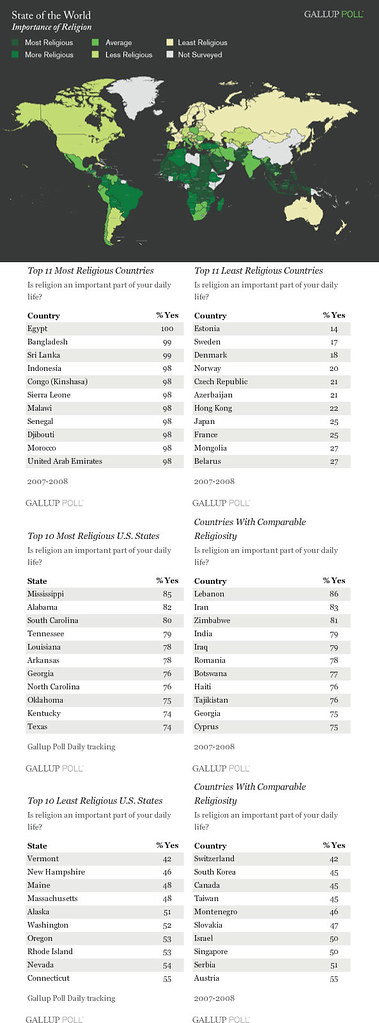
> Take a look at all the countries with growth rates higher than 2%,
and then
> look at how religious they are. You will also be surprised. Again,
your
> argumentation against the importance of religions in this issue
does not
> stand. Take a look at this survey:
> http://farm4.static.flickr.com/3423/3277768007_e06378be14_b.jpg
>
> What you are ignoring is the opposition between religion and
education. Of
> course education would and hopefully will solve the issue of
overpopulation,
> but it will do so by explaining the flat lies that religions
carry, and
> which prevent women from enjoying their rights and freedom in
terms of
> birth control (and others). Therefore, you cannot deny the fact
that, in
> many cases (like in the one originally brought up by Nathan),
there is a
> link between religion (especially what you refer to as "Judaic
religions")
> and demography. You cannot fight one without fighting the other.
>
> Best regards,
> Christian Vincenot
>
>
--
Christian Vincenot, PhD
Biosphere Informatics Laboratory
Department of Social Informatics
Kyoto University, JAPAN
クリスティアン・ヴィンセノ
博士後期課程
グローバルCOE 研究助成
社会情報学専攻 生物圏情報学講座
京都大学 大学院情報学研究科
〒606-8501 京都市左京区吉田本町
Tel: 075-753-3136
Fax: 075-753-3133
--
emilouanna.etsy.com <http://emilouanna.etsy.com>