I'm posting this for Judith, whose having trouble posting:
Regarding atrazine -so you choose to believe Syngenta, the manufacturer of
the chemical, rather than a highly respected university scientist (who has
nothing to gain) who has published his work in the most prestigious
journals? I don't!!
I suppose you believed the tobacco companies also? This is the SAME THING.

"Judith S. Weis" <[email protected]>


> [email protected] wrote:
>
>> Exactly how are these stories "sensational." Is there
>> anything in them that is not factual? Tyrone Hayes
>> work with atrazine and frog development is given
>> substantial credence by knowledgeable folks in the field.
>
> The UC Berkeley story said sensationally: "its [atrazine
> herbicide] effect on sexual development in male frogs
> could be one of many factors in the global decline of
> amphibians"
>
> Syngenta says: http://tinyurl.com/6fobfnk
> "Does atrazine affect frog sexual development?
> The facts are clear: atrazine does not. Government bodies
> reviewing the science have concluded that atrazine is safe
> to use. The EPA and independent researchers around the
> world have rejected claims made by Dr. Tyrone Hayes
> about atrazine, noting that his data do not support his
> conclusions and questioning why he refuses to make
> his raw data available for independent scientific review."
>
> The 1999 Cornell University story said sensationally:
> "Pollen from Bt-corn could represent a serious risk to
> populations of monarchs and other butterflies".
>
> But since 1999 Bt corn has been widely adopted by
> by American farmers. Worse, Roundup Ready corn
> and soybeans also were widely adopted and the resulting
> heavy use of Roundup herbicide eliminated most of
> the milkweed plants that used to grow within these crops
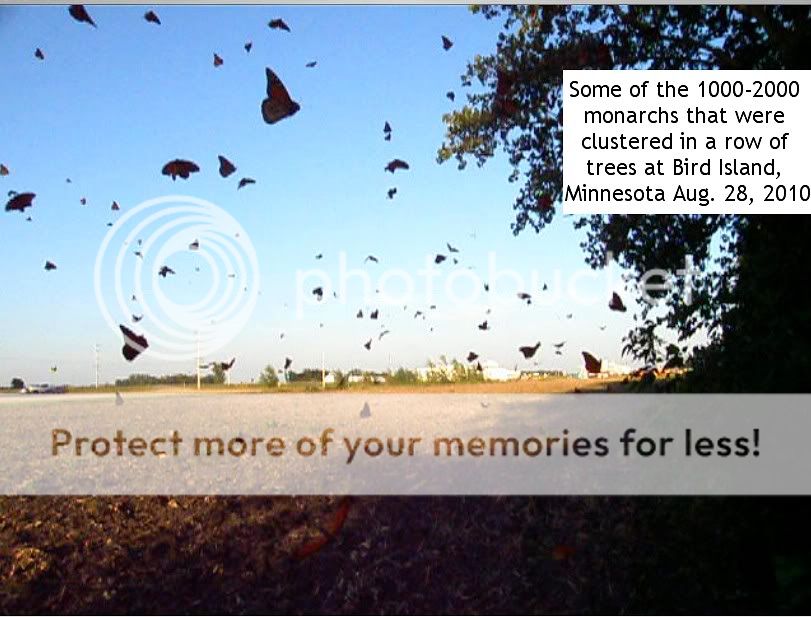
> What was the effect of this one-two punch on monarch
> abundance? These butterflies are still spectacularly
> abundant in the most intensive corn and soybean regions
> of the upper Midwest such as in southern Minnesota:
>
> Still photo:
> http://i959.photobucket.com/albums/ae78/18R-C/bia.jpg
> Video of the same butterflies:
> http://www.youtube.com/watch?v=j4e3S2sm13g
>
> Still photo:
> http://i959.photobucket.com/albums/ae78/18R-C/danub.jpg
>
> Still photo: http://i959.photobucket.com/albums/ae78/18R-C/wintf.jpg
> Video of the same butterflies:
> http://www.youtube.com/watch?v=WJCnU7PB9to
>
> The Cal Poly State University story said sensationally:
> "Studies since the early 1990s indicate Western U.S. populations
> of the monarch butterfly are headed for extinction...under
> the direction of biology professor Francis Villablanca, Monarch
> Alert helps generate data needed to determine just how experts
> can bring about a monarch resurgence."
>
> But the serious decline of the western USA monarch parallels
> serious landscape scale declines in western milkweed abundance
> caused by greatly increased herbiciding of roadsides, vacant lots,
> crop margin, railway lines, etc.
> http://i959.photobucket.com/albums/ae78/18R-C/herba.jpg
> http://i959.photobucket.com/albums/ae78/18R-C/herbd.jpg
> in combination with urban sprawl:
> http://i959.photobucket.com/albums/ae78/18R-C/sprawla.jpg
> http://i959.photobucket.com/albums/ae78/18R-C/sprawlb.jpg
>
> Since Cal Poly does not know how this ongoing intensive weed
> control or sprawl can be stopped, there's no conceivable way
> Cal Poly could: "generate data needed to determine just how
> experts can bring about a monarch resurgence [in milkweed,
> hence monarch] abundance."
>
> Paul Cherubini
>