I checked the four most used solutions.
The first three ones use GenericKeys (in my opinion not the ideal solution
as I described above) and the fourth one as far as I can see does not use
the auth permission backend but does permission handling on his own.
-Moritz

Am Samstag, 14. April 2012 02:14:35 UTC+2 schrieb Mike Axiak:
>
> How does it compare to the solutions that already exist listed here?
>
>  http://djangopackages.com/grids/g/perms/
>
> -Mike
>
> On Fri, Apr 13, 2012 at 7:56 PM, Moritz S.
> <[email protected]>wrote:
>
>> Hi all,
>>
>> I have been using django for a while and became happy by the time I
>> discovered the auth module that supports permission handling. But this
>> module turned out to only be able to handle model based permissions. I
>> could not imagine django of not having such a basic functionality (in my
>> opinion) despite of having so much other great abilities. So I started to
>> search for it but eventually figured out that the auth model's code was
>> prepared for implementing this but it haven't been done yet.
>> So I decided to write a patch for this on my own.
>> Currently I'm writing this patch but there are several design decisions
>> to make so I wanted to share this with you and hear your opinions.
>>
>> First of all: I think the main problem of this implementation is to link
>> the objects with the corresponding permissions. With model based
>> permissions that's easy because you only have to store a permission once
>> with the models ContentType and relate with a ManyToManyField to them and
>> that's it. The problem with object based permissions is that every object
>> needs to have his own set of permissions and you can't just use ForeignKeys
>> or ManyToManyFields from a permission model because in the process of
>> creating the permission model (and table) you don't know about the models
>> that will provide object permissions therefore you can't refer to them.
>> So I tried some different implementations.
>>
>> At first I tried to used dynamic models (e.g. this project makes use of
>> them: http://pypi.python.org/pypi/django-object-permissions): The idea
>> is to create intermediate models like 'MyModel_ObjectPermissions' that
>> stores the object permissions with foreign keys to the model itself, user
>> and group.
>> But this has a huge disadvantage: the use of dynamic models.
>> In fact thinking as database specialist that is the easiest way of
>> connecting the model instances to the permissions but dynamic models are
>> very sensitive and kind of hacky in my opinion and I think that does not
>> match well with django's ideas.
>>
>> Then I found out about GenericRelations from the contenttypes framework.
>> So you could possibly use a single model called 'ObjectPermissions' or
>> something and link users, permissions and instances of all types of models
>> and only had to use one GenericRelation. This solution eliminates the
>> problem wit the dynamic models because it doesn't even make use of them.
>> But the GenericRelations have another not negligible disadvantage: The
>> databases behind django don't have native support for them. I thought of
>> huge django projects handling thousands and thousands of object
>> permissions. I think these GenericRelations wouldn't be such scalable to
>> make use of them.
>>
>> The only solution for me was to find a way to link the (unknown) model
>> instances to the permissions in the reversed direction. So not use
>> ForeignKeys, etc. in the permission model to refer to the unknown model but
>> to refer from the model to the permission itself. That would fix the
>> problem of not knowing the models while creating the permission model. So
>> in the end I thought of following:
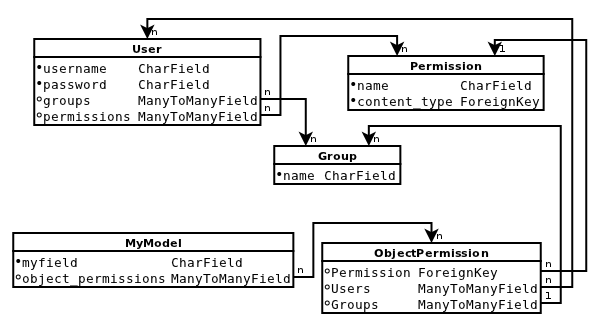
>> - there is a new model in the auth module called 'ObjectPermission' this
>> model has ManyToManyFields to User and Group and a ForeignKey to Permission
>> - instead of ObjectPermission referring to the model using object
>> permissions, a field called 'object_permissions' is added to the
>> corresponding models (by use of the class_prepared signal) (dynamically
>> adding fields is way better than use completely dynamic models in my
>> opinion)
>> - the object_permissions field is a ManyToManyField, that refers to
>> ObjectPermission. In fact, a 'ManyToOneField' would be sufficient but
>> django only has one to many fields (the ForeignKeyField) and we can't just
>> use this in the reversed direction, as I mentioned above
>> This picture illustrates the relations:
>>
>>
>> <https://lh6.googleusercontent.com/-4wiWd_3CYFc/T4i4ZgfPKeI/AAAAAAAAAAM/iCqyCLwKQBA/s1600/object_permissions_models.png>
>>
>>
>> Furthermore I thought of slightly modifying the auth module (apart from
>> the ObjectPermission model) in the following way:
>> - when the auth app is initialized a function is registered to listen to
>> the class_prepared signal. This function adds the object_permissions field
>> to each model, that has the Meta.object_permissions set to True (for this
>> to work, this meta attribute has to be set in django.db.models.options)
>> - the User model gets the methods grant_perm and revoke_perm that takes
>> the permission and as optional argument the object in order to simplify the
>> process of handling permissions
>> - in the ModelBackend the methods has_perm, etc. have to be modified to
>> be able to handle function calls with given objects (obviously)
>>
>> So that was the technical part.
>>
>> Now I want you to give feedback if this implementation is viable and
>> maybe sometimes may get into django.
>>
>>
>> Thanks,
>> Moritz
>>
>> --
>> You received this message because you are subscribed to the Google Groups
>> "Django developers" group.
>> To view this discussion on the web visit
>> https://groups.google.com/d/msg/django-developers/-/WbQ6EMVuxqkJ.
>> To post to this group, send email to [email protected].
>> To unsubscribe from this group, send email to
>> [email protected].
>> For more options, visit this group at
>> http://groups.google.com/group/django-developers?hl=en.
>>
>
>

--
You received this message because you are subscribed to the Google Groups
"Django developers" group.
To view this discussion on the web visit
https://groups.google.com/d/msg/django-developers/-/EzRqqRU1eSUJ.
To post to this group, send email to [email protected].
To unsubscribe from this group, send email to
[email protected].
For more options, visit this group at
http://groups.google.com/group/django-developers?hl=en.