Improves reply:

> Hi Cameron, hi Jonas,
>
> thanks for your feedback.
>
> > You might try some of the RAVE counter-examples, such as the following
> > position from Martin Mueller (White to move):
> > http://www.cameronius.com/research/go-rave-blunder-1.pdf
> >
> > It's a seki position in which FUEGO chooses the correct move B2 without
> > RAVE, but the incorrect move D9 with RAVE enabled.
>
I translated this position in sgf. Programmers can find it at
http://www.althofer.de/mueller-rave-blunder-1.sgf

and may try with their bots. Wiht my commercial bots I can not
see what is happening.

> > Not sure whether this will translate to the bizarre MC behaviour that
> > you're looking for, but it's worth a shot...
>
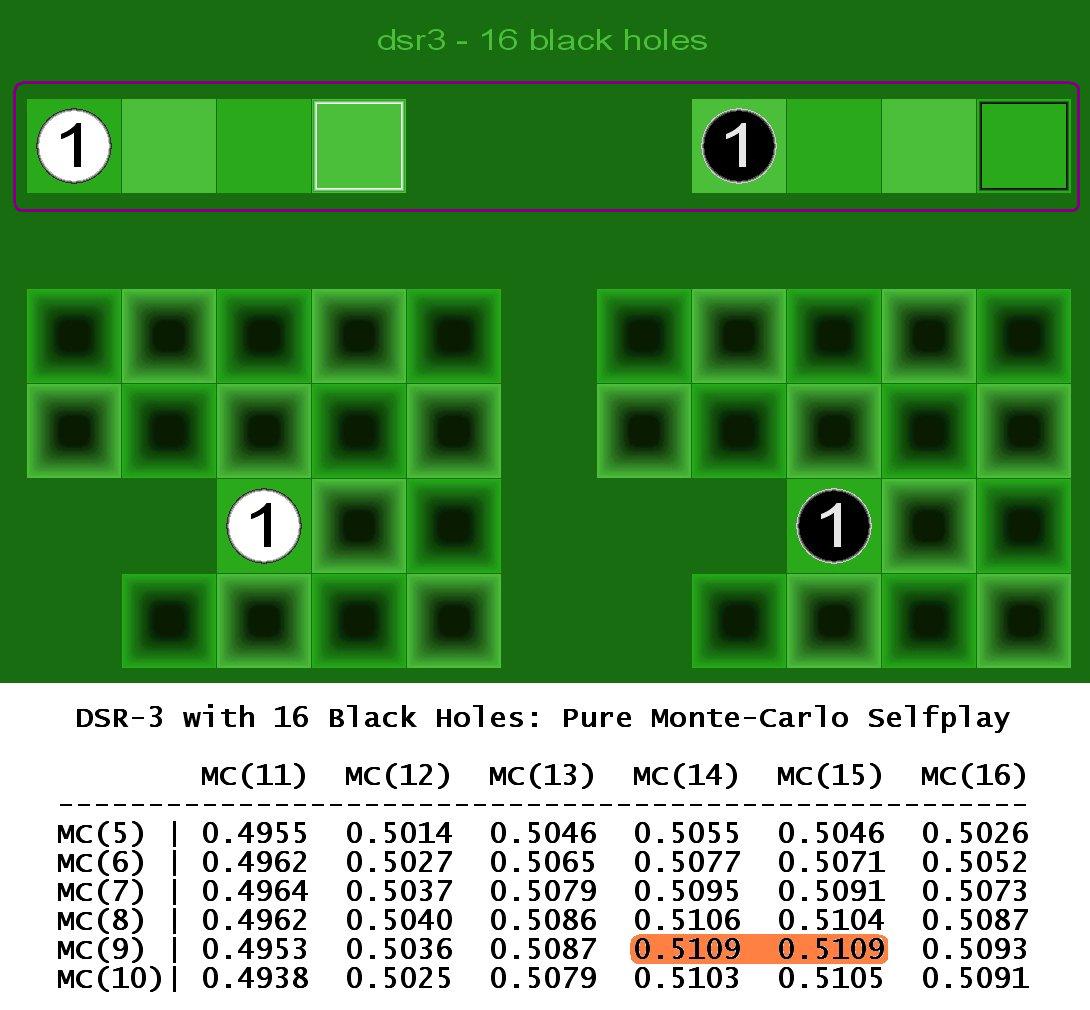
> Here is the first little game where we found the anomaly of pure MC.
>
>    http://www.althofer.de/pure-mc-anomaly.jpg
>
> DSR stand for "Double Step Race".
> The important part is in the upper lane. Each player (White and Black)
> has one stone there. Stones move to the right, either single or double
> steps. The first to reach his goal square (with the frame in white and
> black, respectively) is winner.
> In the lower part each player has one more stone and 16 black holes
> around it. This stone may jump in one of the black holes and will not
> return from there.
>
> Every player with (human) intelligence will never move the lower stone,
> but only run with his upper guy. But MC(8) gets more than 50 % against
> MC(16) under fair conditions (each player gets the first move in
> half of the games).

Orange color marks the pairings where the side with smaller MC-parameter
has the best performance.

After this initial example we found many other games, even whole families
of games where the side with smaller parameters achieves almost 100 %
of wins.

Regards, Ingo.

_______________________________________________
Computer-go mailing list
[email protected]
http://dvandva.org/cgi-bin/mailman/listinfo/computer-go